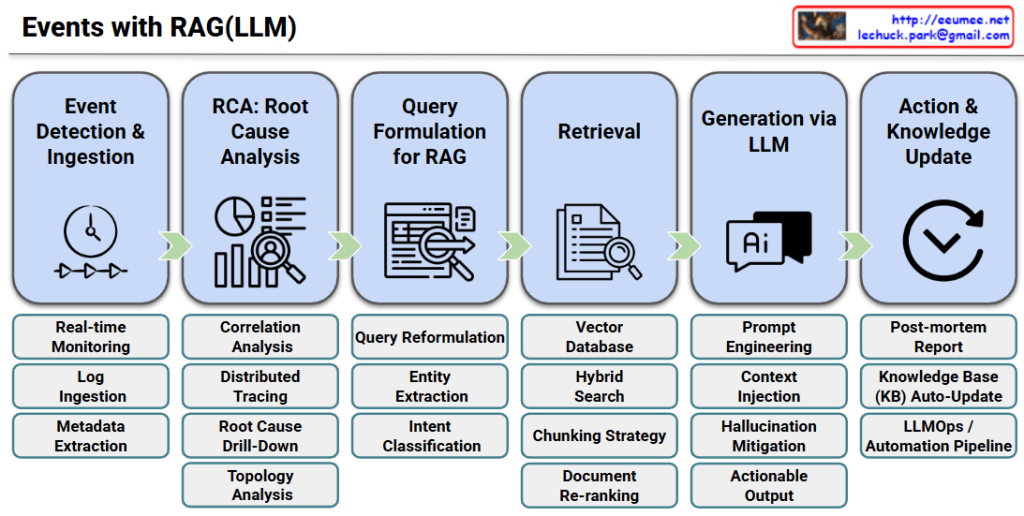
Events with RAG(LLM)

Step 1: Event Detection & Ingestion

This initial stage focuses on capturing system anomalies through real-time monitoring, collecting necessary logs, and extracting essential metadata to understand the context of the event.

Step 2: RCA: Root Cause Analysis

It identifies the fundamental issue behind the surface-level symptoms by utilizing correlation analysis, distributed tracing, root cause drill-down, and infrastructure topology analysis.

Step 3: Query Formulation for RAG

The system translates the RCA findings into an optimized search prompt through query reformulation, entity extraction, and intent classification to fetch the most accurate solutions.

Step 4: Retrieval

It searches for the most relevant technical documents or past incident records from a Vector Database, leveraging hybrid search, chunking strategies, and document re-ranking techniques.

Step 5: Generation via LLM

The LLM generates an actionable troubleshooting guide by combining prompt engineering and context injection, strictly mitigating any AI hallucinations.

Step 6: Action & Knowledge Update

Finally, after the issue is resolved, the system automatically updates its knowledge base with post-mortem reports, ensuring a continuous feedback loop through an automated LLMOps pipeline.


Summary

  1. Event Detection & Root Cause Analysis: When a system incident occurs, it is captured in real-time, and the system deeply traces the actual root cause rather than just addressing surface-level symptoms.
  2. Knowledge Retrieval & Solution Generation: The analyzed root cause is transformed into a RAG-optimized query to retrieve the best reference documents from the internal knowledge base, allowing the LLM to generate an immediately actionable troubleshooting guide.
  3. Knowledge Capitalization & Virtuous Cycle: Once the issue is resolved, a post-mortem report is generated and automatically fed back into the knowledge base, creating a continuously evolving and automated pipeline.

#AIOps #RAG_Architecture #RootCauseAnalysis #LLMOps #IncidentManagement #TroubleshootingAutomation #VectorDatabase

With Gemini
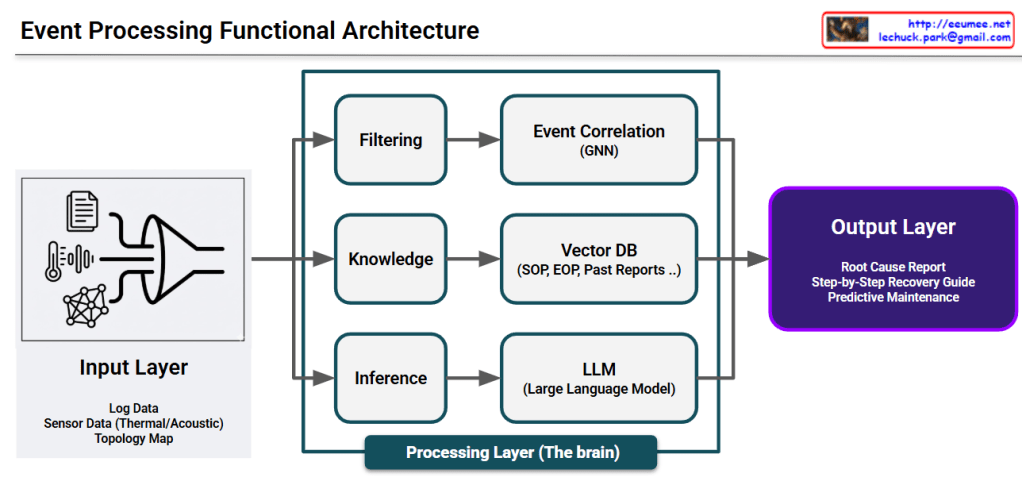
Event Processing Functional Architecture

This image illustrates a Data Processing Pipeline (Architecture) where raw data is ingested, analyzed through an AI engine, and converted into actionable business intelligence.


## Image Interpretation: AI-Driven Data Pipeline

### 1. Input Layer (Left: Data Ingestion)

This represents the raw data collected from various sources within the infrastructure:

  • Log Data (Document Icon): System logs and event records that capture operational history.
  • Sensor Data (Thermometer & Waveform Icons): Real-time monitoring of physical environments, specifically focusing on Thermal (heat) and Acoustic (noise) patterns.
  • Topology Map (Network Icon): The structural map of equipment and their interconnections, providing context for how data flows through the system.

### 2. Integration & Processing (Center: The AI Funnel)

  • The Funnel/Pipe Shape: This symbolizes the process of data fusion and refinement. It represents different data types being standardized and processed through an AI model or analytics engine to filter out noise and identify patterns.

### 3. Output Layer (Right: Actionable Insights)

The final results generated by the analysis, designed to provide immediate value to operators:

  • Root Cause Report (Document with Magnifying Glass): Identifies the underlying reason for a specific failure or anomaly.
  • Step-by-Step Recovery Guide (Checklist with Arrows): Provides a sequential, automated, or manual procedure to restore the system to a healthy state.
  • Predictive Maintenance (Gear with Upward Arrow): Utilizes historical trends to predict potential failures before they occur, optimizing maintenance schedules and reducing downtime.

# Summary

The diagram effectively visualizes the transition from complex raw data to actionable intelligence. It highlights the core value of an AI-driven platform: reducing cognitive load for human operators by providing clear, data-backed directions for maintenance and recovery.


#AI #DataCenter #PredictiveMaintenance #DataAnalytics #SmartInfrastructure #RootCauseAnalysis #DigitalTransformation #OperationsOptimization

With Gemini

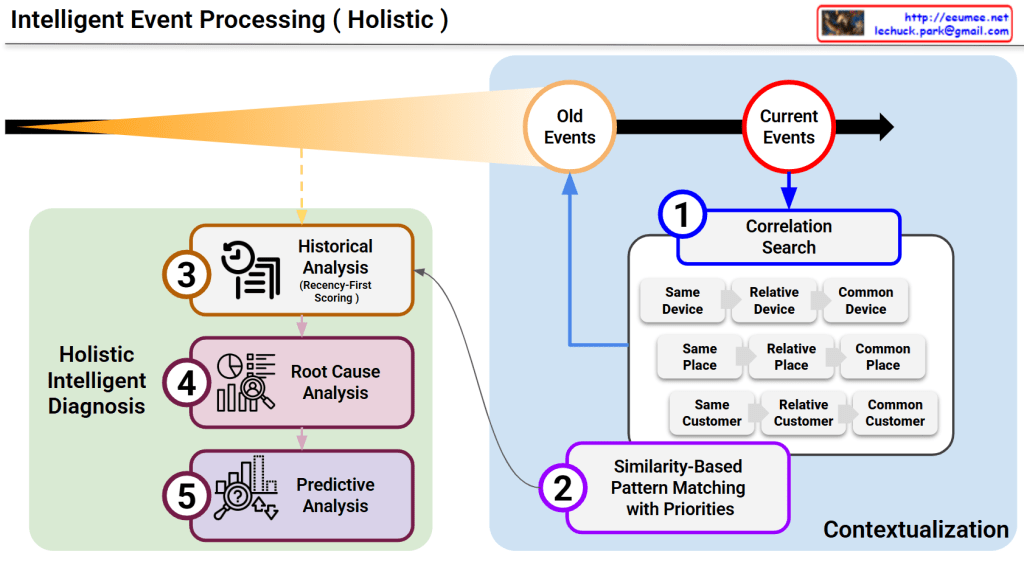
Intelligent Event Analysis Framework ( Holistic Intelligent Diagnosis)

This diagram illustrates a sophisticated framework for Intelligent Event Processing, designed to provide a comprehensive, multi-layered diagnosis of system events. It moves beyond simple alerts by integrating historical context, spatial correlations, and future projections.

1. The Principle of Recency-First Scoring (Top Section)

The orange cone expanding toward the Current Events represents the Time-Decay or Recency-First Scoring model.

  • Weighted Importance: While “Old Events” are maintained for context, the system assigns significantly higher weight to the most recent data.
  • Sensitivity: This ensures the AI remains highly sensitive to emerging trends and immediate anomalies while naturally phasing out obsolete patterns.

2. Multi-Dimensional Correlation Search (Box 1)

When a current event is detected, the system immediately executes a Correlation Search across three primary dimensions to establish a spatial and logical context:

  • Device Context: Investigates if the issue is isolated to the same device, related devices, or common device types.
  • Spatial Context (Place): Analyzes if the event is tied to a specific location, a relative area (e.g., the same rack), or a common facility environment.
  • Customer Context: Checks for patterns across the same customer, relative accounts, or common customer profiles.

3. Similarity-Based Pattern Matching (Box 2)

By combining the results of the Correlation Search with the library of “Old Events,” the system performs Pattern Matching with Priorities.

  • This step identifies historical precedents that most closely resemble the current event’s “fingerprint.”
  • It functions similarly to Case-Based Reasoning (CBR), leveraging past solutions to address present challenges.

4. Holistic Intelligent Diagnosis (Green Box)

This is the core engine where three distinct analytical disciplines converge to create an actionable output:

  • ③ Historical Analysis: Utilizes the recency-weighted scores to understand the evolution of the current issue.
  • ④ Root Cause Analysis (RCA): Drills down into the underlying triggers to identify the “why” behind the event.
  • ⑤ Predictive Analysis: Projects the likely future trajectory of the event, allowing for proactive rather than reactive management.

Summary

For the platform, this diagram serves as the “brain” of the operation. It demonstrates how the agent doesn’t just see a single data point, but rather a “Holistic” picture that connects the dots across time, space, and causality.


#DataCenterOps #AI #EventProcessing #RootCauseAnalysis #PredictiveMaintenance #DataAnalytics #IntelligentDiagnosis #SystemMonitoring #TechInfrastructure

with Gemini

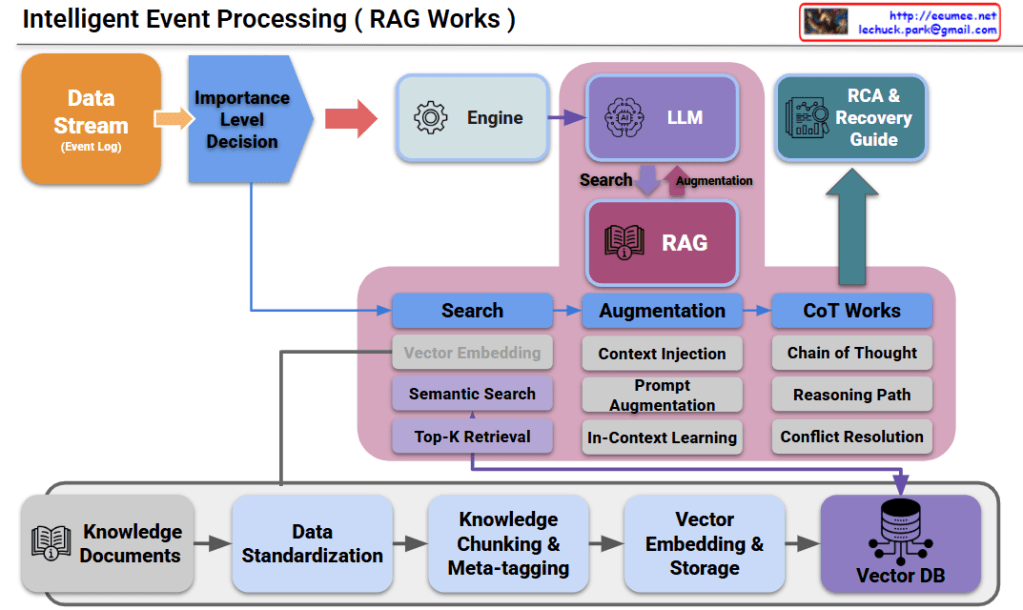
Intelligent Event Analysis Framework ( RAG Works )

This diagram illustrates a sophisticated Intelligent Event Processing architecture that utilizes Retrieval-Augmented Generation (RAG) to transform raw system logs into actionable technical solutions.

Architecture Breakdown: Intelligent Event Processing (RAG Works)

1. Data Inflow & Prioritization

  • Data Stream (Event Log): The system captures real-time logs and events.
  • Importance Level Decision: Instead of processing every minor log, this “gatekeeper” identifies critical events, ensuring the AI engine focuses on high-priority issues.

2. The RAG Core (The Reasoning Engine)

This is the heart of the system (the pink area), where the AI analyzes the problem:

  • Search (Retrieval): The system performs a Semantic Search and Top-K Retrieval to find the most relevant technical information from the Vector DB.
  • Augmentation: It injects this retrieved context into the LLM (Large Language Model) via In-Context Learning, giving the model “temporary memory” of your specific systems.
  • CoT Works (Chain of Thought): This is the “thinking” phase. It uses a Reasoning Path to analyze the data step-by-step and performs Conflict Resolution to ensure the final answer is logically sound.

3. Knowledge Management Pipeline

The bottom section shows how the system “learns”:

  • Knowledge Documents: Technical manuals, past incident reports, and guidelines are collected.
  • Standardization & Chunking: Data is broken down into manageable “chunks” and tagged with metadata.
  • Vector DB: These chunks are converted into mathematical vectors (embeddings) and stored, allowing the engine to search for “meaning” rather than just keywords.

4. Final Output

  • RCA & Recovery Guide: The ultimate goal. The system doesn’t just say there’s an error; it provides a Root Cause Analysis (RCA) and a step-by-step Recovery Guide to help engineers fix the issue immediately.

Summary

  1. Automated Intelligence: It’s an “IT First Responder” that converts raw system noise into precise, logical troubleshooting steps.
  2. Context-Aware Analysis: By combining RAG with Chain-of-Thought reasoning, the system “reads the manual” for you to solve complex errors.
  3. Data-Driven Recovery: The workflow bridges the gap between massive event logs and actionable Root Cause Analysis (RCA) to minimize downtime.

#AIOps #RAG #LLM #GenerativeAI #SystemArchitecture #DevOps #TechInsights #RootCauseAnalysis


With Gemini

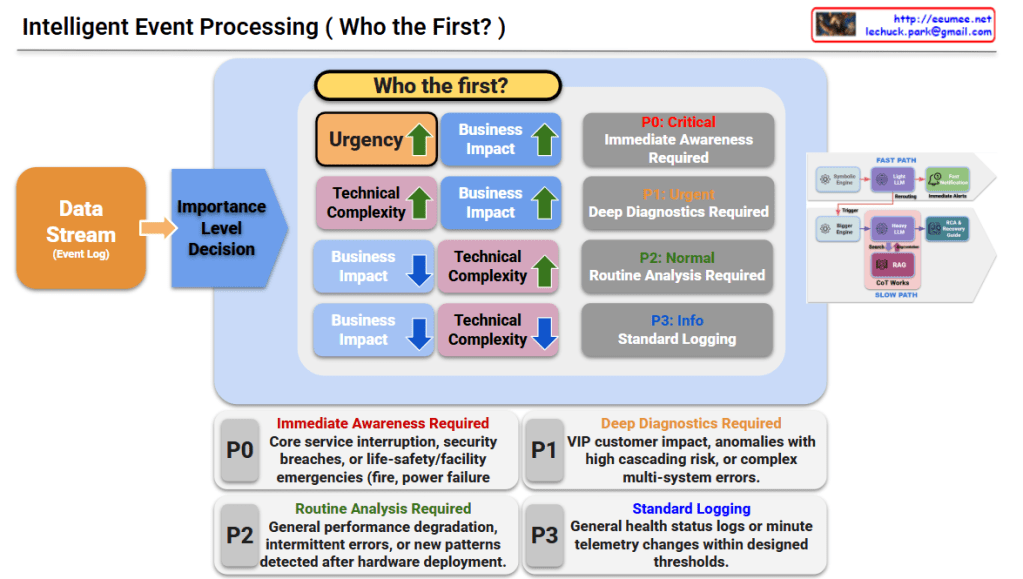
Intelligent Event Analysis Framework ( Who the First? )


Intelligent Event Processing System Overview

This architecture illustrates how a system intelligently prioritizes data streams (event logs) and selects the most efficient processing path—either for speed or for depth of analysis.

1. Importance Level Decision (Who the First?)

Events are categorized into four priority levels ($P0$ to $P3$) based on Urgency, Business Impact, and Technical Complexity.

  • P0: Critical (Immediate Awareness Required)
    • Criteria: High Urgency + High Business Impact.
    • Scope: Core service interruptions, security breaches, or life-safety/facility emergencies (e.g., fire, power failure).
  • P1: Urgent (Deep Diagnostics Required)
    • Criteria: High Technical Complexity + High Business Impact.
    • Scope: VIP customer impact, anomalies with high cascading risk, or complex multi-system errors.
  • P2: Normal (Routine Analysis Required)
    • Criteria: High Technical Complexity + Low Business Impact.
    • Scope: General performance degradation, intermittent errors, or new patterns detected after hardware deployment.
  • P3: Info (Standard Logging)
    • Criteria: Low Technical Complexity + Low Business Impact.
    • Scope: General health status logs or minute telemetry changes within designed thresholds.

2. Processing Paths: Fast Path vs. Slow Path

The system routes events through two different AI-driven pipelines to balance speed and accuracy.

A. Fast Path (Optimized for P0)

  • Workflow: Symbolic Engine → Light LLM → Fast Notification.
  • Goal: Minimizes latency to provide Immediate Alerts for critical issues where every second counts.

B. Slow Path (Optimized for P1 & P2)

  • Workflow: Bigger Engine → Heavy LLM + RAG (Retrieval-Augmented Generation) + CoT (Chain of Thought).
  • Goal: Delivers high-quality Root Cause Analysis (RCA) and detailed Recovery Guides for complex problems requiring deep reasoning.

Summary

  1. The system automatically prioritizes event logs into four levels (P0–P3) based on their urgency, business impact, and technical complexity.
  2. It bifurcates processing into a Fast Path using light models for instant alerting and a Slow Path using heavy LLMs/RAG for deep diagnostics.
  3. This dual-track approach maximizes operational efficiency by ensuring critical failures are reported instantly while complex issues receive thorough AI-driven analysis.

#AIOps #IntelligentEventProcessing #LLM #RAG #SystemMonitoring #IncidentResponse #ITAutomation #CloudOperations #RootCauseAnalysis

With Gemini