
Breakdown of the “AI Workload with Power/Cooling” Diagram
This diagram illustrates the flow of Power and Cooling changes throughout the execution stages of an AI workload. It divides the process into five phases, explaining how data center infrastructure (Power, Cooling) reacts and responds from the start to the completion of an AI job.
Here are the key details for each phase:
1. Pre-Run (Preparation Phase)
- Work Job: Job Scheduling.
- Key Metric: Requested TDP (Thermal Design Power). It identifies beforehand how much heat the job is expected to generate.
- Power/Cooling: PreCooling. This is a proactive measure where cooling levels are increased based on the predicted TDP before the job actually starts and heat is generated.
2. Init / Ramp-up (Initialization Phase)
- Work Job: Context Loading. The process of loading AI models and data into memory.
- Key Metric: HBM Power Usage. The power consumption of High Bandwidth Memory becomes a key indicator.
- Power/Cooling: As VRAM operates, Power consumption begins to rise (Power UP).
3. Execution (Execution Phase)
- Work Job: Kernel Launch. The point where actual computation kernels begin running on the GPU.
- Key Metric: Power Draw. The actual amount of electrical power being drawn.
- Power/Cooling: Instant Power Peak. A critical moment where power consumption spikes rapidly as computation begins in earnest. The stability of the power supply unit (PSU) is vital here.
4. Sustained (Heavy Load Phase)
- Work Job: Heavy Load. Continuous heavy computation is in progress.
- Key Metric: Thermal/Power Cap. Monitoring against set limits for temperature or power.
- Power/Cooling:
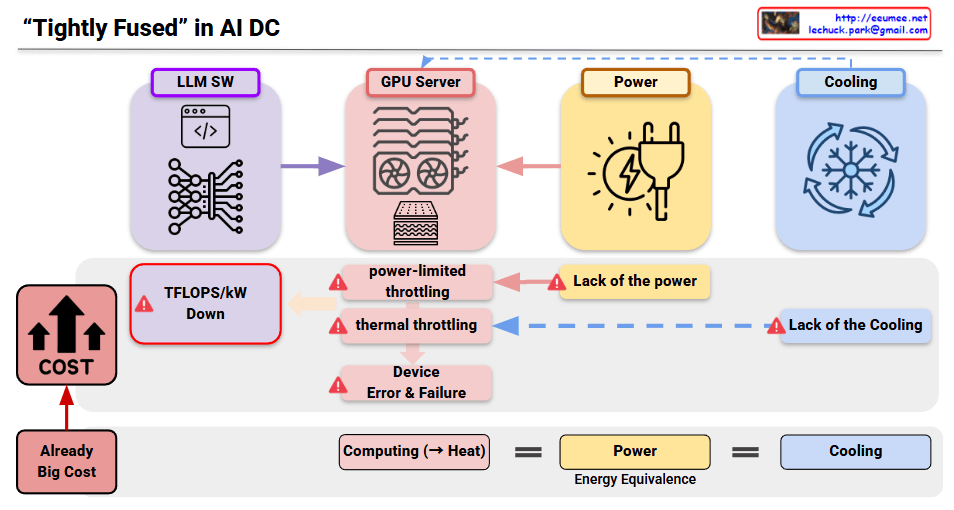
- Throttling: If “What-if” scenarios occur (such as power supply leaks or reaching a Thermal Over-Limit), protection mechanisms activate. DVFS (Dynamic Voltage and Frequency Scaling) triggers Throttling (Down Clock) to protect the hardware.
5. Cooldown (Completion Phase)
- Work Job: Job Complete.
- Key Metric: Power State. The state changes to “Change Down.”
- Power/Cooling: Although the job is finished, Residual Heat remains in the hardware. Instead of shutting off fans immediately, Ramp-down Control is used to cool the equipment gradually and safely.
Summary & Key Takeaways
This diagram demonstrates that managing AI infrastructure goes beyond simply “running a job.” It requires active control of the infrastructure (e.g., PreCooling, Throttling, Ramp-down) to handle the specific characteristics of AI workloads, such as rapid power spikes and high heat generation.
Phase 1 (PreCooling) for proactive heat management and Phase 4 (Throttling) for hardware protection are the core mechanisms determining the stability and efficiency of an AI Data Center.
#AI #ArtificialIntelligence #GPU #HPC #DataCenter #AIInfrastructure #DataCenterOps #GreenIT #SustainableTech #SmartCooling #PowerEfficiency #PowerManagement #ThermalEngineering #TDP #DVFS #Semiconductor #SystemArchitecture #ITOperations
With Gemini
 Lechuck Park