Large Scale Network Driven Design(2) Multi-Plane Fat-Tree & Low Latency

Comprehensive Interpretation: Large Scale Network Driven Design

This document outlines the technical blueprint for “Network Co-Design,” explaining how network architecture must evolve to support massive AI workloads (specifically LLMs) by balancing Bandwidth and Latency.

Here is the breakdown from an architect’s perspective:

1. Structural Efficiency: MPFT & MRFT (The “Green” Section)

This section answers the question: “How do we efficiently cluster thousands of GPUs?”

  • Massive Scalability: It proposes a Multi-Plane Fat-Tree (MPFT) structure using 400G InfiniBand (IB) switches, theoretically capable of scaling up to 16,384 GPUs. This mirrors the scale of NVIDIA SuperPods.
  • Multi-Rail Architecture (MRFT): MRFT utilizes two distinct network planes. Think of this as adding a second level to a highway to double the lanes. It achieves higher bandwidth efficiency compared to traditional 2-tier Fat-Tree designs.
  • Software Optimization (NCCL): The hardware (MRFT) is fully utilized by NCCL (NVIDIA Collective Communications Library). NCCL acts as the traffic controller, ensuring the expanded physical bandwidth is saturated efficiently.
  • Latency Reduction (Packet Striping): The QP & Priority section highlights a critical mechanism where a single Queue Pair (QP) stripes packets across multiple ports simultaneously. This parallel transmission significantly reduces latency.
  • Current Bottlenecks: The design acknowledges limitations, such as InfiniBand’s lack of native support for out-of-order packet placement and the time overhead incurred during inter-plane communication (requires internal forwarding).

2. The Core of Performance: Low Latency & MoE (The “Blue” Section)

This section answers the question: “Why is low latency (and InfiniBand) non-negotiable?”

  • Sensitivity of MoE Models: Modern Mixture of Experts (MoE) models rely heavily on “Expert Parallelism,” which triggers frequent All-to-all communication. If the network lags even by hundreds of microseconds, the entire system performance degrades fataly.
  • RoCE vs. InfiniBand: The document draws a clear line. While RoCE (RDMA over Converged Ethernet) is cost-effective, InfiniBand (IB) is the superior choice for low-latency environments essential for AI training/inference.
  • Surprising Latency Metrics: It highlights a specific scenario: for small data transfers (e.g., 64 Bytes), InfiniBand can be faster than intra-node NVLink (specifically during Cross Leaf communication), proving its dominance in minimizing end-to-end latency.

Summary

  1. Scalable Architecture: The Multi-Plane (MPFT) and Multi-Rail (MRFT) Fat-Tree designs, optimized with NCCL, maximize bandwidth efficiency to support massive clusters of up to 16k GPUs.
  2. Latency Criticality: Modern AI workloads like Mixture of Experts (MoE) are hypersensitive to delay, making InfiniBand the preferred choice over RoCE due to its superior handling of All-to-all communication.
  3. Co-Design Strategy: Achieving peak AI performance requires a “Network Co-Design” approach where high-speed hardware (400G IB) and software protocols (Packet Striping) are tightly integrated to minimize end-to-end latency.

#AINetworking #DataCenterArchitecture #InfiniBand #NCCL #LowLatency #HPC #GPUScaling #MoE #NetworkDesign #AIInfrastructure #DeepseekV3

WIth Gemini

Mixture-of-Experts (MoE) DeepSeek-v3

Image Interpretation: DeepSeek-v3 Mixture-of-Experts (MoE)

This image outlines the key technologies and performance efficiency of the DeepSeek-v3 model, which utilizes the Mixture-of-Experts (MoE) architecture. It is divided into the architecture diagram/cost table on the left and four key technical features on the right.

1. DeepSeekMoE Architecture (Left Diagram)

The diagram illustrates how the model processes data:

  • Separation of Experts: Unlike traditional MoEs, it distinguishes between Shared Experts (Green) and Routed Experts (Blue).
    • Shared Experts: Always active to handle common knowledge.
    • Routed Experts: Selectively activated by the Router to handle specific, specialized features.
  • Workflow: When an input (ut) arrives, the Router selects the top-$K$ experts (Top-Kr). The system processes the input through both shared and selected routed experts in parallel and combines the results.

2. Four Key Technical Features (Right Panel)

This section explains how DeepSeek-v3 overcomes the limitations of existing MoE models:

  • Load Balancing without Auxiliary Loss:
    • Problem: Standard MoEs often use “auxiliary loss” to balance expert usage, which can degrade performance.
    • Solution: It uses learnable bias terms in the router to ensure balance. This bias only affects “dispatching” (where data goes) and not the actual “weights” (calculation values), preserving model quality.
  • Shared Expert Design:
    • Concept: Keeping one or a few experts always active for general tasks allows the routed experts to focus purely on complex, specialized tasks.
    • Benefit: Reduces redundancy and improves the capacity utilization of experts.
  • Hardware-Aware Dual-Pipe Parallelism:
    • Efficiency: It fully overlaps All-to-All communication with computation, minimizing idle time.
    • Optimization: “Node-local expert routing” is used to minimize slow data transfers between different nodes.
  • FP8 Mixed-Precision Training:
    • Speed & Cost: Utilizes the tensor cores of modern GPUs (Hopper/Blackwell) for full FP8 (8-bit floating point) training. This drastically lowers both training and inference costs.

3. Cost Efficiency Comparison (Table 2)

The comparison highlights the massive efficiency gain over dense models:

  • DeepSeek-V3 MoE (671B parameters): Despite having the largest parameter count, its training cost is extremely low at 250 GFLOPS/Token.
  • LLaMa-405B Dense (405B parameters): Although smaller in size, it requires ~10x higher cost (2448 GFLOPS/Token) compared to DeepSeek-v3.
  • Conclusion: DeepSeek-v3 achieves “high performance at low cost” by massively scaling the model size (671B) while keeping the actual computation equivalent to a much smaller model.

Summary

  1. Hybrid Structure: DeepSeek-v3 separates “Shared Experts” for general knowledge and “Routed Experts” for specialized tasks to maximize efficiency.
  2. Optimized Training: It achieves high speed and balance using “Load Balancing without Auxiliary Loss” and “FP8 Mixed-Precision Training.”
  3. Extreme Efficiency: Despite a massive 671B parameter size, it offers roughly 10x lower training costs per token compared to similar dense models (like LLaMa-405B).

#DeepSeek #AI #MachineLearning #MoE #MixtureOfExperts #LLM #DeepLearning #TechTrends #ArtificialIntelligence #ModelArchitecture

With Gemini

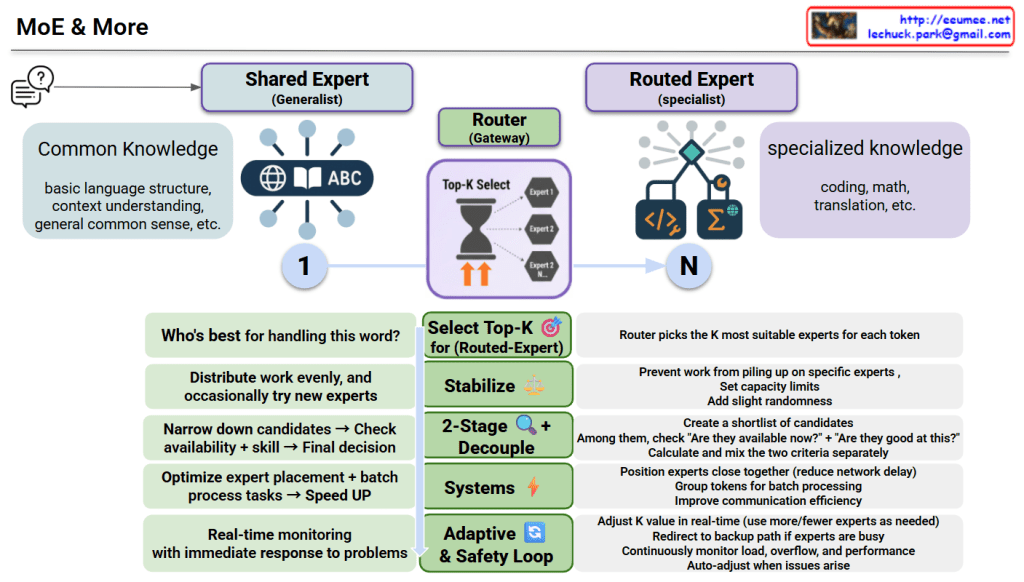
MoE & More

MoE & More – Architecture Interpretation

This diagram illustrates an advanced Mixture of Experts (MoE) model architecture.

Core Structure

1. Two Types of Experts

  • Shared Expert (Generalist)
    • Handles common knowledge: basic language structure, context understanding, general common sense
    • Applied universally to all tokens
  • Routed Expert (Specialist)
    • Handles specialized knowledge: coding, math, translation, etc.
    • Router selects the K most suitable experts for each token

2. Router (Gateway) Role

For each token, determines “Who’s best for handling this word?” by:

  • Selecting K experts out of N available specialists
  • Using Top-K selection mechanism

Key Optimization Techniques

Select Top-K 🎯

  • Chooses K most suitable routed experts
  • Distributes work evenly and occasionally tries new experts

Stabilize βš–οΈ

  • Prevents work from piling up on specific experts
  • Sets capacity limits and adds slight randomness

2-Stage Decouple πŸ”

  • Creates a shortlist of candidate experts
  • Separately checks “Are they available now?” + “Are they good at this?”
  • Calculates and mixes the two criteria separately before final decision
  • Validates availability and skill before selection

Systems ⚑

  • Positions experts close together (reduces network delay)
  • Groups tokens for batch processing
  • Improves communication efficiency

Adaptive & Safety Loop πŸ”„

  • Adjusts K value in real-time (uses more/fewer experts as needed)
  • Redirects to backup path if experts are busy
  • Continuously monitors load, overflow, and performance
  • Auto-adjusts when issues arise

Purpose

This system enhances both efficiency and performance through:

  • Optimized expert placement
  • Accelerated batch processing
  • Real-time monitoring with immediate problem response

Summary

MoE & More combines generalist experts (common knowledge) with specialist experts (domain-specific skills), using an intelligent router to dynamically select the best K experts for each token. Advanced techniques like 2-stage decoupling, stabilization, and adaptive safety loops ensure optimal load balancing, prevent bottlenecks, and enable real-time adjustments for maximum efficiency. The result is a faster, more efficient, and more reliable AI system that scales intelligently.

#MixtureOfExperts #MoE #AIArchitecture #MachineLearning #DeepLearning #LLM #NeuralNetworks #AIOptimization #ScalableAI #RouterMechanism #ExpertSystems #AIEfficiency #LoadBalancing #AdaptiveAI #MLOps

With Claude

Insights into DeepSeek-V3

This image presents an insights overview of DeepSeek-V3, highlighting its key technical innovations and architectural features.

Core Technical Components

1. MLA (Multi-Head Latent Attention)

  • Focuses on memory efficiency
  • Processes attention mechanisms through latent representations to reduce memory footprint

2. MoE (Mixture-of-Experts)

  • Enables cost-effective scaling
  • Activates only relevant experts for each input, reducing computational overhead while maintaining performance

3. FP8 Mixed-Precision Training

  • Achieves efficient computation
  • Combines FP8 and FP32 precision levels strategically

4. MTP (Multi-Token Prediction)

  • Enables faster autoregressive inference
  • Predicts multiple tokens simultaneously (“look ahead two or three letters instead of one at a time”)

5. Multi-Plane Network Topology

  • Provides scalable, efficient cluster networking
  • Acts like a multi-lane highway to prevent bottlenecks

Right Panel Technical Details

KV Cache Compression (latent space)

  • Handles long contexts with low memory and fast decoding

Aux-loss-free Load Balancing + Expert Parallel (All-to-All)

  • Reduces FLOPs/costs while maintaining training/inference performance

Weights/Matmul in FP8 + FP32 Accumulation

  • Computes in lightweight units but sums precisely for critical totals (lower memory, bandwidth, compute, stable accuracy)

Predict Multiple Tokens at Once During Training

  • Delivers higher speed and accuracy boosts in benchmarks

2-tier Fat-Tree Γ— Multiple Planes (separated per RDMA-NIC pair)

  • Provides inter-plane congestion isolation, resilience, and reduced cost/latency

Summary

DeepSeek-V3 represents a comprehensive optimization of large language models through innovations in attention mechanisms, expert routing, mixed-precision training, multi-token prediction, and network architecture. These techniques collectively address the three critical bottlenecks: memory, computation, and communication. The result is a highly efficient model capable of scaling to massive sizes while maintaining cost-effectiveness and performance.

#DeepSeekV3 #LLM #MixtureOfExperts #EfficientAI #ModelOptimization #MultiTokenPrediction #FP8Training #LatentAttention #ScalableAI #AIInfrastructure

With Claude

Human & Data with AI

Data Accumulation Perspective

History β†’ Internet: All knowledge and information accumulated throughout human history is digitized through the internet and converted into AI training data. This consists of multimodal data including text, images, audio, and other formats.

Foundation Model: Large language models (LLMs) and multimodal models are pre-trained based on this vast accumulated data. Examples include GPT, BERT, CLIP, and similar architectures.

Human to AI: Applying Human Cognitive Patterns to AI

1. Chain of Thoughts

  • Implementation of human logical reasoning processes in the Reasoning stage
  • Mimicking human cognitive patterns that break down complex problems into step-by-step solutions
  • Replicating the human approach of “think β†’ analyze β†’ conclude” in AI systems

2. Mixture of Experts

  • AI implementation of human expert collaboration systems utilized in the Experts domain
  • Architecting the way human specialists collaborate on complex problems into model structures
  • Applying the human method of synthesizing multiple expert opinions for problem-solving into AI

3. Retrieval-Augmented Generation (RAG)

  • Implementing the human process of searching existing knowledge β†’ generating new responses into AI systems
  • Systematizing the human approach of “reference material search β†’ comprehensive judgment”

Personal/Enterprise/Sovereign Data Utilization

1. Personal Level

  • Utilizing individual documents, history, preferences, and private data in RAG systems
  • Providing personalized AI assistants and customized services

2. Enterprise Level

  • Integrating organizational internal documents, processes, and business data into RAG systems
  • Implementing enterprise-specific AI solutions and workflow automation

3. Sovereign Level

  • Connecting national or regional strategic data to RAG systems
  • Optimizing national security, policy decisions, and public services

Overall Significance: This architecture represents a Human-Centric AI system that transplants human cognitive abilities and thinking patterns into AI while utilizing multi-layered data from personal to national levels to evolve general-purpose AI (Foundation Models) into intelligent systems specialized for each level. It goes beyond simple data processing to implement human thinking methodologies themselves into next-generation AI systems.

With Claude

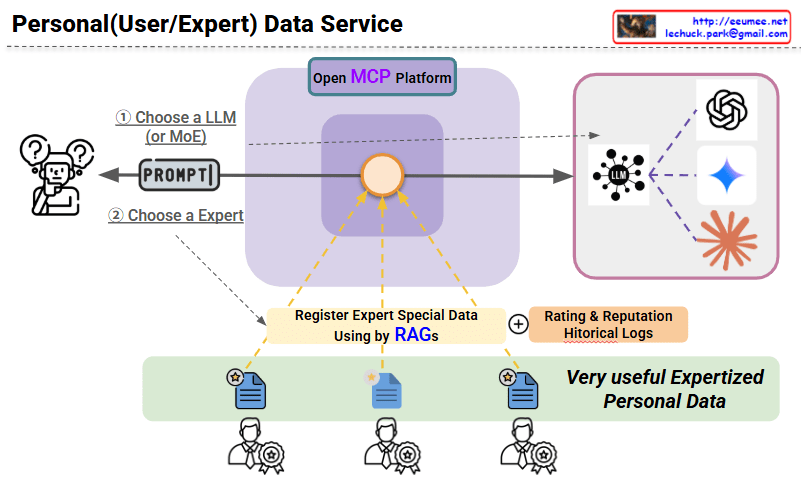
Personal(User/Expert) Data Service

System Overview

The Personal Data Service is an open expert RAG service platform based on MCP (Model Context Protocol). This system creates a bidirectional ecosystem where both users and experts can benefit mutually, enhancing accessibility to specialized knowledge and improving AI service quality.

Core Components

1. User Interface (Left Side)

  • LLM Model Selection: Users can choose their preferred language model or MoE (Mixture of Experts)
  • Expert Selection: Select domain-specific experts for customized responses
  • Prompt Input: Enter specific questions or requests

2. Open MCP Platform (Center)

  • Integrated Management Hub: Connects and coordinates all system components
  • Request Processing: Matches user requests with appropriate expert RAG systems
  • Service Orchestration: Manages and optimizes the entire workflow

3. LLM Service Layer (Right Side)

  • Multi-LLM Support: Integration with various AI model services
  • OAuth Authentication: Direct user selection of paid/free services
  • Vendor Neutrality: Open architecture independent of specific AI services

4. Expert RAG Ecosystem (Bottom)

  • Specialized Data Registration: Building expert-specific knowledge databases through RAG
  • Quality Management System: Ensuring reliability through evaluation and reputation management
  • Historical Logs: Continuous quality improvement through service usage records

Key Features

  1. Bidirectional Ecosystem: Users obtain expert answers while experts monetize their knowledge
  2. Open Architecture: Scalable platform based on MCP standards
  3. Quality Assurance: Expert and answer quality management through evaluation systems
  4. Flexible Integration: Compatibility with various LLM services
  5. Autonomous Operation: Direct data management and updates by experts

With Claude

AI together!!

This diagram titled “AI together!!” illustrates a comprehensive architecture for AI-powered question-answering systems, focusing on the integration of user data, tools, and AI models through standardized protocols.

Key Components:

  1. Left Area (Blue) – User Side:
    • Prompt: The entry point for user queries, represented by a UI interface with chat elements
    • RAG (Retrieval Augmented Generation): A system that enhances AI responses by retrieving relevant information from user data sources
    • My Data: User’s personal data repositories shown as spreadsheets and databases
    • My Tool: Custom tools that can be integrated into the workflow
  2. Right Area (Purple) – AI Model Side:
    • AI Model (foundation): The core AI foundation model represented by a robot icon
    • MOE (Mixture Of Experts): A system that combines multiple specialized AI models for improved performance
    • Domain Specific AI Model: Specialized AI models trained for particular domains or tasks
    • External or Internet: Connection to external knowledge sources and internet resources
  3. Center Area (Green) – Connection Standard:
    • MCP (Model Context Protocol): A standardized protocol that facilitates communication between user-side components and AI models, labeled as “Standard of Connecting”

Information Flow:

  • Questions flow from the prompt interface on the left to the AI models on the right
  • Answers are generated by the AI models and returned to the user interface
  • The RAG system augments queries with relevant information from the user’s data
  • Semantic Search provides additional connections between components
  • All interactions are standardized through the MCP framework

This architecture demonstrates how personal data and custom tools can be seamlessly integrated with foundation and specialized AI models to create a more personalized, context-aware AI system that delivers more accurate and relevant responses to user queries.

With Claude