Cooling for AI (heavy heater)

AI Data Center Cooling System Architecture Analysis

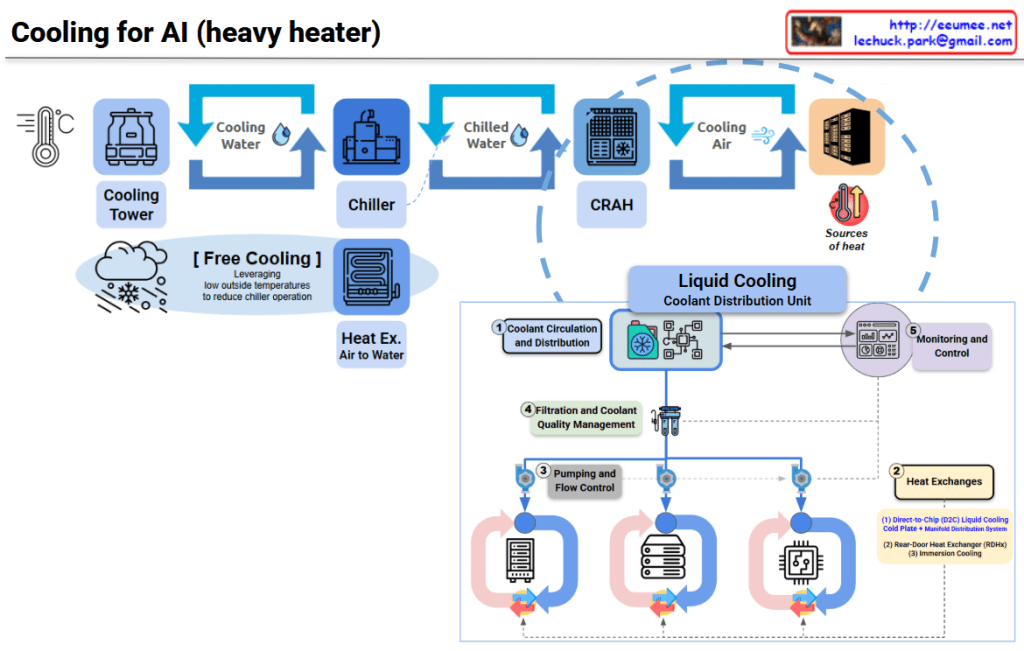
This diagram illustrates the evolution of data center cooling systems designed for high-heat AI workloads.

Traditional Cooling System (Top Section)

Three-Stage Cooling Process:

  1. Cooling Tower – Uses ambient air to cool water
  2. Chiller – Further refrigerates the cooled water
  3. CRAH (Computer Room Air Handler) – Distributes cold air to the server room

Free Cooling option is shown, which reduces chiller operation by leveraging low outside temperatures for energy savings.

New Approach for AI DC: Liquid Cooling System (Bottom Section)

To address extreme heat generation from high-density AI chips, a CDU (Coolant Distribution Unit) based liquid cooling system has been introduced.

Key Components:

① Coolant Circulation and Distribution

  • Direct coolant circulation system to servers

② Heat Exchanges (Two Methods)

  • Direct-to-Chip (D2C) Liquid Cooling: Cold plate with manifold distribution system directly contacting chips
  • Rear-Door Heat Exchanger (RDHx): Heat exchanger mounted on rack rear door (immersion cooling)

③ Pumping and Flow Control

  • Pumps and flow control for coolant circulation

④ Filtration and Coolant Quality Management

  • Maintains coolant quality and removes contaminants

⑤ Monitoring and Control

  • Real-time monitoring and cooling performance control

Critical Differences

Traditional Method: Air cooling → Indirect, suitable for low-density workloads

AI DC Method: Liquid cooling → Direct, high-efficiency, capable of handling high TDP (Thermal Design Power) of AI chips

Liquid has approximately 25x better heat transfer efficiency than air, making it effective for cooling AI accelerators (GPUs, TPUs) that generate hundreds of watts to kilowatt-level heat.


Summary:

  1. Traditional data centers use air-based cooling (Cooling Tower → Chiller → CRAH), suitable for standard workloads.
  2. AI data centers require liquid cooling with CDU systems due to extreme heat from high-density AI chips.
  3. Liquid cooling offers direct-to-chip heat removal with 25x better thermal efficiency than air, supporting kW-level heat dissipation.

#AIDataCenter #LiquidCooling #DataCenterInfrastructure #CDU #ThermalManagement #DirectToChip #AIInfrastructure #GreenDataCenter #HeatDissipation #HyperscaleComputing #AIWorkload #DataCenterCooling #ImmersionCooling #EnergyEfficiency #NextGenDataCenter

With Claude

Power/Cooling impacts to AI Work

Power/Cooling Impacts on AI Work – Analysis

This slide summarizes research findings on how AI workloads impact power grids and cooling systems.

Key Findings:

📊 Reliability & Failure Studies

  • Large-Scale ML Cluster Reliability (Meta, 2024/25)
    • 1024-GPU job MTTF (Mean Time To Failure): 7.9 hours
    • 8-GPU job: 47.7 days
    • 16,384-GPU job: 1.8 hours
    • → Larger jobs = higher failure risk due to cooling/power faults amplifying errors

🔌 Silent Data Corruption (SDC)

  • SDC in LLM Training (2025)
    • Meta report: 6 SDC failures in 54-day pretraining run
    • Power droop, thermal stress → hardware faults → silent errors → training divergence

Inference Energy Efficiency

  • LLM Inference Energy Consumption (2025)
    • GPT-4o query benchmarks:
      • Short: 0.43 Wh
      • Medium: ~3.71 Wh
    • Batch 4→8: ~43% savings
    • Batch 8→16: ~43% savings per prompt
    • → PUE & infrastructure efficiency significantly impact inference cost, delay, and carbon footprint

🏭 Grid-Level Instability

  • AI-Induced Power Grid Disruptions (2024)
    • Model training causes power transients
    • Dropouts → hardware resets
    • Grid-level instability → node-level errors (SDC, restarts) → LLM job failures

🎯 Summary:

  1. Large-scale AI workloads face exponentially higher failure rates – bigger jobs are increasingly vulnerable to power/cooling system issues, with 16K-GPU jobs failing every 1.8 hours.
  2. Silent data corruption from thermal/power stress causes undetected training failures, while inference efficiency can be dramatically improved through batch optimization (43% energy reduction).
  3. AI training creates a vicious cycle of grid instability – power transients trigger hardware faults that cascade into training failures, requiring robust infrastructure design for power stability and fault tolerance.

#AIInfrastructure #MLOps #DataCenterEfficiency #PowerManagement #AIReliability #LLMTraining #SilentDataCorruption #EnergyEfficiency #GridStability #AIatScale #HPC #CoolingSystem #AIFailures #SustainableAI #InferenceOptimization

With Claude

AI Stabilization & Optimization

This diagram illustrates the AI Stabilization & Optimization framework addressing the reality where AI’s explosive development encounters critical physical and technological barriers.

Core Concept: Explosive Change Meets Reality Walls

The AI → Explosion → Wall (Limit) pathway shows how rapid AI advancement inevitably hits real-world constraints, requiring immediate strategic responses.

Four Critical Walls (Real-World Limitations)

  • Data Wall: Training data depletion
  • Computing Wall: Processing power and memory constraints
  • Power Wall: Energy consumption explosion (highlighted in red)
  • Cooling Wall: Thermal management limits

Dual Response Strategy

Stabilization – Managing Change

Stable management of rapid changes:

  • LM SW: Fine-tuning, RAG, Guardrails for system stability
  • Computing: Heterogeneous, efficient, modular architecture
  • Power: UPS, dual path, renewable mix for power stability
  • Cooling: CRAC control, monitoring for thermal stability

Optimization – Breaking Through/Approaching Walls

Breaking limits or maximizing utilization:

  • LM SW: MoE, lightweight solutions for efficiency maximization
  • Computing: Near-memory, neuromorphic, quantum for breakthrough
  • Power: AI forecasting, demand response for power optimization
  • Cooling: Immersion cooling, heat reuse for thermal innovation

Summary

This framework demonstrates that AI’s explosive innovation requires a dual strategy: stabilization to manage rapid changes and optimization to overcome physical limits, both happening simultaneously in response to real-world constraints.

#AIOptimization #AIStabilization #ComputingLimits #PowerWall #AIInfrastructure #TechBottlenecks #AIScaling #DataCenterEvolution #QuantumComputing #GreenAI #AIHardware #ThermalManagement #EnergyEfficiency #AIGovernance #TechInnovation

With Claude