Data Center Digitalization

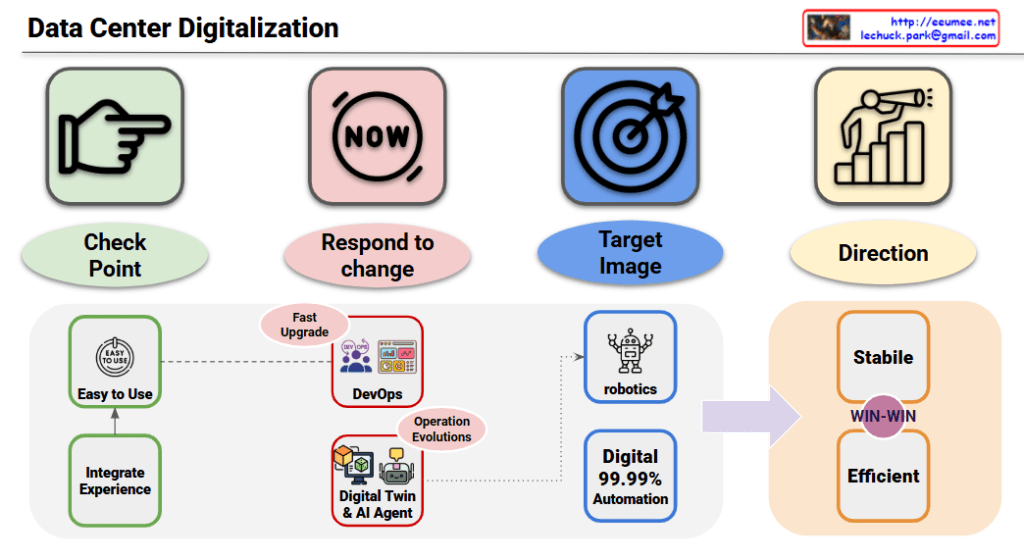
This image presents a roadmap for “Data Center Digitalization” showing the evolutionary process. Based on your explanation, here’s a more accurate interpretation:

Top 4 Core Concepts (Purpose for All Stages)

  • Check Point: Current state inspection and verification point for each stage
  • Respond to change: Rapid response system to quick changes
  • Target Image: Final target state to be achieved
  • Direction: Overall strategic direction setting

Digital Transformation Evolution Stages

Stage 1: Experience-Based Digital Environment Foundation

  • Easy to Use: Creating user-friendly digital environments through experience
  • Integrate Experience: Integrating existing data center operational experience and know-how into the digital environment
  • Purpose: Utilizing existing operational experience as checkpoints to establish a foundation for responding to changes

Stage 2: DevOps Integrated Environment Configuration

  • DevOps: Development-operations integrated environment supporting Fast Upgrade
  • Building efficient development-operations integrated systems based on existing operational experience and know-how
  • Purpose: Implementing DevOps environment that can rapidly respond to changes based on integrated experience

Stage 3: Evolution to Intelligent Digital Environment

  • Digital Twin & AI Agent(LLM): Accumulated operational experience and know-how evolve into digital twins and AI agents
  • Intelligent automated decision-making through Operation Evolutions
  • Purpose: Establishing intelligent systems toward the target image and confirming operational direction

Stage 4: Complete Automation Environment Achievement

  • Robotics: Unmanned operations through physical automation
  • Digital 99.99% Automation: Nearly complete digital automation environment integrating all experience and know-how
  • Purpose: Achieving the final target image – complete digital environment where all experience is implemented as automation

Final Goal: Simultaneous Development of Stability and Efficiency

WIN-WIN Achievement:

  • Stable: Ensuring high availability and reliability based on accumulated operational experience
  • Efficient: Maximizing operational efficiency utilizing integrated know-how

This diagram presents a strategic roadmap where data centers systematically integrate existing operational experience and know-how into digital environments, evolving step by step while reflecting the top 4 core concepts as purposes for each stage, ultimately achieving both stability and efficiency simultaneously.

With Claude

DC Changes

This image shows a diagram that matches 3 Environmental Changes in data centers with 3 Operational Response Changes.

Environmental Changes → Operational Response Changes

1. Hyper Scale

Environmental Change: Large-scale/Complexity

  • Systems becoming bigger and more complex
  • Increased management complexity

→ Operational Response: DevOps + Big Data/AI Prediction

  • Development-Operations integration through DevOps
  • Intelligent operations through big data analytics and AI prediction

2. New DC (New Data Center)

Environmental Change: New/Edge and various types of data centers

  • Proliferation of new edge data centers
  • Distributed infrastructure environment

→ Operational Response: Integrated Operations

  • Multi-center integrated management
  • Standardized operational processes
  • Role-based operational framework

3. AI DC (AI Data Center)

Environmental Change: GPU Large-scale Computing/Massive Power Requirements

  • GPU-intensive high-performance computing
  • Enormous power consumption

→ Operational Response: Digital Twin – Real-time Data View

  • Digital replication of actual configurations
  • High-quality data-based monitoring
  • Real-time predictive analytics including temperature prediction

This diagram systematically demonstrates that as data center environments undergo physical changes, operational approaches must also become more intelligent and integrated in response.

with Claude

Digital Twin with LLM

This image demonstrates the revolutionary applicability of Digital Twin enhanced by LLM integration.

Three Core Components of Digital Twin

Digital Twin consists of three essential elements:

  1. Modeling – Creating digital replicas of physical objects
  2. Data – Real-time sensor data and operational information collection
  3. Simulation – Predictive analysis and scenario testing

Traditional Limitations and LLM’s Revolutionary Solution

Previous Challenges: Modeling results were expressed only through abstract concepts like “Visual Effect” and “Easy to view of complex,” making practical interpretation difficult.

LLM as a Game Changer:

  • Multimodal Interpretation: Transforms complex 3D models, data patterns, and simulation results into intuitive natural language explanations
  • Retrieval Interpretation: Instantly extracts key insights from vast datasets and converts them into human-understandable formats
  • Human Interpretation Resource Replacement: LLM provides expert-level analytical capabilities, enabling continuous 24/7 monitoring

Future Value of Digital Twin

With LLM integration, Digital Twin evolves from a simple visualization tool into an intelligent decision-making partner. This becomes the core driver for maximizing operational efficiency and continuous innovation, accelerating digital transformation across industries.

Ultimately, this diagram emphasizes that LLM is the key technology that unlocks the true potential of Digital Twin, demonstrating its necessity and serving as the foundation for sustained operational improvement and future development.

With Claude

Digital Twin and the LLM

Digital Twin Concept

A Digital Twin is composed of three key elements:

  • High Precision Data: Exact, structured numerical data
  • Real 3D Model: Visual representation that is easy to comprehend
  • History/Prediction Simulation: Temporal analysis capabilities

LLM Approach

Large Language Models expand on the Digital Twin concept with:

  • Enormous Unstructured Data: Ability to incorporate and process diverse, non-structured information
  • Text-based Interface: Making analysis more accessible through natural language rather than requiring visual interpretation
  • Enhanced Simulation: Improved predictive capabilities leveraging more comprehensive datasets

Key Advantages of LLM over Traditional Digital Twin

  1. Data Flexibility: LLMs can handle both structured and unstructured data, expanding beyond the limitations of traditional Digital Twins
  2. Accessibility: Text-based interfaces lower the barrier to understanding complex analyses
  3. Implementation Efficiency: Recent advances in LLM and GPU technologies make these solutions more practical to implement than complex Digital Twin systems
  4. Practical Application: LLMs offer a more approachable alternative while maintaining the core benefits of Digital Twin concepts

This comparison illustrates how LLMs can serve as an evolution of Digital Twin technology, providing similar benefits through more accessible means and potentially expanding capabilities through their ability to process diverse data types.

With Claude

Computing Room Digital Twin for AI Computing

From Claude with some prompting
focusing on the importance of the digital twin-based floor operation optimization system for high-performance computing rooms in AI data centers, emphasizing stability and energy efficiency. I’ll highlight the key elements marked with exclamation points.

Purpose of the system:

  1. Enhance stability
  2. Improve energy efficiency
  3. Optimize floor operations

Key elements (marked with exclamation points):

  1. Interface:
    • Efficient data collection interface using IPMI, Redis and Nvidia DCGM
    • Real-time monitoring of high-performance servers and GPUs to ensure stability
  2. Intelligent/Smart PDU:
    • Precise power usage measurement contributing to energy efficiency
    • Early detection of anomalies to improve stability
  3. High Resolution under 1 sec:
    • High-resolution data collection in less than a second enables real-time response
    • Immediate detection of rapid changes or anomalies to enhance stability
  4. Analysis with AI:
    • AI-based analysis of collected data to derive optimization strategies
    • Utilized for predictive maintenance and energy usage optimization
  5. Computing Room Digital Twin:
    • Virtual replication of the actual computing room for simulation and optimization
    • Scenario testing for various situations to improve stability and efficiency

This system collects and analyzes data from high-power servers, power distribution units, cooling facilities, and environmental sensors. It optimizes the operation of AI data center computing rooms, enhances stability, and improves energy efficiency.

By leveraging digital twin technology, the system enables not only real-time monitoring but also predictive maintenance, energy usage optimization, and proactive response to potential issues. This leads to improved stability and reduced operational costs in high-performance computing environments.

Ultimately, this system serves as a critical infrastructure for efficient operation of AI data centers, energy conservation, and stable service provision. It addresses the unique challenges of managing high-density, high-performance computing environments, ensuring optimal performance while minimizing risks and energy consumption.

Digital Twin

From DALL-E with some prompting
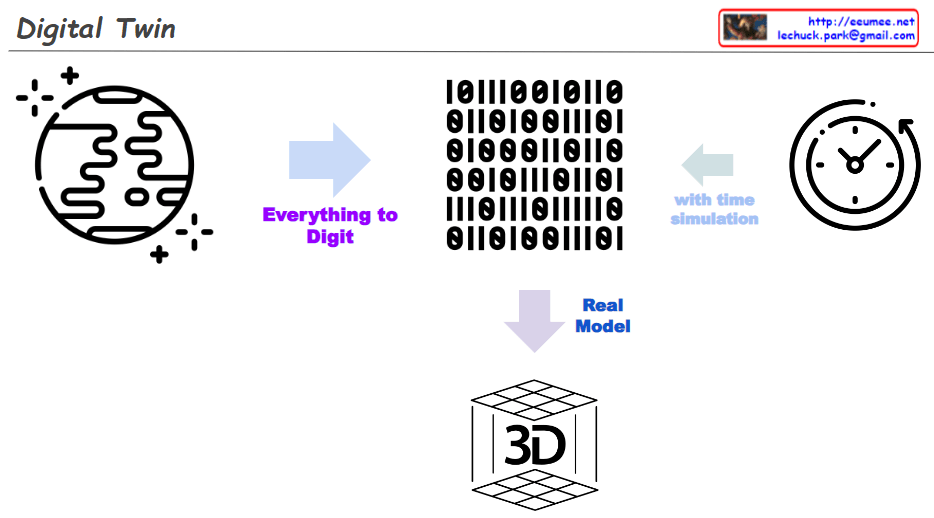
This image depicts a conceptual diagram for a “Digital Twin.”

  • In the top left, there’s an icon representing a physical object, resembling the Earth with dots and lines, indicating complexity and connectivity.
  • A rightward arrow from the object leads to a phrase “Everything to Digit,” suggesting the transformation of a physical object into digital data.
  • The top right block is filled with binary codes, representing digital information.
  • Next to this block, there’s an icon of a clock with the phrase “with time simulation,” indicating the process includes temporal changes or predictions over time.
  • An arrow points downward to the phrase “Real Model,” signifying the creation of a practical model from the digital information and simulations.
  • At the bottom, there’s a 3D cube labeled “3D,” symbolizing the digital twin’s realization as a three-dimensional model.

A digital twin is a virtual replica of a physical object or system, bridging the physical and digital worlds. It can be used for real-time analytics, system monitoring, troubleshooting, and predictive maintenance. The diagram visually represents the process of creating a digital twin, omitting personal or organizational contact information that is present in the image.