Redfish for AI DC

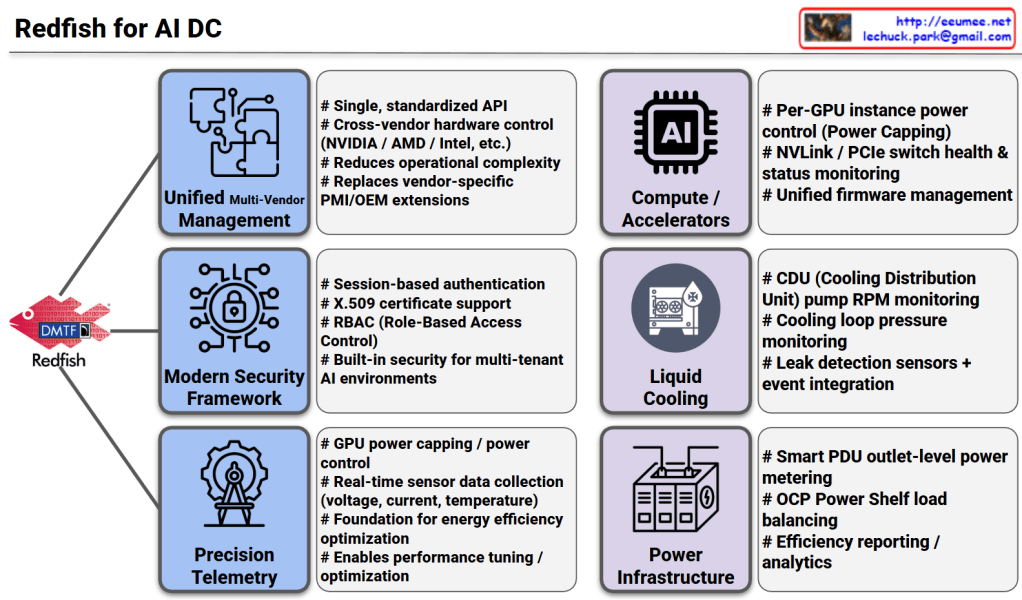
This image illustrates the pivotal role of the Redfish API (developed by DMTF) as the standardized management backbone for modern AI Data Centers (AI DC). As AI workloads demand unprecedented levels of power and cooling, Redfish moves beyond traditional server management to provide a unified framework for the entire infrastructure stack.


1. Management & Security Framework (Left Column)

  • Unified Multi-Vendor Management:
    • Acts as a single, standardized API to manage diverse hardware from different vendors (NVIDIA, AMD, Intel, etc.).
    • It reduces operational complexity by replacing fragmented, vendor-specific IPMI or OEM extensions with a consistent interface.
  • Modern Security Framework:
    • Designed for multi-tenant AI environments where security is paramount.
    • Supports robust protocols like session-based authentication, X.509 certificates, and RBAC (Role-Based Access Control) to ensure only authorized entities can modify critical infrastructure.
  • Precision Telemetry:
    • Provides high-granularity, real-time data collection for voltage, current, and temperature.
    • This serves as the foundation for energy efficiency optimization and fine-tuning performance based on real-time hardware health.

2. Infrastructure & Hardware Control (Right Column)

  • Compute / Accelerators:
    • Enables per-GPU instance power capping, allowing operators to limit power consumption at a granular level.
    • Monitors the health of high-speed interconnects like NVLink and PCIe switches, and simplifies firmware lifecycle management across the cluster.
  • Liquid Cooling:
    • As AI chips run hotter, Redfish integrates with CDU (Cooling Distribution Unit) systems to monitor pump RPM and loop pressure.
    • It includes critical safety features like leak detection sensors and integrated event handling to prevent hardware damage.
  • Power Infrastructure:
    • Extends management to the rack level, including Smart PDU outlet metering and OCP (Open Compute Project) Power Shelf load balancing.
    • Facilitates advanced efficiency analytics to drive down PUE (Power Usage Effectiveness).

Summary

For an AI DC Optimization Architect, Redfish is the essential “language” that enables Software-Defined Infrastructure. By moving away from manual, siloed hardware management and toward this API-driven approach, data centers can achieve the extreme automation required to shift OPEX structures predominantly toward electricity costs rather than labor.

#AIDataCenter #RedfishAPI #DMTF #DataCenterInfrastructure #GPUComputing #LiquidCooling #SustainableIT #SmartPDU #OCP #InfrastructureAutomation #TechArchitecture #EnergyEfficiency


With Gemini
Externals of Modular DC

Externals of Modular DC Infrastructure

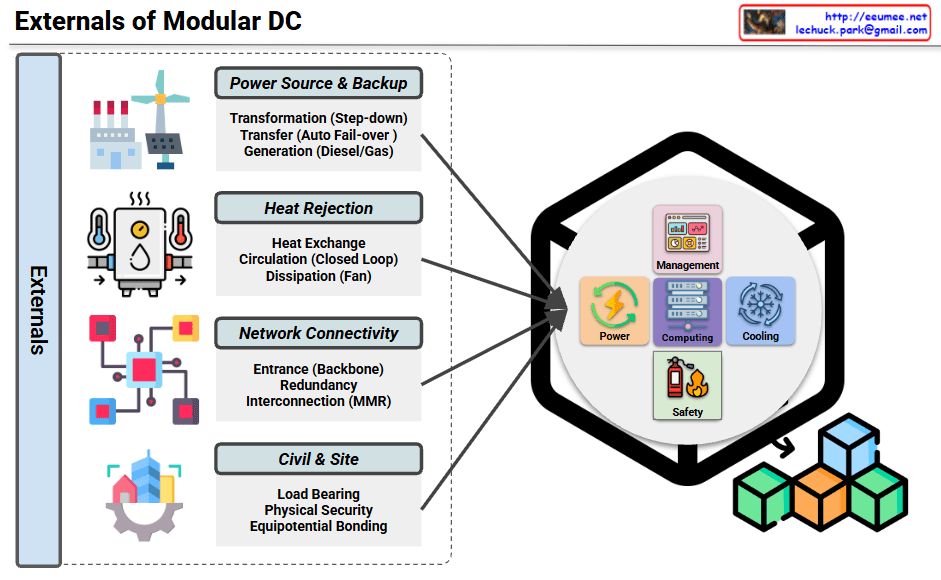
This diagram illustrates the external infrastructure systems that support a Modular Data Center (Modular DC).

Main Components

1. Power Source & Backup

  • Transformation (Step-down transformer)
  • Transfer switch (Auto Fail-over)
  • Generation (Diesel/Gas generators)

Ensures stable power supply and emergency backup capabilities.

2. Heat Rejection

  • Heat Exchange equipment
  • Circulation system (Closed Loop)
  • Dissipation system (Fan-based)

Cooling infrastructure that removes heat generated from the data center to the outside environment.

3. Network Connectivity

  • Entrance (Backbone connection)
  • Redundancy configuration
  • Interconnection (MMR – Meet Me Room)

Provides connectivity and telecommunication infrastructure with external networks.

4. Civil & Site

  • Load Bearing structures
  • Physical Security facilities
  • Equipotential Bonding

Handles building foundation and physical security requirements.

Internal Management Systems

The module integrates the following management elements:

  • Management: Integrated control system
  • Power: Power management
  • Computing: Computing resource management
  • Cooling: Cooling system control
  • Safety: Safety management

Summary

Modular data centers require four critical external infrastructure systems: power supply with backup generation, heat rejection for thermal management, network connectivity for communications, and civil/site infrastructure for physical foundation and security. These external systems work together to support the internal management components (power, computing, cooling, and safety) within the modular unit. This architecture enables rapid deployment while maintaining enterprise-grade reliability and scalability.

#ModularDataCenter #DataCenterInfrastructure #DCInfrastructure #EdgeComputing #HybridIT #DataCenterDesign #CriticalInfrastructure #PowerBackup #CoolingSystem #NetworkRedundancy #PhysicalSecurity #ModularDC #DataCenterSolutions #ITInfrastructure #EnterpriseIT

With Claude

Cooling for AI (heavy heater)

AI Data Center Cooling System Architecture Analysis

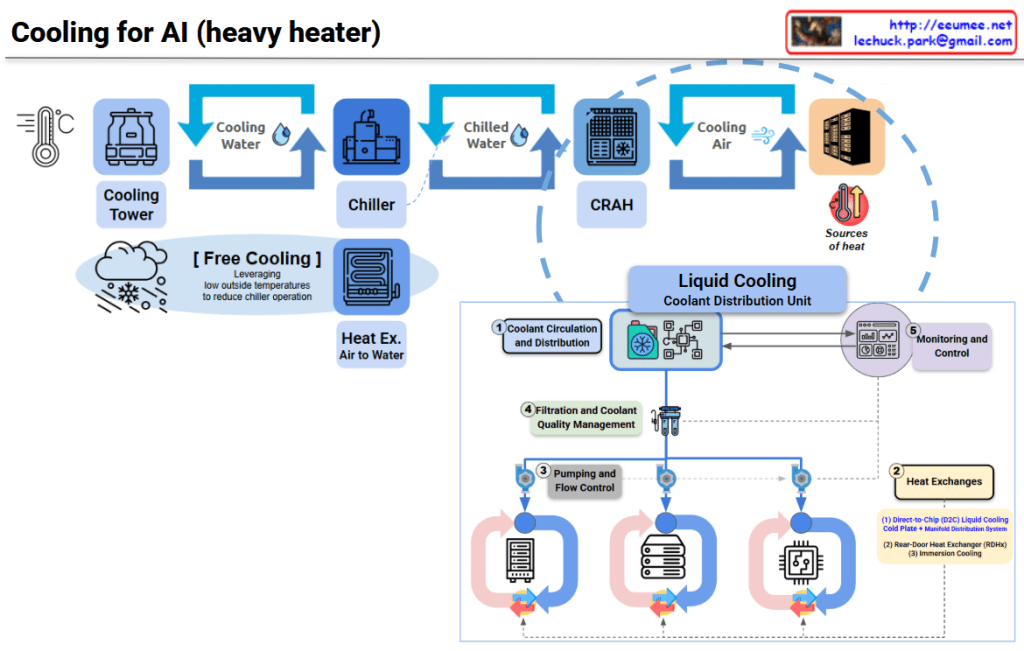
This diagram illustrates the evolution of data center cooling systems designed for high-heat AI workloads.

Traditional Cooling System (Top Section)

Three-Stage Cooling Process:

  1. Cooling Tower – Uses ambient air to cool water
  2. Chiller – Further refrigerates the cooled water
  3. CRAH (Computer Room Air Handler) – Distributes cold air to the server room

Free Cooling option is shown, which reduces chiller operation by leveraging low outside temperatures for energy savings.

New Approach for AI DC: Liquid Cooling System (Bottom Section)

To address extreme heat generation from high-density AI chips, a CDU (Coolant Distribution Unit) based liquid cooling system has been introduced.

Key Components:

① Coolant Circulation and Distribution

  • Direct coolant circulation system to servers

② Heat Exchanges (Two Methods)

  • Direct-to-Chip (D2C) Liquid Cooling: Cold plate with manifold distribution system directly contacting chips
  • Rear-Door Heat Exchanger (RDHx): Heat exchanger mounted on rack rear door (immersion cooling)

③ Pumping and Flow Control

  • Pumps and flow control for coolant circulation

④ Filtration and Coolant Quality Management

  • Maintains coolant quality and removes contaminants

⑤ Monitoring and Control

  • Real-time monitoring and cooling performance control

Critical Differences

Traditional Method: Air cooling → Indirect, suitable for low-density workloads

AI DC Method: Liquid cooling → Direct, high-efficiency, capable of handling high TDP (Thermal Design Power) of AI chips

Liquid has approximately 25x better heat transfer efficiency than air, making it effective for cooling AI accelerators (GPUs, TPUs) that generate hundreds of watts to kilowatt-level heat.


Summary:

  1. Traditional data centers use air-based cooling (Cooling Tower → Chiller → CRAH), suitable for standard workloads.
  2. AI data centers require liquid cooling with CDU systems due to extreme heat from high-density AI chips.
  3. Liquid cooling offers direct-to-chip heat removal with 25x better thermal efficiency than air, supporting kW-level heat dissipation.

#AIDataCenter #LiquidCooling #DataCenterInfrastructure #CDU #ThermalManagement #DirectToChip #AIInfrastructure #GreenDataCenter #HeatDissipation #HyperscaleComputing #AIWorkload #DataCenterCooling #ImmersionCooling #EnergyEfficiency #NextGenDataCenter

With Claude