Computing Room Digital Twin for AI Computing

From Claude with some prompting
focusing on the importance of the digital twin-based floor operation optimization system for high-performance computing rooms in AI data centers, emphasizing stability and energy efficiency. I’ll highlight the key elements marked with exclamation points.

Purpose of the system:

  1. Enhance stability
  2. Improve energy efficiency
  3. Optimize floor operations

Key elements (marked with exclamation points):

  1. Interface:
    • Efficient data collection interface using IPMI, Redis and Nvidia DCGM
    • Real-time monitoring of high-performance servers and GPUs to ensure stability
  2. Intelligent/Smart PDU:
    • Precise power usage measurement contributing to energy efficiency
    • Early detection of anomalies to improve stability
  3. High Resolution under 1 sec:
    • High-resolution data collection in less than a second enables real-time response
    • Immediate detection of rapid changes or anomalies to enhance stability
  4. Analysis with AI:
    • AI-based analysis of collected data to derive optimization strategies
    • Utilized for predictive maintenance and energy usage optimization
  5. Computing Room Digital Twin:
    • Virtual replication of the actual computing room for simulation and optimization
    • Scenario testing for various situations to improve stability and efficiency

This system collects and analyzes data from high-power servers, power distribution units, cooling facilities, and environmental sensors. It optimizes the operation of AI data center computing rooms, enhances stability, and improves energy efficiency.

By leveraging digital twin technology, the system enables not only real-time monitoring but also predictive maintenance, energy usage optimization, and proactive response to potential issues. This leads to improved stability and reduced operational costs in high-performance computing environments.

Ultimately, this system serves as a critical infrastructure for efficient operation of AI data centers, energy conservation, and stable service provision. It addresses the unique challenges of managing high-density, high-performance computing environments, ensuring optimal performance while minimizing risks and energy consumption.

AI DC Key

From Claude with some prompting
This image titled “AI DC Key” illustrates the key components of an AI data center. Here’s an interpretation of the diagram:

  1. On the left, there’s an icon representing “Massive Data”.
  2. The center showcases four core elements of AI:
    • “Super Power”
    • “Super Computing” (utilizing GPU)
    • “Super Cooling”
    • “Optimizing Operation”
  3. Below each core element, key considerations are listed:
    • Super Power: “Nature & Consistent”
    • Super Computing: “Super Parallel”
    • Super Cooling: “Liquid Cooling”
    • Optimizing Operation: “Data driven Auto & AI”
  4. On the right, an icon represents “Analyzed Data”.
  5. The overall flow illustrates the process of massive data being input, processed through the AI core elements, and resulting in analyzed data.

This diagram visualizes the essential components of a modern AI data center and their key considerations. It demonstrates how high-performance computing, efficient power management, advanced cooling technology, and optimized operations effectively process and analyze large-scale data, emphasizing the critical technologies or approaches for each element.

Computing with supers

From Claude with some prompting
This diagram titled “Computing works with supers” illustrates the structure and operational principles of modern high-performance computing systems. Key features include:

  1. Power Management: The “Making Power” section features a power icon labeled “Super,” indicating the massive power supply required for high-performance computing. This is emphasized by the phrase “Super Energy is required.”
  2. Central Processing Unit (CPU): Responsible for “Making Infra” and “Making Logic,” performing basic computational functions.
  3. Graphics Processing Unit (GPU) and AI: Located below the CPU, the GPU is directly connected to an AI model. The phrase “Delegate work to AI” demonstrates AI’s significant role in handling complex computing tasks.
  4. Heat Management: The diagram shows “Making Super Heat” from the GPU, managed by a “Control It with Cooling” system, highlighting the importance of thermal management.
  5. Integrated Management: The right sidebar groups power, GPU, and cooling systems together, with the caption “Must Manage All connected Supers.” This underscores the interconnectedness of these core elements and the need for integrated management.
  6. System Efficiency: Each major component is labeled “Super,” emphasizing their crucial roles in the high-performance system. This suggests that harmonious management of these elements determines the overall system’s efficiency and performance.
  7. Output: The “Super” human icon at the top right implies that this high-performance system produces exceptional results.

This diagram emphasizes that power management, GPU utilization, heat management, and AI integration are critical in modern high-performance computing. It highlights that efficient integrated management of these elements is key to determining the overall system’s performance and efficiency. Additionally, it suggests the growing importance of AI and automation technologies in effectively managing such complex systems.

AI Data Center

From Claude with some prompting
The image provides a comprehensive overview of the key components and infrastructure required for an AI data center. At the core lies the high computing power, facilitated by cutting-edge CPUs, GPUs, large memory capacity, and high-speed interconnects for parallel and fast data processing.

However, the intense computational demands of AI workloads generate significant heat, which the image highlights as a critical challenge. To address this, the diagram depicts the transition from traditional air cooling to liquid cooling systems, which are better equipped to handle the high heat dissipation and thermal management needs of AI hardware.

The image also emphasizes the importance of power management and “green computing” initiatives, aiming to make the data center operations more energy-efficient and environmentally sustainable, given the substantial power requirements of AI systems.

Additionally, the diagram recognizes the complexity of managing and orchestrating such a large-scale AI infrastructure, advocating for AI-driven management systems to intelligently monitor, optimize, and automate various aspects of the data center operations, including power, cooling, servers, and networking.

Furthermore, the image touches upon the need for robust security measures, with the concept of a “Secured Cloud Service” depicted, ensuring data privacy and protection for AI applications and services hosted in the data center.

Overall, the image presents a holistic view of an AI data center, highlighting the symbiotic relationship between high-performance computing hardware, advanced cooling solutions like liquid cooling, power management, AI-driven orchestration, and robust security measures – all working in tandem to support cutting-edge AI applications and services effectively and efficiently.

Facility with AI

From DALL-E with some prompting
The image represents the integration of AI into facility operation optimization. The process begins with AI suggesting guidelines based on predictive models that take into account variables like weather temperature and cooling load. These models undergo evaluation and analysis to assess risks and efficiency before being validated.

Guidance for optimization is then provided, focusing on reducing power usage in cooling towers, chillers, and pumps. A domain operator analyzes the risks and efficiency gains from the proposed changes.

The final stage involves a gradual application of the AI recommendations to the actual operation, with continuous updates to the AI model ensuring real-time adaptability. The percentage indicates the extent to which the AI’s guidance is applied, suggesting that while the guide may be 100% complete, the actual application may vary.

This is followed by the application and analysis (monitoring) phase, which ensures that the optimizations are working as intended and provides feedback for further improvements. This iterative process emphasizes the importance of continuously refining AI-driven operations to maintain optimal performance with minimal risk.

Cooling Optimization

From DALL-E with some prompting
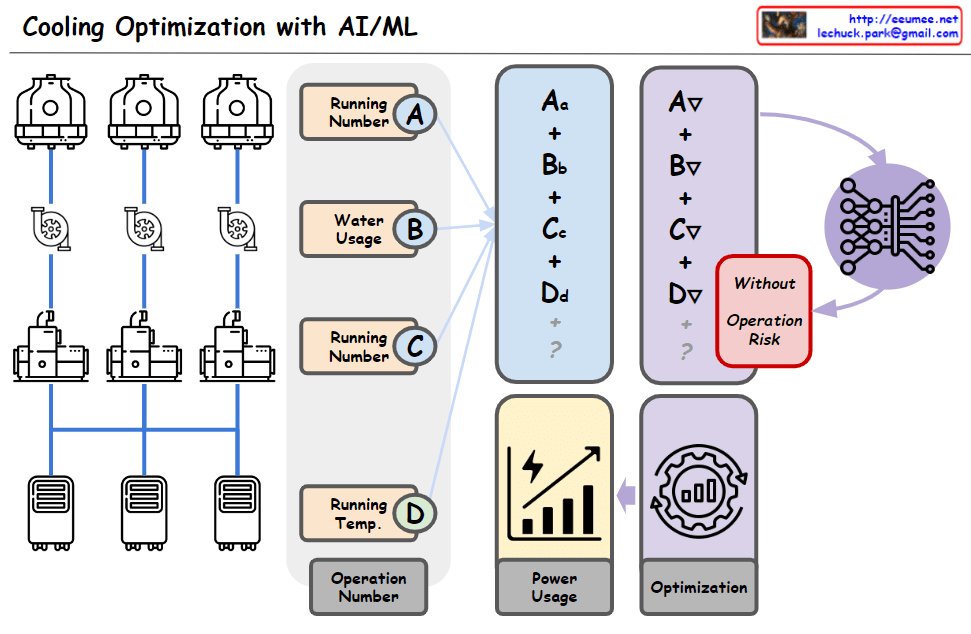
The illustration depicts a process where key operational metrics related to energy usage in cooling systems are analyzed by AI to achieve energy optimization. The AI model evaluates essential data such as running numbers, water usage, and operational temperature to continuously optimize the system while emphasizing stable operation without disruptions. This represents an advanced approach to managing cooling systems that enhances energy efficiency while minimizing operational risks.

All data is connected

from DALL-E with some prompting
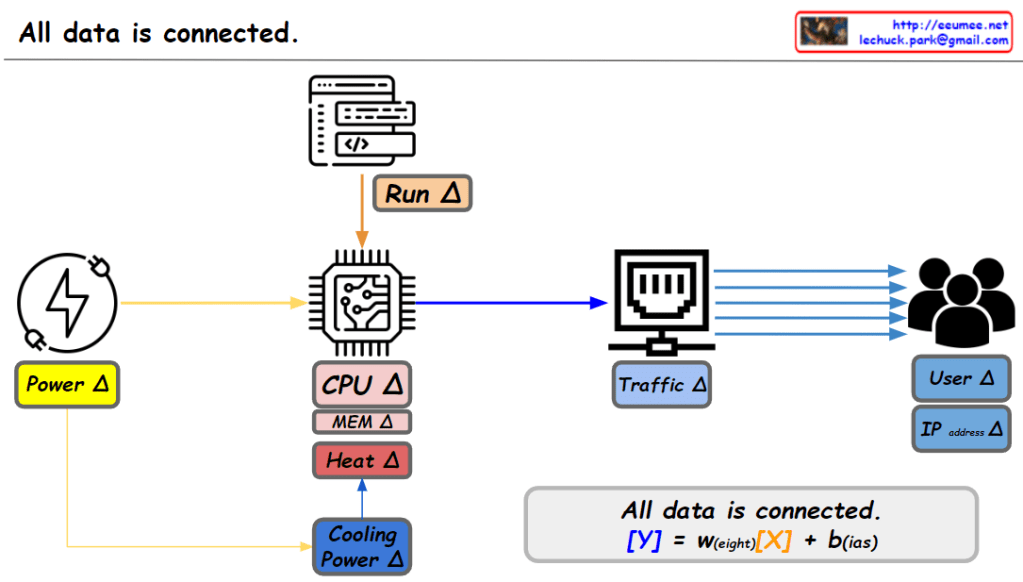
This image illustrates that key metrics generated from computing activities (such as power, CPU performance, memory usage, heat, and cooling power), data traffic, and user behavior (e.g., IP addresses) are interconnected. These metrics influence one another and their interactions can provide insights into the overall state of the system. The linear regression equation at the bottom of the image represents a simple mathematical model for analyzing and predicting the relationships between these metrics, suggesting how they can be numerically understood and connected.