
Reading book like

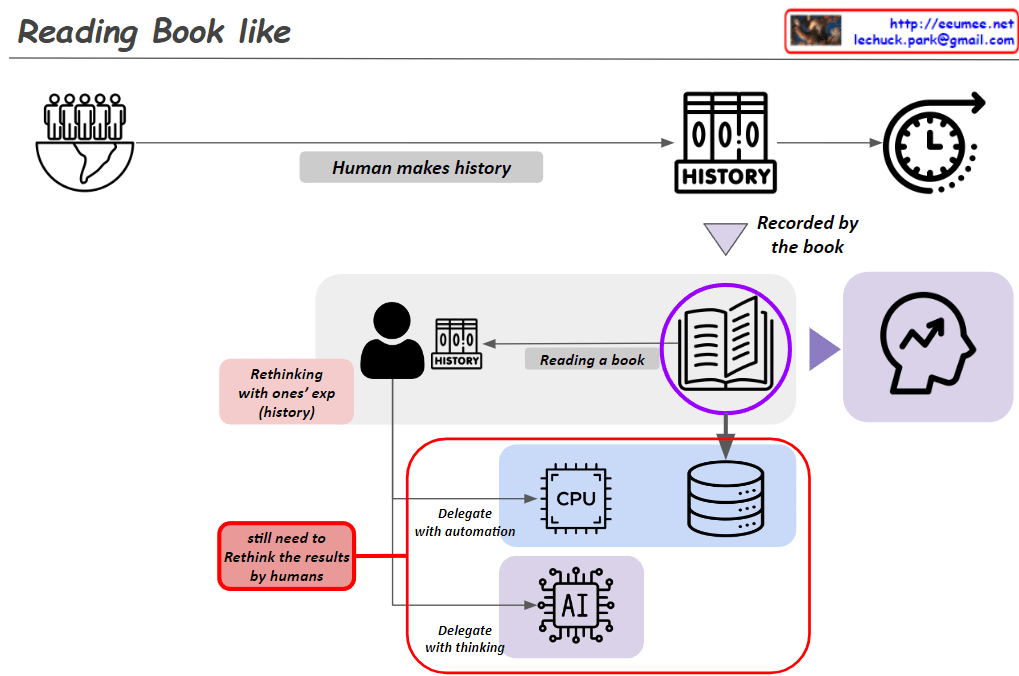
This diagram illustrates the process of learning history and technological advancement, highlighting the crucial role of humans:

  1. Creation and Recording of History:
    • Humans make history, which is recorded and transmitted through books.
  2. Knowledge Acquisition and Personal Growth:
    • Individuals learn history through books and reinterpret it by combining it with their own experiences.
  3. Technological Advancements and Utilization:
    • Automation of calculations through CPU
    • Delegation of some thinking processes to AI
  4. The Pivotal Role of Humans – Rethinking:
    • The key message is “still need to Rethink the results by humans”
    • This emphasizes that humans must critically evaluate and reinterpret the results obtained through technology
    • Through the process of rethinking, humans gain deeper understanding, new insights, and continue to develop
  5. Continuous Development Cycle:
    • Human rethinking generates new ideas and perspectives, which in turn become part of the history-making process

In conclusion, this diagram underscores that despite technological progress, human cognitive abilities, especially rethinking, are essential for individual and societal development. While humans use technology as a tool, the final interpretation and meaning-making remain uniquely human abilities, achieved through critical thinking and reinterpretation.

Computing with supers

From Claude with some prompting
This diagram titled “Computing works with supers” illustrates the structure and operational principles of modern high-performance computing systems. Key features include:

  1. Power Management: The “Making Power” section features a power icon labeled “Super,” indicating the massive power supply required for high-performance computing. This is emphasized by the phrase “Super Energy is required.”
  2. Central Processing Unit (CPU): Responsible for “Making Infra” and “Making Logic,” performing basic computational functions.
  3. Graphics Processing Unit (GPU) and AI: Located below the CPU, the GPU is directly connected to an AI model. The phrase “Delegate work to AI” demonstrates AI’s significant role in handling complex computing tasks.
  4. Heat Management: The diagram shows “Making Super Heat” from the GPU, managed by a “Control It with Cooling” system, highlighting the importance of thermal management.
  5. Integrated Management: The right sidebar groups power, GPU, and cooling systems together, with the caption “Must Manage All connected Supers.” This underscores the interconnectedness of these core elements and the need for integrated management.
  6. System Efficiency: Each major component is labeled “Super,” emphasizing their crucial roles in the high-performance system. This suggests that harmonious management of these elements determines the overall system’s efficiency and performance.
  7. Output: The “Super” human icon at the top right implies that this high-performance system produces exceptional results.

This diagram emphasizes that power management, GPU utilization, heat management, and AI integration are critical in modern high-performance computing. It highlights that efficient integrated management of these elements is key to determining the overall system’s performance and efficiency. Additionally, it suggests the growing importance of AI and automation technologies in effectively managing such complex systems.

DNS Why?

From Claude with some prompting
This image is a network diagram explaining the function and importance of DNS (Domain Name System). The main points are:

  1. WWW service works with DNS on TCP/IP.
  2. DNS is responsible for mapping domains to IP addresses.
  3. All network devices on the Internet can only route to IP addresses.
  4. It’s difficult to include actual service characteristics in IP addresses (only by number).
  5. Domain addresses are easy to use and must be mapped to IP addresses.
  6. On the client side, there’s a DNS Resolver (caching).
  7. On the server side, there’s a DNS server, which includes Authoritative Server, Root Server, and TLD Server. These are managed by IANA.
  8. At the center of the diagram is the key question: “So, how does DNS-IP Mapping work?”

This diagram visually explains the working principle of DNS and its importance in the Internet. It emphasizes the crucial role DNS plays in translating user-friendly domain names into IP addresses that computers can understand.

personalized RAG

from Claude with some prompting
This diagram illustrates a personalized RAG (Retrieval-Augmented Generation) system that allows individuals to use their personal data with various LLM (Large Language Model) implementations. Key aspects include:

  1. User input: Represented by a person icon and notebook on the left, indicating personal data or queries.
  2. On-Premise storage: Contains LLM models that can be managed and run locally by the user.
  3. Cloud integration: An API connects to cloud-based LLM services, represented by icons in the “on cloud” section. These also symbolize different cloud-based LLM models.
  4. Flexible model utilization: The structure enables users to leverage both on-premise and cloud-based LLM models, allowing for combination of different models’ strengths or selection of the most suitable model for specific tasks.
  5. Privacy protection: A “Control a privacy Filter” icon emphasizes the importance of managing privacy filters to prevent inappropriate exposure of sensitive information to LLMs.
  6. Model selection: The “Use proper Foundation models” icon stresses the importance of choosing appropriate base models for different tasks.

This system empowers individual users to safely manage their data while flexibly utilizing various LLM models, both on-premise and cloud-based. It places a strong emphasis on privacy protection, which is crucial in RAG systems dealing with personal data.

The diagram effectively showcases how personal data can be integrated with advanced LLM technologies while maintaining control over privacy and model selection.