GPU Server Room : Changes

Image Overview

This dashboard displays the cascading resource changes that occur when GPU workload increases in an AI data center server room monitoring system.

Key Change Sequence (Estimated Values)

  1. GPU Load Increase: 30% → 90% (AI computation tasks initiated)
  2. Power Consumption Rise: 0.42kW → 1.26kW (3x increase)
  3. Temperature Delta Rise: 7°C → 17°C (increased heat generation)
  4. Cooling System Response:
    • Water flow rate: 200 LPM → 600 LPM (3x increase)
    • Fan speed: 600 RPM → 1200 RPM (2x increase)

Operational Prediction Implications

  • Operating Costs: Approximately 3x increase from baseline expected
  • Spare Capacity: 40% cooling system capacity remaining
  • Expansion Capability: Current setup can accommodate additional 67% GPU load

This AI data center monitoring dashboard illustrates the cascading resource changes when GPU workload increases from 30% to 90%, triggering proportional increases in power consumption (3x), cooling flow rate (3x), and fan speed (2x). The system demonstrates predictable operational scaling patterns, with current cooling capacity showing 40% remaining headroom for additional GPU load expansion. Note: All values are estimated figures for demonstration purposes.

Note: All numerical values are estimated figures for demonstration purposes and do not represent actual measured data.

With Claude
Human Vs AI

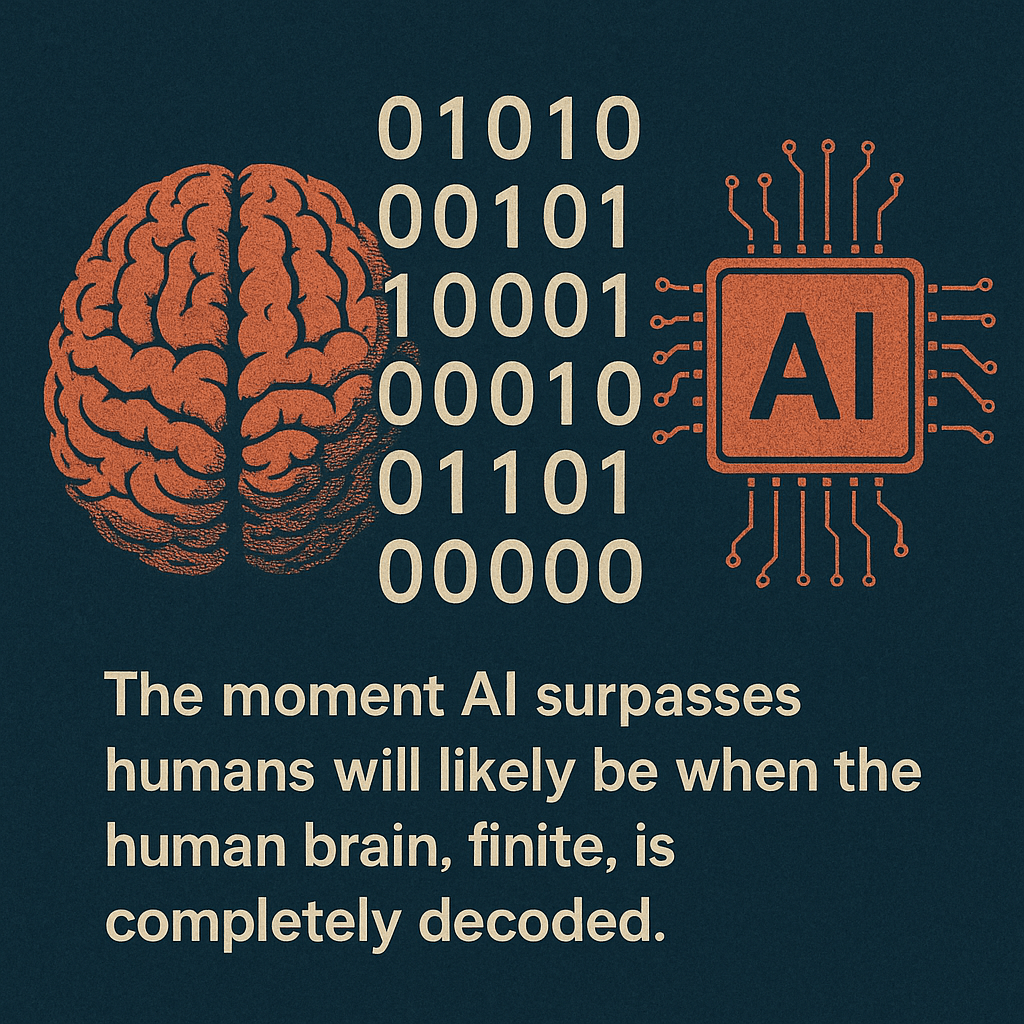
The moment AI surpasses humans will come only if the human brain is proven to be finite.
If every neural connection, every thought pattern, and every emotional process can be fully analyzed and translated into code, then AI, with its capacity to process and optimize those codes, can ultimately transcend human capability.
But if the human brain contains layers of complexity that are infinite or fundamentally unquantifiable, then no matter how advanced AI becomes, it will always fall short of complete understanding—and thus remain behind

“Encoder/Decoder” in a Transformer

Transformer Encoder-Decoder Architecture Explanation

This image is a diagram that visually explains the encoder-decoder structure of the Transformer model.

Encoder Section (Top, Green)

Purpose: Process “questions” by converting input text into vectors

Processing Steps:

  1. Tokenize input tokens and apply positional encoding
  2. Capture relationships between tokens using multi-head attention
  3. Extract meaning through feed-forward neural networks
  4. Stabilize with layer normalization

Decoder Section (Bottom, Purple)

Purpose: Generate new stories from text

Processing Steps:

  1. Apply positional encoding to output tokens
  2. Masked Multi-Head Self-Attention (Key Difference)
    • Mask future tokens using “Only Next” approach
    • Constraint for sequential generation
  3. Reference input information through encoder-decoder attention
  4. Apply feed-forward neural networks and layer normalization

Key Features

  • Encoder: Processes entire input at once to understand context
  • Decoder: References only previous tokens to sequentially generate new tokens
  • Attention Mechanism: Focuses on highly relevant parts for information processing

This is the core architecture used in various natural language processing tasks such as machine translation, text summarization, and question answering.

With Claude

Basic Power Operations

This image illustrates “Basic Power Operations,” showing the path and processes of electricity flowing from source to end-use.

The upper diagram includes the following key components from left to right:

  • Power Source/Intake – High voltage for efficient delivery with high warning
  • Transformer – Performs voltage step-down
  • Generator and Fuel Tank – Backup Power
  • Transformer #2 – Additional voltage step-down
  • UPS/Battery – 2nd Backup Power
  • PDU/TOB – Supplies power to the final servers

The diagram displays two backup power systems:

  • Backup power (Full outage) – Functions during complete power failures with backup time provided by Oil Tank with Generators
  • Backup Power (Partial outage) – Operates during partial outages with backup time provided by the Battery with UPSs

The simplified diagram at the bottom summarizes the complex power system into these fundamental elements:

  1. Source – Origin point of power
  2. Step-down – Voltage conversion
  3. Backup – Emergency power supply
  4. Use – Final power consumption

Throughout all stages of this process, two critical functions occur continuously:

  • Transmit – The ongoing process of transferring power that happens between and during all steps
  • Switching/Block – Control points distributed throughout the system that direct, regulate, or block power flow as needed

This demonstrates that seemingly complex power systems can be distilled into these essential concepts, with transmission and switching/blocking functioning as integral operations that connect and control all stages of the power delivery process.

WIth Claude

“Positional Encoding” in a Transformer

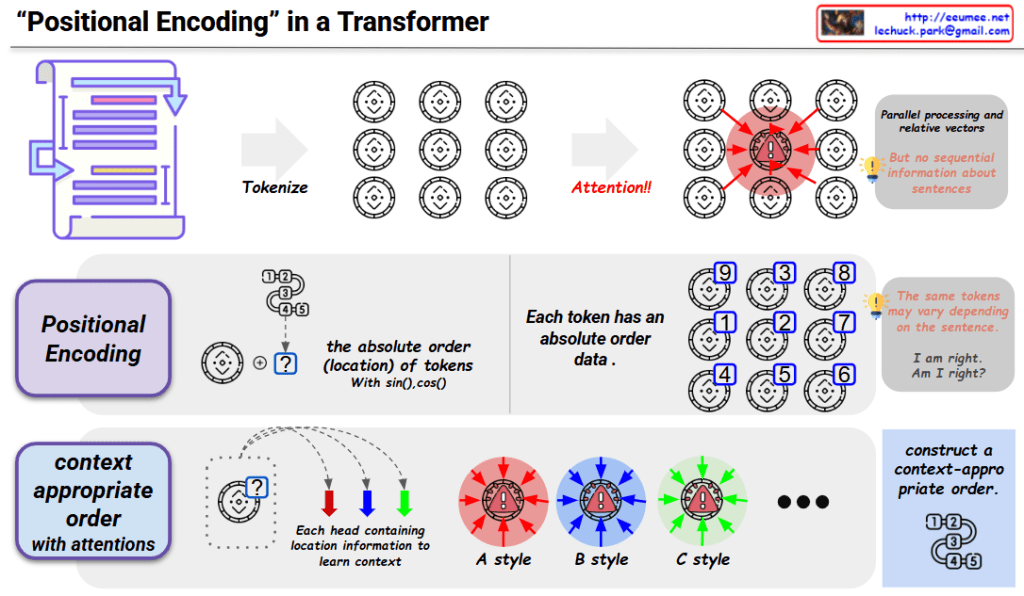
Positional Encoding in Transformer Models

The Problem: Loss of Sequential Information

Transformer models use an attention mechanism that enables each token to interact with all other tokens in parallel, regardless of their positions in the sequence. While this parallel processing offers computational advantages, it comes with a significant limitation: the model loses all information about the sequential order of tokens. This means that without additional mechanisms, a Transformer cannot distinguish between sequences like “I am right” and “Am I right?” despite their different meanings.

The Solution: Positional Encoding

To address this limitation, Transformers implement positional encoding:

  1. Definition: Positional encoding adds position-specific information to each token’s embedding, allowing the model to understand sequence order.
  2. Implementation: The standard approach uses sinusoidal functions (sine and cosine) with different frequencies to create unique position vectors:
    • For each position in the sequence, a unique vector is generated
    • These vectors are calculated using sin() and cos() functions
    • The position vectors are then added to the corresponding token embeddings
  3. Mathematical properties:
    • Each position has a unique encoding
    • The encodings have a consistent pattern that allows the model to generalize to sequence lengths not seen during training
    • The relative positions of tokens can be expressed as a linear function of their encodings

Integration with Attention Mechanism

The combination of positional encoding with the attention mechanism enables Transformers to process tokens in parallel while maintaining awareness of their sequential relationships:

  1. Context-aware processing: Each attention head learns to interpret the positional information within its specific context.
  2. Multi-head flexibility: Different attention heads (A style, B style, C style) can focus on different aspects of positional relationships.
  3. Adaptive ordering: The model learns to construct context-appropriate ordering of tokens, enabling it to handle different linguistic structures and semantics.

Practical Impact

This approach allows Transformers to:

  • Distinguish between sentences with identical words but different orders
  • Understand syntactic structures that depend on word positions
  • Process variable-length sequences effectively
  • Maintain the computational efficiency of parallel processing while preserving sequential information

Positional encoding is a fundamental component that enables Transformer models to achieve state-of-the-art performance across a wide range of natural language processing tasks.

With Claude

CDU (Coolant Distribution Unit)

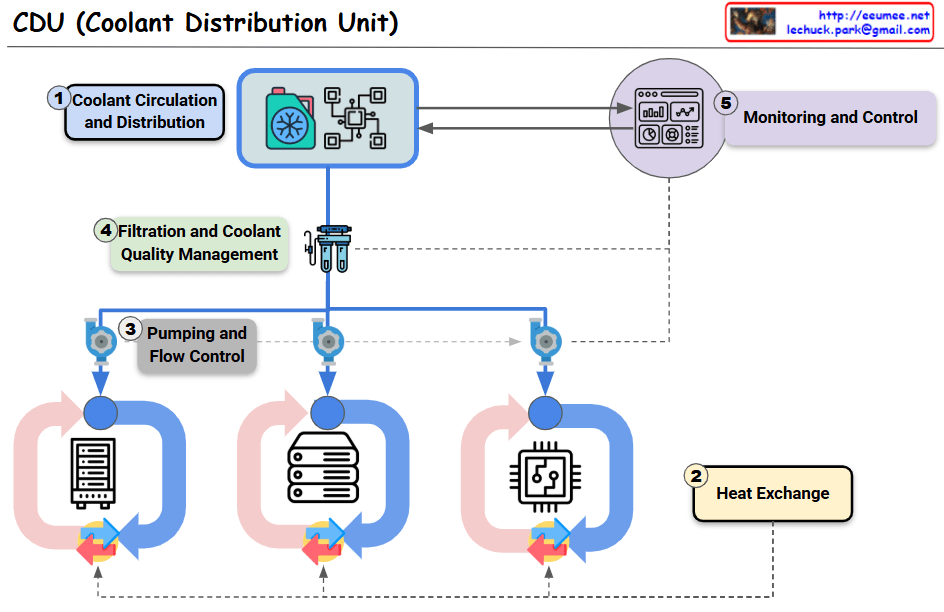
This image illustrates a Coolant Distribution Unit (CDU) with its key components and the liquid cooling system implemented in modern AI data centers. The diagram shows five primary components:

  1. Coolant Circulation and Distribution: The central component that efficiently distributes liquid coolant throughout the entire system.
  2. Heat Exchange: This section removes heat absorbed by the liquid coolant to maintain the cooling system’s efficiency.
  3. Pumping and Flow Control: Includes pumps and control devices that precisely manage the movement of coolant throughout the system.
  4. Filtration and Coolant Quality Management: A filtration system that purifies the liquid coolant and maintains optimal quality for cooling efficiency.
  5. Monitoring and Control: An interface that provides real-time monitoring and control of the entire liquid cooling system.

The three devices shown at the bottom of the diagram represent different levels of liquid cooling application in modern AI data centers:

  • Rack-level liquid cooling
  • Individual server-level liquid cooling
  • Direct processor (CPU/GPU) chip-level liquid cooling

This diagram demonstrates how advanced liquid cooling technology has evolved from traditional air cooling methods to effectively manage the high heat generated in AI-intensive modern data centers. It shows an integrated approach where the CDU facilitates coolant circulation to efficiently remove heat at rack, server, and chip levels.

With Claude