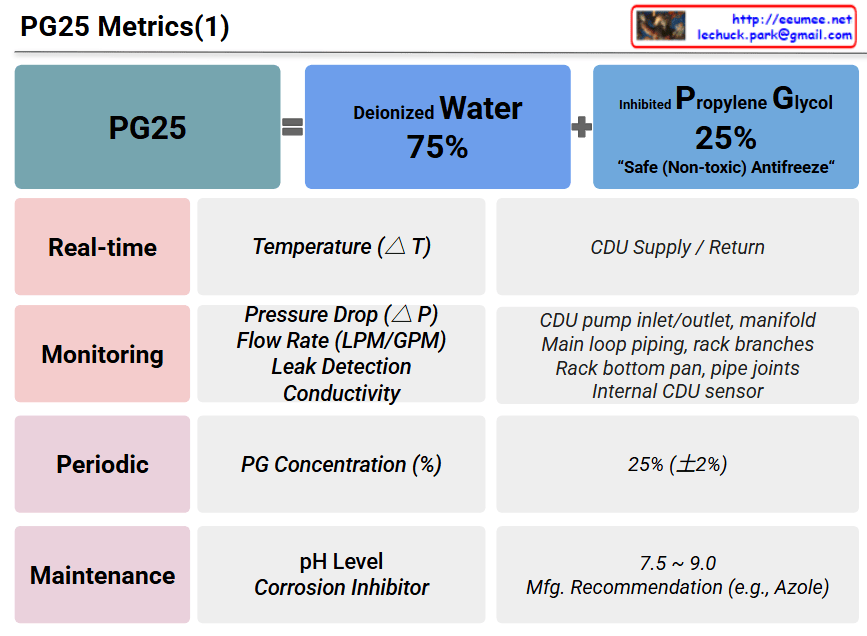
This image file (image_a2495a.png) is a presentation slide titled “PG25 Metrics(1).” It explains the chemical composition of PG25, a cooling fluid often used in liquid cooling systems, and details the key metrics required to manage it effectively.
1. Composition of PG25 (Top Section)
- PG25 is defined as a mixture of two primary components.
- Deionized Water: 75%
- Inhibited Propylene Glycol: 25%
- This specific formula is described as a “Safe (Non-toxic) Antifreeze.”
2. Management Metrics (Bottom Table)
The table below categorizes the management metrics into four distinct phases based on frequency and purpose:
- Real-time:
- Metrics: Temperature change ($\Delta T$)
- Location/Reference: CDU (Coolant Distribution Unit) Supply / Return lines
- Monitoring:
- Metrics: Pressure Drop ($\Delta P$), Flow Rate (LPM/GPM), Leak Detection, and Conductivity
- Location/Reference: CDU pump inlet/outlet and manifold, Main loop piping and rack branches, Rack bottom pan and pipe joints, Internal CDU sensor
- Periodic:
- Metrics: PG (Propylene Glycol) Concentration (%)
- Location/Reference: Maintained at 25% ($\pm 2\%$)
- Maintenance:
- Metrics: pH Level, Corrosion Inhibitor
- Location/Reference: pH level kept between 7.5 and 9.0; Corrosion inhibitors managed per Manufacturer’s Recommendation (e.g., Azole)
📝 Summary
This slide provides a systematic guide for maintaining the optimal condition of PG25 cooling fluid (75% Deionized Water + 25% Propylene Glycol) used in liquid cooling applications. It breaks down the fluid management process into Real-time, Monitoring, Periodic, and Maintenance phases, clearly outlining the essential metrics (temperature, pressure, flow rate, concentration, pH) and target values for each stage.
#PG25 #LiquidCooling #Coolant #DataCenter #ServerCooling #Maintenance #Monitoring #Antifreeze
With Gemini
 Lechuck Park