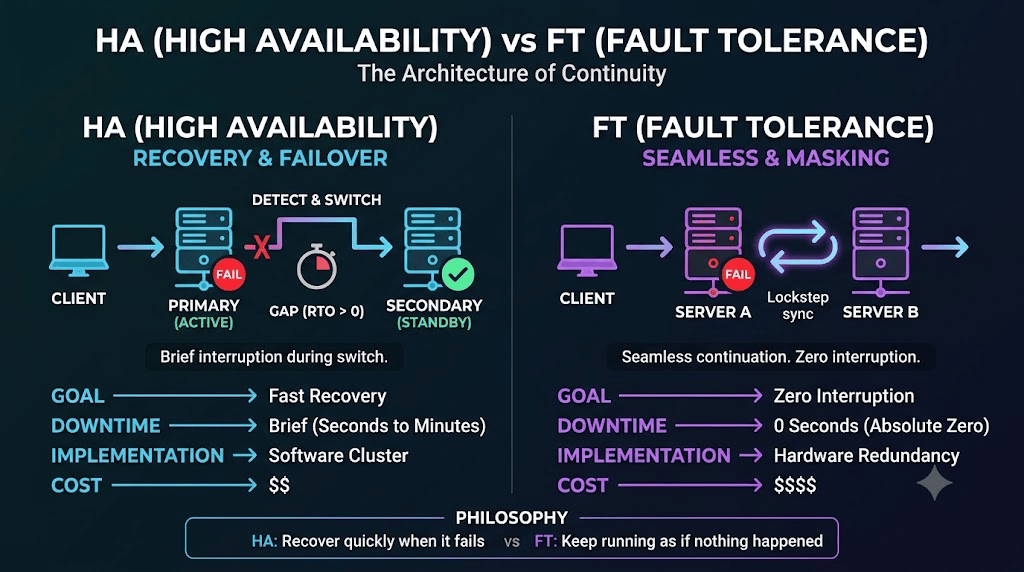
Set against a dark background with contrasting neon accents, this infographic titled “HA (HIGH AVAILABILITY) vs FT (FAULT TOLERANCE): The Architecture of Continuity” visually contrasts two distinct engineering approaches to system reliability. A vertical divider splits the layout into two halves, using glowing cyan on the left to represent High Availability and neon purple on the right to represent Fault Tolerance.
Left Panel: HA (High Availability) — Recovery & Failover
The left side illustrates how a High Availability architecture responds to an unexpected failure through a step-by-step failover mechanism:
- Visual Flow: Traffic originates from a CLIENT and initially heads toward the PRIMARY (ACTIVE) server, which is struck by a failure indicated by a red FAIL badge. Because the primary connection is severed (marked with a red X), the system initiates a DETECT & SWITCH detour around a stopwatch icon labeled GAP (RTO > 0) before successfully routing traffic to the SECONDARY (STANDBY) server marked with a green checkmark.
- Operational Impact: A callout box beneath the diagram notes that there is a “Brief interruption during switch” while the standby node takes over.
- Key Metrics & Characteristics:
- GOAL: Fast Recovery.
- DOWNTIME: Brief (Seconds to Minutes).
- IMPLEMENTATION: Software Cluster.
- COST: Moderate, represented as $$.
Right Panel: FT (Fault Tolerance) — Seamless & Masking
The right side demonstrates how a Fault Tolerant architecture eliminates switchover delays entirely by running duplicated components in unison:
- Visual Flow: The CLIENT connects to a unified pair of systems—SERVER A and SERVER B—linked together by continuous circular arrows labeled Lockstep sync. Even though SERVER A encounters a hardware fault (marked with a red FAIL badge), SERVER B is already processing the exact same state in lockstep and continues sending the output stream forward without a detour or stopwatch gap.
- Operational Impact: The caption beneath the diagram highlights “Seamless continuation. Zero interruption.”
- Key Metrics & Characteristics:
- GOAL: Zero Interruption.
- DOWNTIME: 0 Seconds (Absolute Zero).
- IMPLEMENTATION: Hardware Redundancy.
- COST: High, represented as $$$$.
Core Design Philosophy
At the bottom of the infographic, a spanning banner encapsulates the fundamental mindset separating the two architectures:
HA:“Recover quickly when it fails” vs FT:“Keep running as if nothing happened”
Ultimately, the visual comparison boils down to a trade-off between cost-effective resilience and absolute continuity: High Availability (HA) relies on software clustering ($$) to detect failures and switch to a standby server within seconds or minutes, whereas Fault Tolerance (FT) invests in lockstep hardware redundancy ($$$$) to mask failures in real time and guarantee absolute zero downtime.
#HighAvailability #FaultTolerance #SystemArchitecture #InfrastructureEngineering #ZeroDowntime #Failover #DataCenter #Resilience #ITOperations #CloudArchitecture
With Gemini