Detailed Breakdown of Automation Control Layers
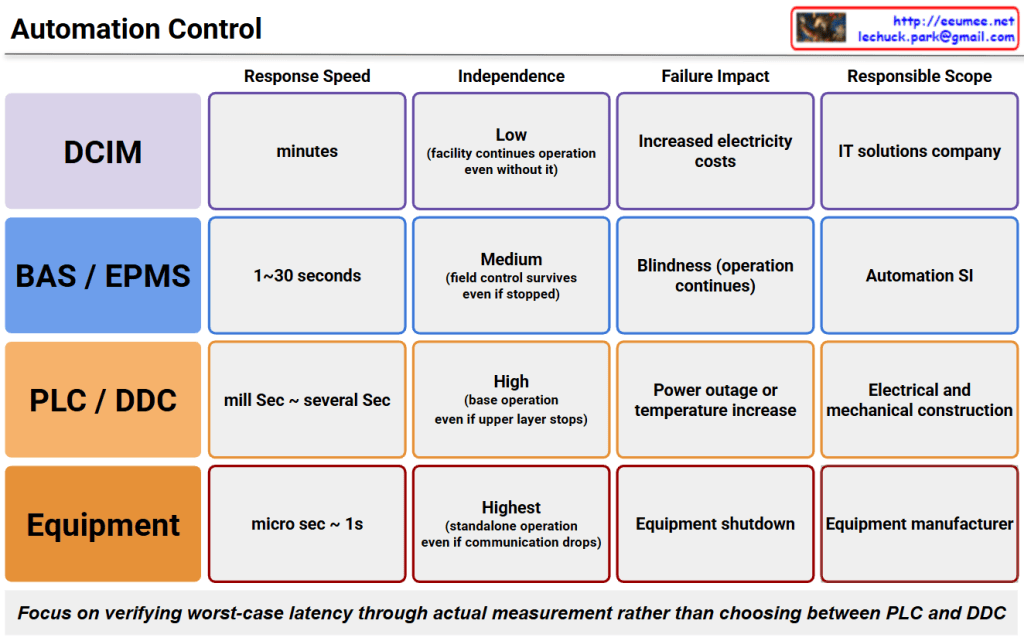
- Equipment
- Response Speed: Ranges from microseconds to 1 second, offering the most immediate reaction.
- Independence: Highest (Enables standalone operation even if communication drops entirely).
- Failure Impact: Results in an immediate shutdown of the specific equipment.
- Responsible Scope: Handled by the equipment manufacturer.
- PLC / DDC
- Response Speed: Milliseconds to several seconds.
- Independence: High (Base operations continue even if the upper layer stops).
- Failure Impact: Can cause power outages or temperature increases.
- Responsible Scope: Handled by electrical and mechanical contractors.
- BAS / EPMS
- Response Speed: Takes 1 to 30 seconds.
- Independence: Medium (Field-level control survives even if the upper system stops).
- Failure Impact: Causes “blindness” (loss of monitoring visibility), though physical operation continues.
- Responsible Scope: Managed by automation system integrators (SIs).
- DCIM
- Response Speed: Operates on a time scale of minutes.
- Independence: Low (The facility can continue operating even without it).
- Failure Impact: Leads to management inefficiencies such as increased electricity costs rather than immediate outages.
- Responsible Scope: Handled by IT solution companies.
Core Message
The note at the bottom highlights a critical paradigm shift: rather than debating whether to choose PLC or DDC based on theory, engineering teams must focus on empirically verifying worst-case latency through actual measurements.
Summary
Automation control architectures are strictly layered by response speed and independence, requiring engineers to prioritize measured worst-case latency verification over conventional component selection debates.
#AutomationControl #DataCenter #PLC #DDC #BAS #EPMS #DCIM #InfrastructureEngineering #ControlSystems
With Gemini