To the full Automation

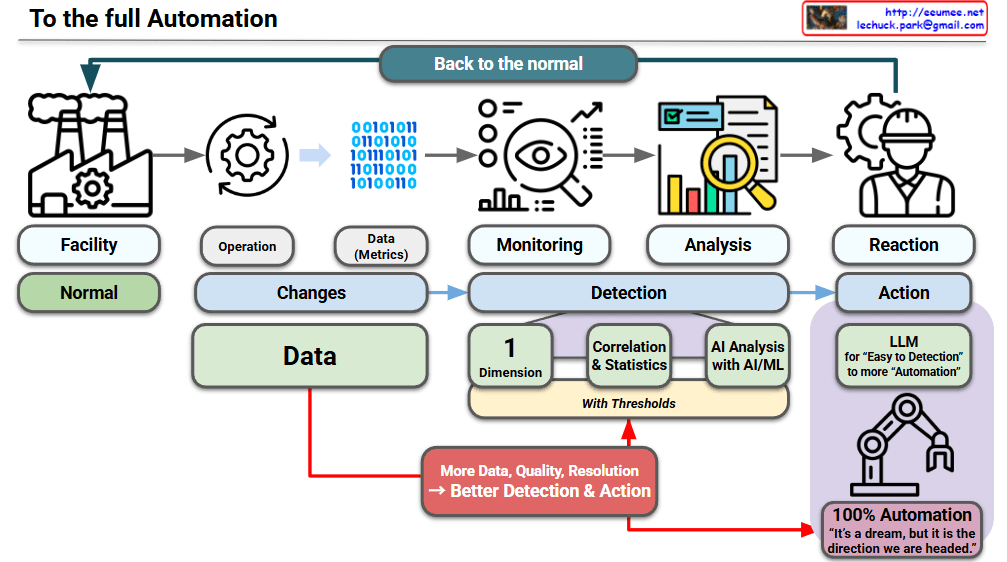
This visual emphasizes the critical role of high-quality data as the engine driving the transition from human-led reactions to fully autonomous operations. This roadmap illustrates how increasing data resolution directly enhances detection and automated actions.


Comprehensive Analysis of the Updated Roadmap

1. The Standard Operational Loop

The top flow describes the current state of industrial maintenance:

  • Facility (Normal): The baseline state where everything functions correctly.
  • Operation (Changes) & Data: Any deviation in operation produces data metrics.
  • Monitoring & Analysis: The system observes these metrics to identify anomalies.
  • Reaction: Currently, a human operator (the worker icon) must intervene to bring the system “Back to the normal”.

2. The Data Engine

The most significant addition is the emphasized Data block and its impact on the automation cycle:

  • Quality and Resolution: The diagram highlights that “More Data, Quality, Resolution” are the foundation.
  • Optimization Path: This high-quality data feeds directly into the “Detection” layer and the final “100% Automation” goal, stating that better data leads to “Better Detection & Action”.

3. Evolution of Detection Layers

Detection matures through three distinct levels, all governed by specific thresholds:

  • 1 Dimension: Basic monitoring of single variables.
  • Correlation & Statistics: Analyzing relationships between different data points.
  • AI Analysis with AI/ML: Utilizing advanced machine learning for complex pattern recognition.

4. The Goal: 100% Automation

The final stage replaces human “Reaction” with autonomous “Action”:

  • LLM Integration: Large Language Models are utilized to bridge the gap from “Easy Detection” to complex “Automation”.
  • The Vision: The process culminates in 100% Automation, where a robotic system handles the recovery loop independently.
  • The Philosophy: It concludes with the defining quote: “It’s a dream, but it is the direction we are headed”.

Summary

  • The roadmap evolves from human intervention (Reaction) to autonomous execution (Action) powered by AI and LLMs.
  • High-resolution data quality is identified as the core driver that enables more accurate detection and reliable automated outcomes.
  • The ultimate objective is a self-correcting system that returns to a “Normal” state without manual effort.

#HyperAutomation #DataQuality #IndustrialAI #SmartManufacturing #LLM #DigitalTwin #AutonomousOperations #AIOp

With Gemini
DC Digitalizations with ISA-95


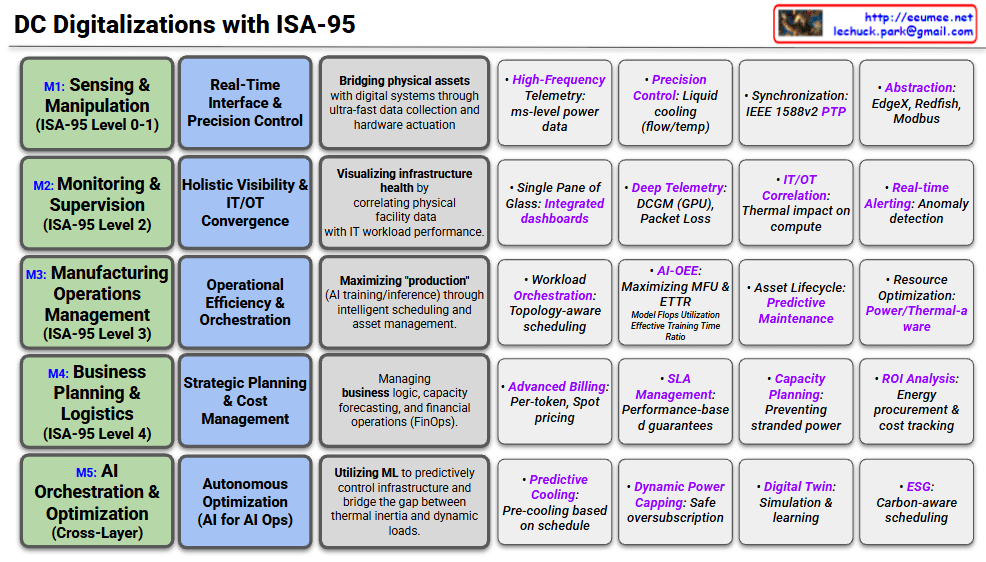
5-Layer Breakdown of DC Digitalization

M1: Sensing & Manipulation (ISA-95 Level 0-1)

  • Focus: Bridging physical assets with digital systems.
  • Key Activities: Ultra-fast data collection and hardware actuation.
  • Examples: High-frequency power telemetry (ms-level), precision liquid cooling control, and PTP (Precision Time Protocol) for synchronization.

M2: Monitoring & Supervision (ISA-95 Level 2)

  • Focus: Holistic visibility and IT/OT Convergence.
  • Key Activities: Correlating physical facility health (cooling/power) with IT workload performance.
  • Examples: Integrated dashboards (“Single Pane of Glass”), GPU telemetry via DCGM, and real-time anomaly detection.

M3: Manufacturing Operations Management (ISA-95 Level 3)

  • Focus: Operational efficiency and workload orchestration.
  • Key Activities: Maximizing “production” (AI output) through intelligent scheduling.
  • Examples: Topology-aware scheduling, AI-OEE (maximizing Model Flops Utilization), and predictive maintenance for assets.

M4: Business Planning & Logistics (ISA-95 Level 4)

  • Focus: Strategic planning, FinOps, and cost management.
  • Key Activities: Managing business logic, forecasting capacity, and financial tracking.
  • Examples: Per-token billing, SLA management with performance guarantees, and ROI analysis on energy procurement.

M5: AI Orchestration & Optimization (Cross-Layer)

  • Focus: Autonomous optimization (AI for AI Ops).
  • Key Activities: Using ML to predictively control infrastructure and bridge the gap between thermal inertia and dynamic loads.
  • Examples: Predictive cooling (cooling down before a heavy job starts), Digital Twins, and Carbon-aware scheduling (ESG).

Summary of Core Concepts

  • IT/OT Convergence: Integrating Information Technology (servers/software) with Operational Technology (power/cooling).
  • AI-OEE: Adapting the “Overall Equipment Effectiveness” metric from manufacturing to measure how efficiently a DC produces AI models.
  • Predictive Control: Moving from reactive monitoring to proactive, AI-driven management of power and heat.

#DataCenter #DigitalTransformation #ISA95 #AIOps #SmartFactory #ITOTConvergence #SustainableIT #GPUOrchestration #FinOps #LiquidCooling

With Gemini

2 Key Points For Digitalizations

2 Key Points For Digitalizations

This diagram illustrates two essential elements for successful digital transformation.

1️⃣ Data Quality

“High Precision & High Resolution”

The left section shows the data collection and quality management phase:

  • Facility/Device: Physical infrastructure including servers, networks, power systems, and cooling equipment
  • Data Generator: Generates data from various sources
  • 3T Process:
    • Performance: Data collection and measurement
    • Transform: Data processing and standardization
    • Transfer: Data movement and delivery

The key is to secure high-quality data with high precision and resolution.

2️⃣ Fast & Accurate Data Correlation

“Rapid Data Correlation Analysis with AI”

The right section represents the data utilization phase:

  • Data Storing: Systematic storage in various types of databases
  • Monitoring: Real-time system surveillance and alerts
  • Analysis: In-depth data analysis and insight extraction

The ultimate goal is to quickly and accurately identify correlations between data using AI.

Core Message

The keys to successful digitalization are:

  1. Input Stage: Accurate and detailed data collection
  2. Output Stage: Fast and precise AI-based analysis

True digital transformation becomes possible when these two elements work in harmony.


Summary

✅ Successful digitalization requires two pillars: high-quality data input (high precision & resolution) and intelligent output (AI-driven analysis).

✅ The process flows from facility infrastructure through data generation, the 3T transformation (Performance-Transform-Transfer), to storage, monitoring, and analysis.

✅ When quality data collection meets fast AI correlation analysis, organizations achieve meaningful digital transformation and actionable insights.

#DigitalTransformation #DataQuality #AIAnalysis #DataCorrelation #HighPrecisionData #BigData #DataDriven #Industry40 #SmartFactory #DataInfrastructure #DigitalStrategy #AIInsights #DataManagement #TechInnovation #EnterpriseIT

With Claude