Platform

This image is a diagram titled “Platform” that explains three types of platform business models.

3 Platforms:

  1. Information Sharing Platform (Sharing Information / Who? Information)
    • Users share information, but the “Who?” question raises concerns about who actually provides the information and who captures its value
    • Highlights the structural issue where users provide content for free while platforms monopolize advertising revenue
  2. Platform-Controlled Work (Work for Platform / Controlled by Platform)
    • Workers ostensibly work for the platform but are actually controlled by the platform
    • Reflects the reality of platform labor where workers are classified as “independent contractors” but are actually dependent on the platform’s algorithms, fee policies, and rating systems
    • Represents the unequal power relationships found in the gig economy
  3. Platform Usage (Using Platform)
    • Users actively utilize the platform to create new value
    • Shows high user satisfaction with the “I LOVE THIS” indicator
    • Represents a positive relationship where users proactively leverage platform tools

Bottom Integrated Concept:

  • “Together” → “on the platform” → “make values”

Key Message: This diagram demonstrates that platforms are not neutral technologies but embody different power relationships and value distribution structures. The second type particularly critiques the structural problems of platform labor, revealing that despite the surface narrative of “creating value together,” unequal power relationships actually exist. This is a critical visualization that analyzes the various interests and power structures hidden behind the platform economy.

With Claude
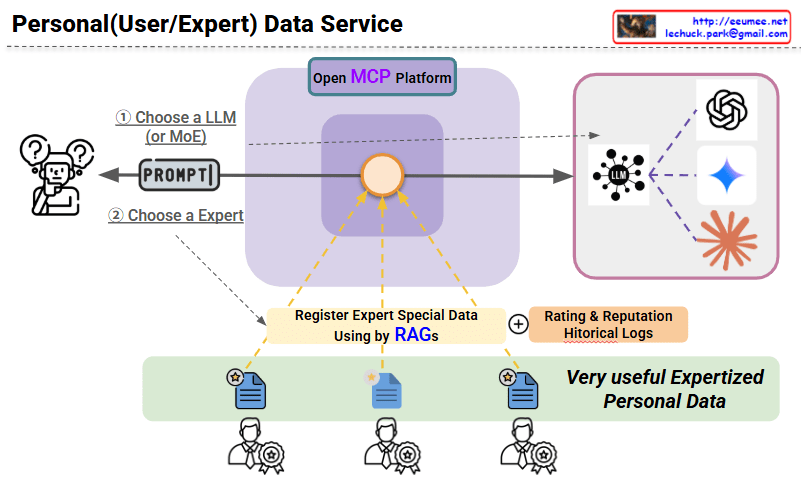
Personal(User/Expert) Data Service

System Overview

The Personal Data Service is an open expert RAG service platform based on MCP (Model Context Protocol). This system creates a bidirectional ecosystem where both users and experts can benefit mutually, enhancing accessibility to specialized knowledge and improving AI service quality.

Core Components

1. User Interface (Left Side)

  • LLM Model Selection: Users can choose their preferred language model or MoE (Mixture of Experts)
  • Expert Selection: Select domain-specific experts for customized responses
  • Prompt Input: Enter specific questions or requests

2. Open MCP Platform (Center)

  • Integrated Management Hub: Connects and coordinates all system components
  • Request Processing: Matches user requests with appropriate expert RAG systems
  • Service Orchestration: Manages and optimizes the entire workflow

3. LLM Service Layer (Right Side)

  • Multi-LLM Support: Integration with various AI model services
  • OAuth Authentication: Direct user selection of paid/free services
  • Vendor Neutrality: Open architecture independent of specific AI services

4. Expert RAG Ecosystem (Bottom)

  • Specialized Data Registration: Building expert-specific knowledge databases through RAG
  • Quality Management System: Ensuring reliability through evaluation and reputation management
  • Historical Logs: Continuous quality improvement through service usage records

Key Features

  1. Bidirectional Ecosystem: Users obtain expert answers while experts monetize their knowledge
  2. Open Architecture: Scalable platform based on MCP standards
  3. Quality Assurance: Expert and answer quality management through evaluation systems
  4. Flexible Integration: Compatibility with various LLM services
  5. Autonomous Operation: Direct data management and updates by experts

With Claude

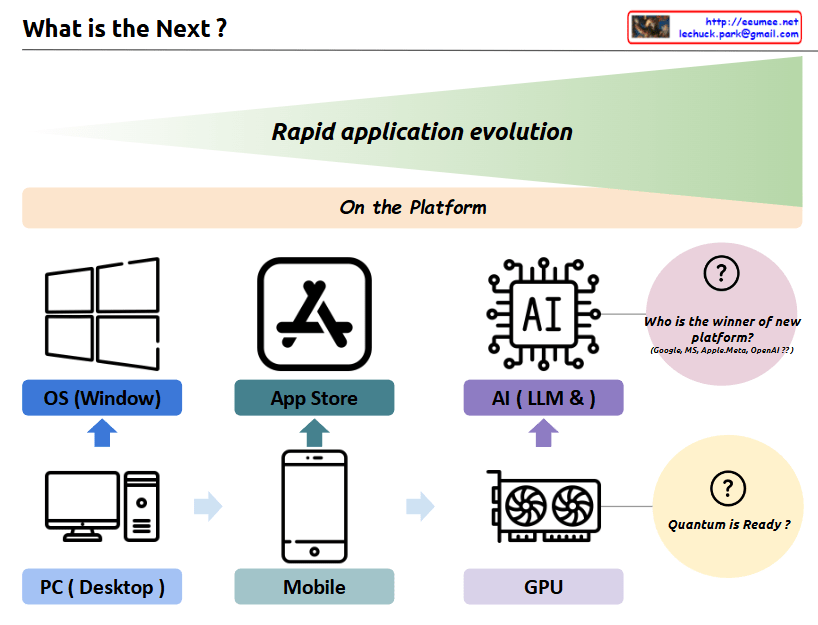
What is The Next?

With Claude
a comprehensive interpretation of the image and its concept of “Rapid application evolution”:

The diagram illustrates the parallel evolution of both hardware infrastructure and software platforms, which has driven rapid application development and user experiences:

  1. Hardware Infrastructure Evolution:
  • PC/Desktop → Mobile Devices → GPU
  • Represents the progression of core computing power platforms
  • Each transition brought fundamental changes in how users interact with technology
  1. Software Platform Evolution:
  • Windows OS → App Store → AI/LLM
  • Shows the evolution of application ecosystems
  • Each platform created new possibilities for user applications

The symbiotic relationship between these two axes:

  • PC Era: Integration of PC hardware with Windows OS
  • Mobile Era: Combination of mobile devices with app store ecosystems
  • AI Era: Marriage of GPU infrastructure with LLM/AI platforms

Each transition has led to exponential growth in application capabilities and user experiences, with hardware and software platforms developing in parallel and reinforcing each other.

Future Outlook:

  1. “Who is the winner of new platform?”
  • Current competition between Google, MS, Apple/Meta, OpenAI
  • Platform leadership in the AI era remains undecided
  • Possibility for new players to emerge
  1. “Quantum is Ready?”
  • Suggests quantum computing as the next potential hardware revolution
  • Implies the possibility of new software platforms emerging to leverage quantum capabilities
  • Continues the pattern of hardware-software co-evolution

This cyclical pattern of hardware-software evolution suggests that we’ll continue to see new infrastructure innovations driving platform development, and vice versa. Each cycle has dramatically expanded the possibilities for applications and user experiences, and this trend is likely to continue with future technological breakthroughs.

The key insight is that major technological leaps happen when both hardware infrastructure and software platforms evolve together, creating new opportunities for application development and user experiences that weren’t previously possible.

Golden Circle For DC Operation

From perplexity with some prompting
The image explains the “Golden Circle for DC Operation,” focusing on optimizing data center operations.

WHY: Data Center Operation Optimization

  • Purpose: To optimize the operation of data centers.
  • Service Development: Through data-driven processes, including monitoring, automation, tool development, and customer-focused services.

HOW: Consistent Process & Data Management

  • Method: Ensures reliable data through consistent processes and management.
  • Standardization: Achieved through data lists, hardware/software protocols, and service/process views and flows.

WHAT: Integrated Digital Operation Platform

  • Objective: To build an integrated digital operation platform.
  • Platform: Operator-led development that involves analysis, AI integration, and service creation.

This structure emphasizes efficiency, standardization, and a data-centric approach to data center operations.

Standardization & Platform Why?

From Claude with some prompting
This diagram illustrates the importance of standardization and platform development, highlighting two key objectives:

  1. Standardization:
    • Encompasses the stages from real work (machine and processing) through digitization, collecting, and verification.
    • Purpose: “Move on with data trust”
    • Meaning: By establishing standardized processes for data collection and verification, it ensures data reliability. This allows subsequent stages to proceed without concerns about data quality.
  2. Software Development Platform:
    • Includes analysis, improvement, and new development stages.
    • Purpose: “Make easy to improve & go to new”
    • Meaning: Building on standardized data and processes, the platform facilitates easier service improvements and new service development and expansion.

This structure offers several advantages:

  1. Data Reliability: Standardized processes for collection and verification ensure trustworthy data, eliminating concerns about data quality in later stages.
  2. Efficient Improvement and Innovation: With reliable data and a standardized platform, improving existing services or developing new ones becomes more straightforward.
  3. Scalability: The structure provides a foundation for easily adding new services or features.

In conclusion, this diagram visually represents two core strategies: establishing data reliability through standardization and enabling efficient service improvement and expansion through a dedicated platform. It emphasizes how standardization allows teams to trust and focus on using the data, while the platform makes it easier to improve existing services and develop new ones.

DC OP Platform

From Claude with some prompting
This image depicts a diagram of the “DC op Platform” (Data Center Operations Platform). The main components are as follows:

  1. On the left, there’s “DC Op Env.” (Data Center Operations Environment), which consists of three main parts:
    • DCIM (Data Center Infrastructure Management)
    • Auto Control
    • Facility These three elements undergo a “Standardization” process.
  2. In the center, there are two “Standardization” server icons, representing the standardization process of the platform.
  3. On the right, there’s the “Data Center Op. Platform”, which comprises three main components:
    • Service Development
    • Integrated operations
    • Server Room Digital Twin
  4. Arrows show how the standardized elements connect to these three main components.

This diagram visually illustrates how the data center operations environment evolves through a standardization process into an integrated data center operations platform.

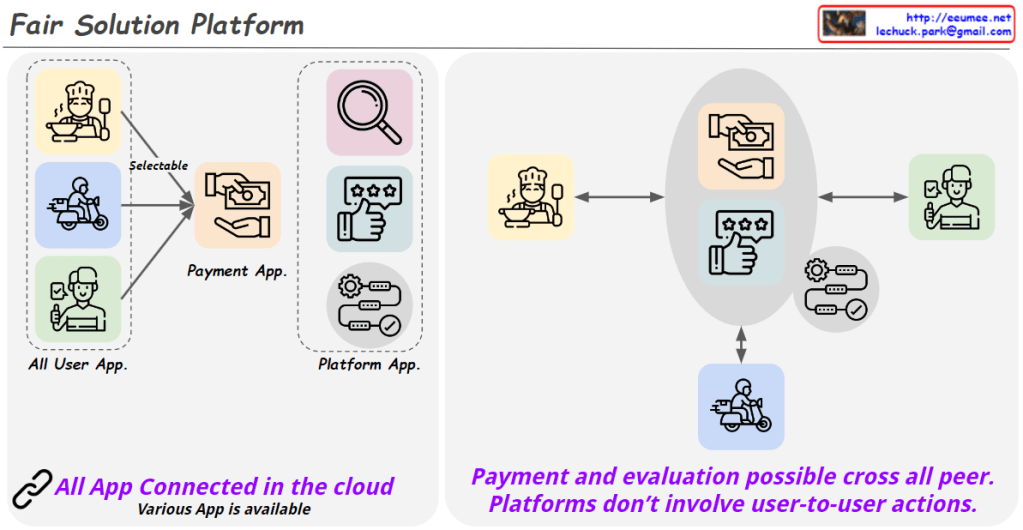
Fair Solution Platform

From Claude with some prompting
The “Fair Solution Platform” is designed with the following key concepts:

  1. User Empowerment:
    • All users (chefs, delivery personnel, customers, etc.) can directly choose which service apps to use for actual interactions (ordering, payment, delivery, evaluation, etc.).
  2. Platform Neutrality:
    • The platform provider does not interfere with direct user-to-user interactions.
    • Instead, it creates an environment where various apps can connect and be provided.
  3. Connectivity and Diversity:
    • All apps are connected through the cloud.
    • The platform fosters an ecosystem where diverse apps can be offered.
  4. Additional Features:
    • Provides functionality to search for services and activity results conducted on the platform.
  5. Fair Cost Structure:
    • The platform only charges fees related to its role as a platform.
    • Terms of transactions between users are decided directly by the parties involved.
  6. User Rights Protection:
    • This model aims to safeguard the rights of actual producers and consumers.
    • It facilitates direct transactions with minimal intermediary intervention.

The platform aims to maximize user autonomy, maintain platform neutrality, and create a fair trading environment. By doing so, it seeks to overcome the limitations of traditional platform models and create a more equitable and efficient service ecosystem.