DC OP Platform

From Claude with some prompting
This image depicts a diagram of the “DC op Platform” (Data Center Operations Platform). The main components are as follows:

  1. On the left, there’s “DC Op Env.” (Data Center Operations Environment), which consists of three main parts:
    • DCIM (Data Center Infrastructure Management)
    • Auto Control
    • Facility These three elements undergo a “Standardization” process.
  2. In the center, there are two “Standardization” server icons, representing the standardization process of the platform.
  3. On the right, there’s the “Data Center Op. Platform”, which comprises three main components:
    • Service Development
    • Integrated operations
    • Server Room Digital Twin
  4. Arrows show how the standardized elements connect to these three main components.

This diagram visually illustrates how the data center operations environment evolves through a standardization process into an integrated data center operations platform.
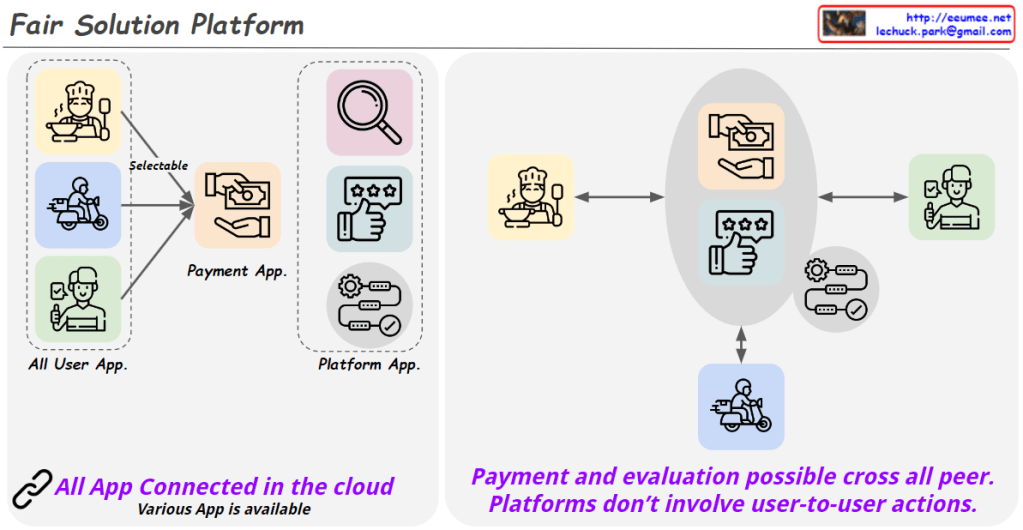
Fair Solution Platform

From Claude with some prompting
The “Fair Solution Platform” is designed with the following key concepts:

  1. User Empowerment:
    • All users (chefs, delivery personnel, customers, etc.) can directly choose which service apps to use for actual interactions (ordering, payment, delivery, evaluation, etc.).
  2. Platform Neutrality:
    • The platform provider does not interfere with direct user-to-user interactions.
    • Instead, it creates an environment where various apps can connect and be provided.
  3. Connectivity and Diversity:
    • All apps are connected through the cloud.
    • The platform fosters an ecosystem where diverse apps can be offered.
  4. Additional Features:
    • Provides functionality to search for services and activity results conducted on the platform.
  5. Fair Cost Structure:
    • The platform only charges fees related to its role as a platform.
    • Terms of transactions between users are decided directly by the parties involved.
  6. User Rights Protection:
    • This model aims to safeguard the rights of actual producers and consumers.
    • It facilitates direct transactions with minimal intermediary intervention.

The platform aims to maximize user autonomy, maintain platform neutrality, and create a fair trading environment. By doing so, it seeks to overcome the limitations of traditional platform models and create a more equitable and efficient service ecosystem.

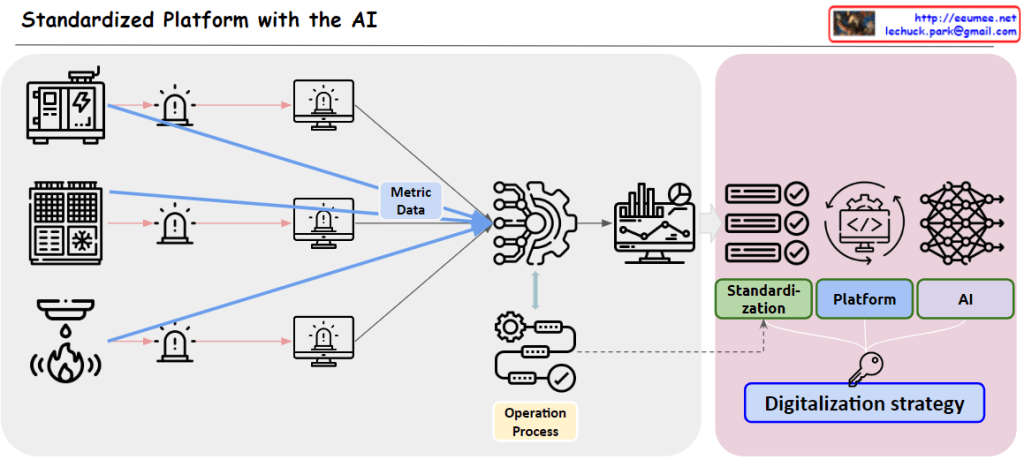
Standardized Platform with the AI

From Claude with some prompting
This image illustrates a “Standardized Platform with the AI”. Here’s a breakdown of the key components and processes:

  1. Left side: Various devices or systems (generator, HVAC system, fire detector, etc.) are shown. Each device is connected to an alarm system and a monitoring screen.
  2. Center: “Metric Data” from these devices is sent to a central gear-shaped icon, representing a data processing system.
  3. Upper right: The processed data is displayed on a dashboard or analytics screen.
  4. Lower right: There’s a section labeled “Operation Process”, indicating management or optimization of operational processes.
  5. Far right: Boxes representing the system’s components:
    • “Standardization”
    • “Platform”
    • “AI”
  6. Bottom: “Digitalization strategy” serves as the foundation for the entire system.

This diagram visualizes a digital transformation strategy that collects data from various systems and devices, processes it using AI on a standardized platform, and uses this to optimize and manage operations.

The flow shows how raw data from different sources is standardized, processed, and utilized to create actionable insights and improve operational efficiency, all underpinned by a comprehensive digitalization strategy.

Framework & Platform

From Claude with some prompting
Summary:

  1. General Work:
    • Simple producer-product-user relationship
  2. Framework:
    • Provides structure and workflow optimized for specific domains
    • Efficiently produces consistent quality products
    • Producer-centric, users primarily consumers
  3. Platform:
    • Offers a broad ecosystem
    • Users can act as prosumers
    • Enables creation of diverse and extensive products
    • Facilitates complex interactions and network effects

Key Differences:

  • Framework focuses on efficiency and consistency
  • Platform emphasizes diversity, scalability, and user engagement
  • Framework applies to specific domains, Platform to broad areas
  • Platform allows for more diverse and active user roles

Framework is about streamlining production within defined boundaries, while Platform creates an environment for diverse creation and interaction.

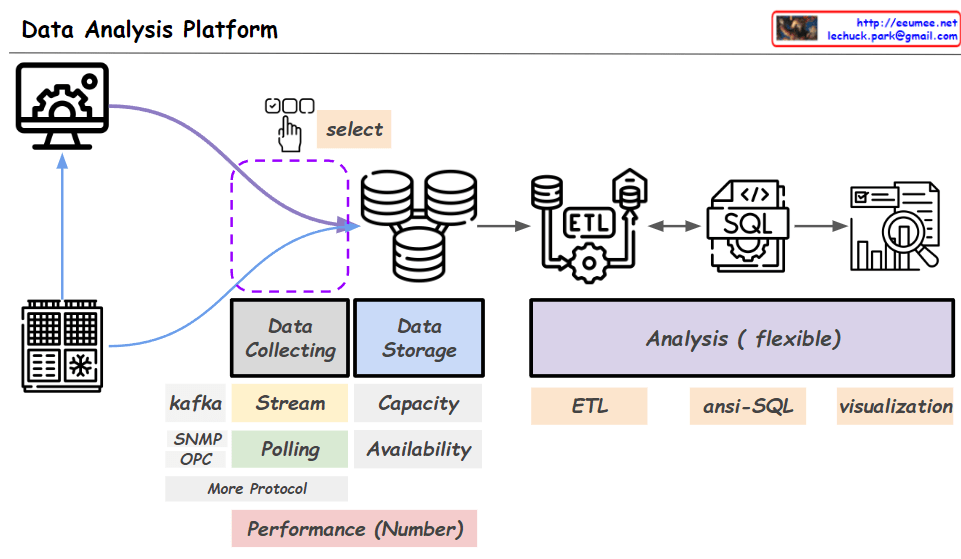
Data Analysis Platform

From Claude with some prompting
The given image illustrates the overall architecture of a data analysis platform. At the data collecting stage, data is gathered from actual equipment or systems (servers). Protocols like Kafka, SNMP, and OPC are used for data streaming or polling.

The ‘select’ part indicates selecting specific data from the entire collected dataset. Based on the configuration information of the actual equipment, only the data of interest can be selectively collected, allowing the expansion of the data collection scope.

The selected data is stored in a data storage system and then loaded into an SQL database through an ETL (Extract, Transform, Load) process. Afterward, flexible data analysis is enabled using tools like ETL, ansi-SQL, and visualization.

Performance metrics for the entire process are provided numerically, and analysis tasks can be performed through the user interface of the data analysis platform.

The key aspects highlighted are the collection of data from actual equipment/systems, selective data collection based on equipment configuration, data storage, ETL process, SQL database, analysis tools (ETL, SQL, visualization), performance metrics, and the analysis platform user interface.

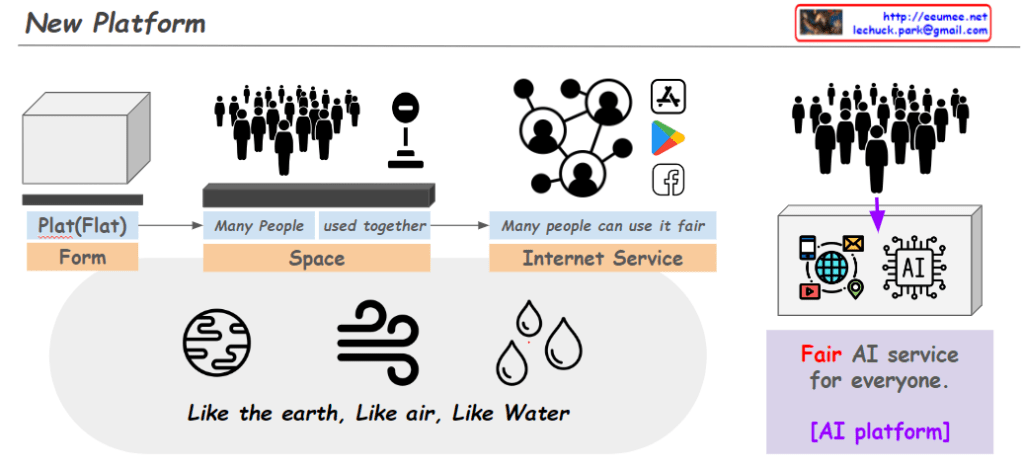
New Platform

From DALL-E with some prompting
This image appears to depict a conceptual framework for a new platform designed to advance AI in a way that ensures it is a fair and equitable system accessible to everyone. It illustrates the following key components:

Plat(Flat) Form: Represents the fundamental structure of the platform, which is depicted as flat and formative, suggesting a foundation or base layer.
Space: Symbolizes a communal space where many people come together, indicating collaborative use and a shared environment.
Internet Service: Portrayed by interconnected nodes, suggesting a service that integrates with the modern internet ecosystem, designed to be used fairly by many.
AI Platform: Signified by various AI-related icons, highlighting the emphasis on artificial intelligence. Accompanied by the phrase “Fair AI service for everyone,” it conveys the platform’s commitment to equitable access to AI technology.
Overall, the image conveys a message that internet services, much like the earth, air, and water, are essential and should be naturally accessible. The main goal highlighted is to foster the development of AI as a platform—a system that is just and available to all, akin to universal resources.

Exp to the AI

From DALL-E with some prompting
The image outlines a transformative process in AI development:

Experience to Data: This depicts the conversion of real-world experiences into digital data. Icons indicate a brain or cognition and a gear mechanism, symbolizing the process of understanding and systematizing experiences.

Digital to Platform: The transformed data is then standardized on a platform. Icons of servers and a microchip suggest data storage and processing.

Platform Makes New & AI: Utilizing the standardized data, the platform facilitates the creation of new AI services. Icons of an AI chip and a symbol for ‘new’ represent the innovation and development of AI applications.

Overall, the image emphasizes the value of converting experiences into a digital format that can be standardized on a platform to drive the creation of innovative AI services.