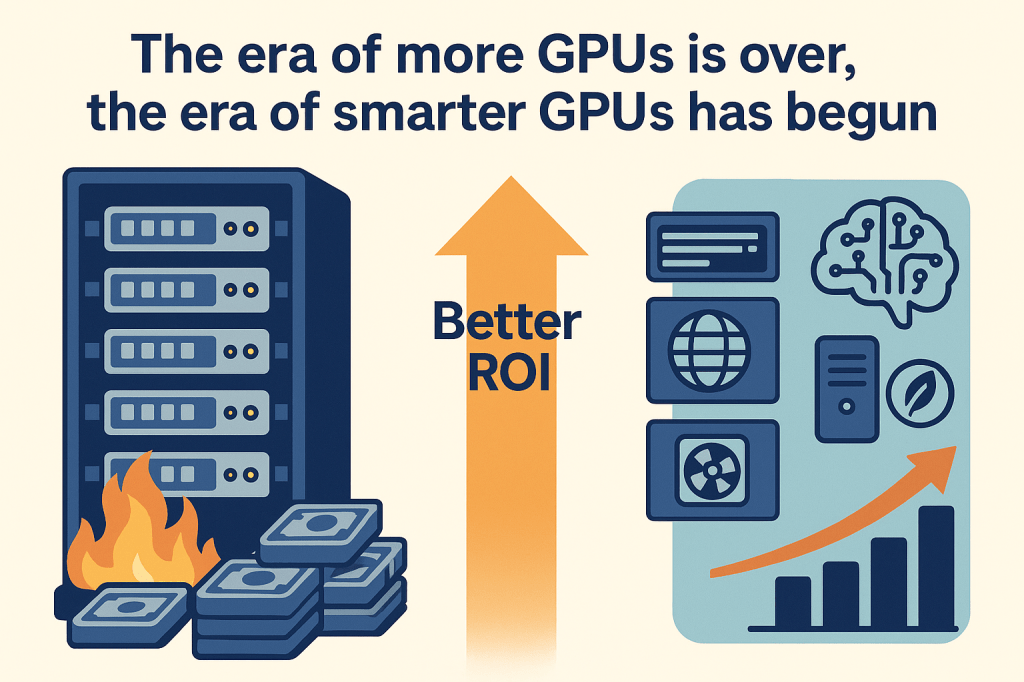
This illustration contrasts an old approach of endlessly adding more GPU servers, burning money for little gain, with a new era where AI-driven optimization of software, network, cooling and power delivers smarter GPUs and a much better ROI.
The Computing for the Fair Human Life.

This illustration contrasts an old approach of endlessly adding more GPU servers, burning money for little gain, with a new era where AI-driven optimization of software, network, cooling and power delivers smarter GPUs and a much better ROI.

This diagram illustrates the fundamental purpose and stages of optimization.
Input β Processing β Output β Verification
Optimization aims to increase speed and reduce resources by removing unnecessary operations. It follows a staged approach starting from software-level improvements and extending to hardware implementation when needed. The process ensures predictable, verifiable results through deterministic inputs/outputs and rule-based methods.
#Optimization #PerformanceTuning #CodeOptimization #AlgorithmImprovement #SoftwareEngineering #HardwareAcceleration #ResourceManagement #SpeedOptimization #MemoryOptimization #SystemDesign #Benchmarking #Profiling #EfficientCode #ComputerScience #SoftwareDevelopment
With Claude

This image summarizes four cutting-edge research studies demonstrating the bidirectional optimization relationship between AI LLMs and cooling systems. It proves that physical cooling infrastructure and software workloads are deeply interconnected.
Direction 1: Physical Cooling β AI Performance Impact
Direction 2: AI Software β Cooling Control
[Cooling HW β AI SW Performance]
β Physical cooling improvements directly enhance AI workload real-time processing capabilities
[AI SW β Cooling HW Control]
β AI software intelligently controls physical cooling to improve overall system efficiency
[AI SW β Cooling HW Interaction]
β Complete closed-loop where AI controls physical systems, and results feedback to AI performance
[Cooling HW β AI SW Training Stability]
β Advanced physical cooling technology secures feasibility of large-scale LLM training
βββββββββββββββββββββββββββββββββββββββββββββββββββββββββββ
β Physical Cooling Systems β
β (Liquid cooling, Immersion, CRAC, Heat exchangers) β
ββββββββββββββββ¬βββββββββββββββββββββββββ¬ββββββββββββββββββ
β β
Tempβ Powerβ Stabilityβ AI-based Control
β RL/LLM Controllers
ββββββββββββββββ΄βββββββββββββββββββββββββ΄ββββββββββββββββββ
β AI Workloads (LLM/VLM) β
β Performanceβ Throughputβ Throttlingβ Training Stabilityββ
βββββββββββββββββββββββββββββββββββββββββββββββββββββββββββββ
Better cooling β AI performance improvement β smarter cooling control
β Energy savings β more AI jobs β advanced cooling optimization
β Sustainable large-scale AI infrastructure
These studies demonstrate:
These four studies establish that next-generation AI data centers must evolve into integrated ecosystems where physical cooling and software workloads interact in real-time to self-optimize. The bidirectional relationshipβwhere better cooling enables superior AI performance, and AI algorithms intelligently control cooling systemsβcreates a virtuous cycle that simultaneously achieves enhanced performance, energy efficiency, and sustainable scalability for large-scale AI infrastructure.
#EnergyEfficiency#GreenAI#SustainableAI#DataCenterOptimization#ReinforcementLearning#AIControl#SmartCooling
With Claude

Analysis of Optimization Strategy Framework
Stable Environment β Minimal optimization sufficient
Volatile Environment β 60-80% optimization optimal
This framework demonstrates that “good enough” often outperforms “perfect” in real-world scenarios. The 60-80% optimization zone represents the intersection of achievability, efficiency, and business valueβparticularly crucial in today’s rapidly changing business landscape. True optimization isn’t about reaching 100%; it’s about finding the right balance between effort invested and value delivered, while maintaining the agility to adapt when requirements inevitably change.
(!) 60-80% is just a number. The best number is changed by …
With Claude

BitNet is an innovative neural network architecture that achieves extreme efficiency through ultra-low precision quantization while maintaining model performance through strategic design choices.
1. Ultra-Low Precision (1.58-bit)
2. Weight Quantization
3. Multi-Layer Structure
4. Precision-Targeted Operations
5. Hardware & Kernel Optimization
6. Token Relationship Computing
BitNet represents a breakthrough in neural network efficiency by using extreme weight quantization (1.58-bit) that dramatically reduces memory usage and computational complexity while preserving model performance through hardware-optimized bitwise operations and multi-layer combinatorial representation power.
With Claude

This diagram presents a systematic framework that defines the essence of AI LLMs as “Massive Simple Parallel Computing” and systematically outlines the resulting issues and challenges that need to be addressed.
Massive: Enormous scale with billions of parameters Simple: Fundamentally simple computational operations (matrix multiplications, etc.) Parallel: Architecture capable of simultaneous parallel processing Computing: All of this implemented through computational processes
Big Issues:
Very Required:
How can we solve all these requirements?
In other words, this framework poses the fundamental question about specific solutions and approaches to overcome the problems inherent in the essential characteristics of current LLMs. This represents a compressed framework showing the core challenges for next-generation AI technology development.
The diagram effectively illustrates how the defining characteristics of LLMs directly lead to significant challenges, which in turn demand specific capabilities, ultimately raising the critical question of implementation methodology.
With Claude

This diagram illustrates the 3 Core Technological Components of AI World and their surrounding challenges.
Data management as the raw material for AI technology:
Performance enhancement of AI technology:
Ensuring reliability and trustworthiness of AI technology:
This diagram demonstrates how the three core technological elements – AI Infrastructure, AI Model, and AI Agent – form the center of AI World, while interacting with the three fundamental challenges of Data, Optimization, and Verification to create a comprehensive AI ecosystem.
With Claude