LMM Operation

LLM Operations System Analysis

This diagram illustrates the architecture of an LLM Operations (LLMOps) system, demonstrating how Large Language Models are deployed and operated in industrial settings.

Key Components and Data Flow

1. Data Input Sources (3 Categories)

  • Facility: Digitized sensor data that gets detected and generates alert/event logs
  • Manual: Equipment manuals and technical documentation
  • Experience: Operational manuals including SOP/MOP/EOP (Standard/Maintenance/Emergency Operating Procedures)

2. Central Processing System

  • RAG (Retrieval-Augmented Generation): A central hub that integrates and processes all incoming data
  • Facility data is visualized through metrics and charts for monitoring purposes

3. LLM Operations

  • The central LLM synthesizes all information to provide intelligent operational support
  • Interactive interface enables user communication and queries

4. Final Output and Control

  • Dashboard for data visualization and monitoring
  • AI chatbot for real-time operational assistance
  • Operator Control: The bottom section shows checkmark (✓) and X-mark (✗) buttons along with an operator icon, indicating that final decision-making authority remains with human operators

System Characteristics

This system represents a smart factory solution that integrates AI into traditional industrial operations, providing comprehensive management from real-time data monitoring to operational manual utilization.

The key principle is that while AI provides comprehensive analysis and recommendations, the final operational decisions and approvals still rest with human operators. This is clearly represented through the operator icon and approval/rejection buttons at the bottom of the diagram.

This demonstrates a realistic and desirable AI operational model that emphasizes safety, accountability, and the importance of human judgment in unpredictable situations.

With Claude

ALL to LLM

This image is an architecture diagram titled “ALL to LLM” that illustrates the digital transformation of industrial facilities and AI-based operational management systems.

Left Section (Industrial Equipment):

  • Cooling tower (cooling system)
  • Chiller (refrigeration/cooling equipment)
  • Power transformer (electrical power conversion equipment)
  • UPS (Uninterruptible Power Supply)

Central Processing:

  • Monitor with gears: Equipment data collection and preprocessing system
  • Dashboard interface: “All to Bit” analog-to-digital conversion interface
  • Bottom gears and human icon: Manual/automated operational system management

Right Section (AI-based Operations):

  • Purple area with binary code (0s and 1s): All facility data converted to digital bit data
  • Robot icons: LLM-based automated operational systems
  • Document/analysis icons: AI analysis results and operational reports

Overall, this diagram represents the transformation from traditional manual or semi-automated industrial facility operations to a fully digitized system where all operational data is converted to bit-level information and managed through LLM-powered intelligent facility management and predictive maintenance in an integrated operational system.

With Claude

GPU Server Room : Changes

Image Overview

This dashboard displays the cascading resource changes that occur when GPU workload increases in an AI data center server room monitoring system.

Key Change Sequence (Estimated Values)

  1. GPU Load Increase: 30% → 90% (AI computation tasks initiated)
  2. Power Consumption Rise: 0.42kW → 1.26kW (3x increase)
  3. Temperature Delta Rise: 7°C → 17°C (increased heat generation)
  4. Cooling System Response:
    • Water flow rate: 200 LPM → 600 LPM (3x increase)
    • Fan speed: 600 RPM → 1200 RPM (2x increase)

Operational Prediction Implications

  • Operating Costs: Approximately 3x increase from baseline expected
  • Spare Capacity: 40% cooling system capacity remaining
  • Expansion Capability: Current setup can accommodate additional 67% GPU load

This AI data center monitoring dashboard illustrates the cascading resource changes when GPU workload increases from 30% to 90%, triggering proportional increases in power consumption (3x), cooling flow rate (3x), and fan speed (2x). The system demonstrates predictable operational scaling patterns, with current cooling capacity showing 40% remaining headroom for additional GPU load expansion. Note: All values are estimated figures for demonstration purposes.

Note: All numerical values are estimated figures for demonstration purposes and do not represent actual measured data.

With Claude

Basic Power Operations

This image illustrates “Basic Power Operations,” showing the path and processes of electricity flowing from source to end-use.

The upper diagram includes the following key components from left to right:

  • Power Source/Intake – High voltage for efficient delivery with high warning
  • Transformer – Performs voltage step-down
  • Generator and Fuel Tank – Backup Power
  • Transformer #2 – Additional voltage step-down
  • UPS/Battery – 2nd Backup Power
  • PDU/TOB – Supplies power to the final servers

The diagram displays two backup power systems:

  • Backup power (Full outage) – Functions during complete power failures with backup time provided by Oil Tank with Generators
  • Backup Power (Partial outage) – Operates during partial outages with backup time provided by the Battery with UPSs

The simplified diagram at the bottom summarizes the complex power system into these fundamental elements:

  1. Source – Origin point of power
  2. Step-down – Voltage conversion
  3. Backup – Emergency power supply
  4. Use – Final power consumption

Throughout all stages of this process, two critical functions occur continuously:

  • Transmit – The ongoing process of transferring power that happens between and during all steps
  • Switching/Block – Control points distributed throughout the system that direct, regulate, or block power flow as needed

This demonstrates that seemingly complex power systems can be distilled into these essential concepts, with transmission and switching/blocking functioning as integral operations that connect and control all stages of the power delivery process.

WIth Claude

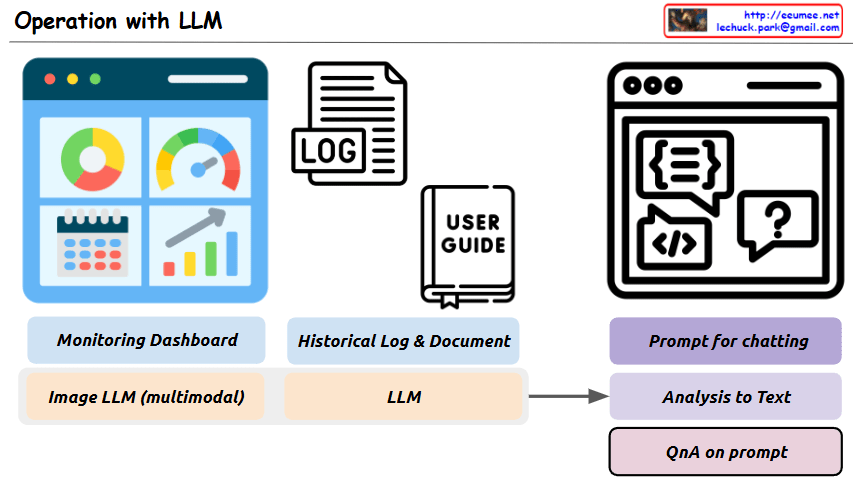
Operation with LLM

This image is a diagram titled “Operation with LLM,” showing a system architecture that integrates Large Language Models (LLMs) with existing operational technologies.

The main purpose of this system is to more efficiently analyze and solve various operational data and situations using LLMs.

Key components and functions:

  1. Top Left: “Monitoring Dashboard” – Provides an environment where LLMs can interpret image data collected from monitoring screens.
  2. Top Center: “Historical Log & Document” – LLMs analyze system log files and organize related processes from user manuals.
  3. Top Right: “Prompt for chatting” – An interface for interacting with LLMs through appropriate prompts.
  4. Bottom Left: “Image LLM (multimodal)” – Represents multimodal LLM functionality for interpreting images from monitoring screens.
  5. Bottom Center: “LLM” – The core language model component that processes text-based logs and documents.
  6. Bottom Right:
    • “Analysis to Text” – LLMs analyze various input sources and convert them to text
    • “QnA on prompt” – Users can ask questions about problem situations, and LLMs provide answers

This system aims to build an integrated operational environment where problems occurring in operational settings can be easily analyzed through LLM prompting and efficiently solved through a question-answer format.

With Claude

Operation with system

Key Analysis of Operation Cost Diagram

This diagram illustrates the cost structure of system implementation and operation, highlighting the following key concepts:

  1. High Initial Deployment Cost: At the beginning of a system’s lifecycle, deployment costs are substantial. This represents a one-time investment but requires significant capital.
  2. Perpetual Nature of Operation Costs: Operation costs continue indefinitely as long as the system exists, making them a permanent expense factor.
  3. Components of Operation Cost: Operation costs consist of several key elements:
    • Energy Cost
    • Labor Cost
    • Disability Cost
    • Additional miscellaneous costs (+@)
  4. Role of Automation Systems: As shown on the right side of the diagram, implementing automation systems can significantly reduce operation costs over time.
  5. Timing of Automation Investment: While automation systems also require initial investment during the early phases, they deliver long-term operation cost reduction benefits, ultimately improving the overall cost structure.

This diagram effectively visualizes the relationship between initial costs and long-term operational expenses, as well as the cost optimization strategy through automation.

With Claude