HTTP Service components

From Claude with some prompting
This image illustrates the network structure of an HTTP service. The main components are:

Client Side:

  • Browser: Handles URL requests, HTML parsing, and JavaScript execution
  • OS: Runs the browser, translates URL (domain) to IP

Internet:

  • DNS: Converts domain names to IP addresses
  • IP: Transfers data using IP addresses

Server Side:

  • OS (Operating System): Runs applications, manages IP network
  • TLS: Handles encryption
  • WEB:
    • Manages HTML embedding
    • Handles JSP (JavaServer Pages)
    • Typically deals with static content and some dynamic content generation
  • WAS (Web Application Server):
    • Handles server-side programming and application logic
    • Manages complex dynamic content generation
    • Interacts with the database
    • Handles business logic of the application
  • DB: Database for storing and retrieving data for web services

The diagram shows the entire process of how an HTTP request is handled, from the web browser to the server’s database. It briefly explains the technologies and protocols involved at each step, providing a helpful overview of the basic structure of web services.

nagle for TCP

From Claude with some prompting
This image illustrates the TCP (Transmission Control Protocol) packet structure and the Nagle algorithm.

  1. Top section:
    • Shows data transfer between two computers.
    • Demonstrates how data (payload) is divided into multiple packets for transmission.
  2. Middle section – Packet structure:
    • Data Payload: The actual data being transmitted
    • TCP/IP header: Contains control information for communication
    • Ethernet header: 14 Bytes
    • IPv4 header: 20 Bytes
    • TCP header: 20 Bytes
    • Data + Padding: Actual data and padding added if necessary
    • MTU Limit: Maximum Transmission Unit limit
  3. Bottom section – Nagle’s Algorithm:
    • Normal TCP/IP transmission: Small data packets are sent individually
    • With Nagle’s Algorithm: Small data packets are combined into larger packets before transmission
    • Packet sending conditions:
      1. When an ACK is received
      2. On timeout
      3. When the TCP sending window overflows

The image effectively demonstrates the packet structure in TCP communications and explains how the Nagle algorithm improves network efficiency. The main purpose of Nagle’s algorithm is to reduce network overhead by bundling small packets together before transmission.

For the Same Traffic metering

From Claude with some prompting
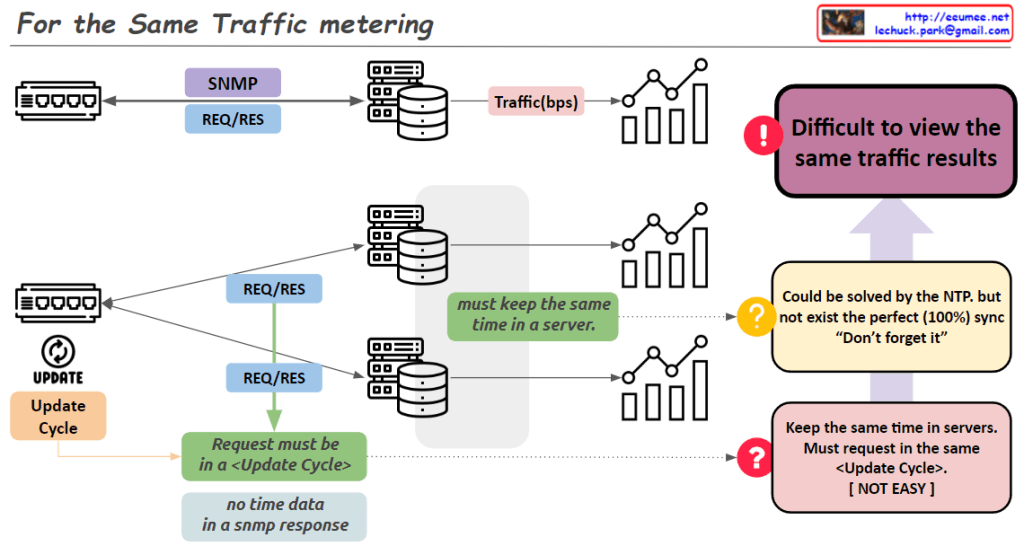
“For the Same Traffic Metering” – Key Points:

  1. Problem: Different collection servers using SNMP may not yield the same results for identical traffic.
  2. Main causes of discrepancy:
    • Network equipment updates traffic information periodically.
    • To get consistent values, SNMP requests must align with the equipment’s update cycle.
    • Difficult to synchronize requests precisely across multiple servers.
  3. Challenges for resolution:
    • Servers need accurate time synchronization.
    • All requests should occur within the same ‘Update Cycle’ of the equipment.
  4. Time synchronization:
    • NTP can partially solve the issue.
    • Perfect (100%) synchronization is not achievable in practice.
  5. Consequence: SNMP data collected from multiple servers may show different results for the same traffic.
  6. Key insight: The image emphasizes the difficulties in accurate data collection using SNMP in network monitoring systems.
  7. Implications: Network administrators and system designers must be aware of these limitations and consider them when collecting and interpreting data.

This summary highlights the complexities involved in ensuring consistent traffic metering across multiple collection points in a network environment.

TCP Reliable 3

From Claude with some prompting
RTT is measured by sending a packet (SEQ=A) and receiving an acknowledgment (ACK), providing insights into network latency. Bandwidth is measured by sending a sequence of packets (SEQ A to Z) and observing the amount of data transferred based on the acknowledgment of the last packet.

This image explains how to measure round-trip time (RTT) and bandwidth utilization to control and optimize TCP (Transmission Control Protocol) communications. The measured metrics are leveraged by various mechanisms to improve the reliability and efficiency of TCP.

These measured metrics are utilized by several mechanisms to enhance TCP performance. TCP Timeout sets appropriate timeout values by considering RTT variation. TIMELY provides delay information to the transport layer based on RTT measurements.

Furthermore, TCP BBR (Bottleneck Bandwidth and Round-trip propagation time) models the bottleneck bandwidth and RTT propagation time to determine the optimal sending rate according to network conditions.

In summary, this image illustrates how measuring RTT and bandwidth serves as the foundation for various mechanisms that improve the reliability and efficiency of the TCP protocol by adapting to real-time network conditions.

Infiniband

From claude with some prompting
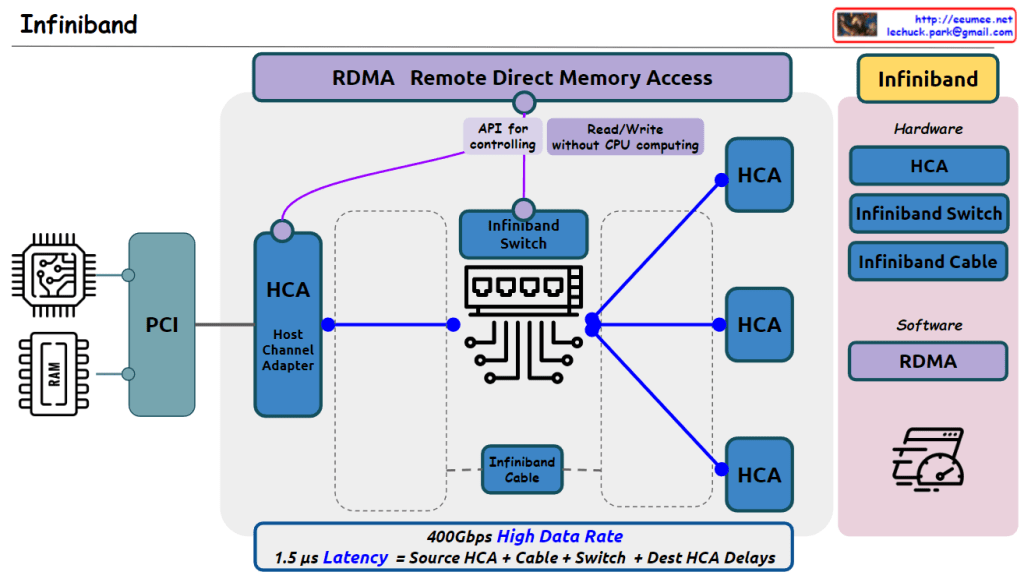
The image correctly depicts the essential hardware elements of an InfiniBand network, including the PCI interface, Host Channel Adapters (HCAs), InfiniBand Switch, and InfiniBand cables connecting the HCAs to the switch.

It highlights RDMA (Remote Direct Memory Access) as a key technology that enables read/write operations without CPU involvement, facilitated by APIs for controlling the HCAs.

The hardware components listed (HCA, InfiniBand Switch, InfiniBand Cable) are accurate.

However, there is one potential inaccuracy in the details provided. The stated latency of 1.5μs seems quite low for an end-to-end InfiniBand communication. Typical InfiniBand latencies are in the range of a few microseconds, depending on the specific InfiniBand generation and configuration.

Additionally, while the image mentions a “400Gbps High Data Rate,” it’s important to note that this is an aggregate bandwidth across multiple links or ports, not necessarily the speed of a single link.

Overall, the image effectively conveys the main concepts and components of InfiniBand technology, with just a minor potential discrepancy in the stated latency value.


My own AI agent

From DALL-E with some prompting
This image appears to be a conceptual diagram of an individual’s AI agent, divided into several parts:

  1. Personal Area: There’s a user icon with arrows labeled ‘Control’ and ‘Sensing All’. This suggests the user can direct the AI agent and the AI is capable of gathering comprehensive information from its environment.
  2. Micro & Macro Infinite World: This part features illustrations that seem to represent microorganisms, plants, butterflies, etc., indicating that the AI collects data from both microscopic and macroscopic environments.
  3. Personalized Resource: The icon resembling a human brain could represent personalized services or data tailored to the user.
  4. Cloud Infra: The cloud infrastructure is presumably responsible for data processing and storage.
  5. Cloud Service: Depicted as a server providing various services, connected to the cloud infrastructure.
  6. Internet Connected: A globe icon with various network points suggests that the AI agent is connected to global information and knowledge via the internet.

Overall, the diagram illustrates a personalized AI agent that collects information under the user’s control, processes it through cloud infrastructure and services, and ultimately contributes to collective intelligence through an internet connection.