Metric Data

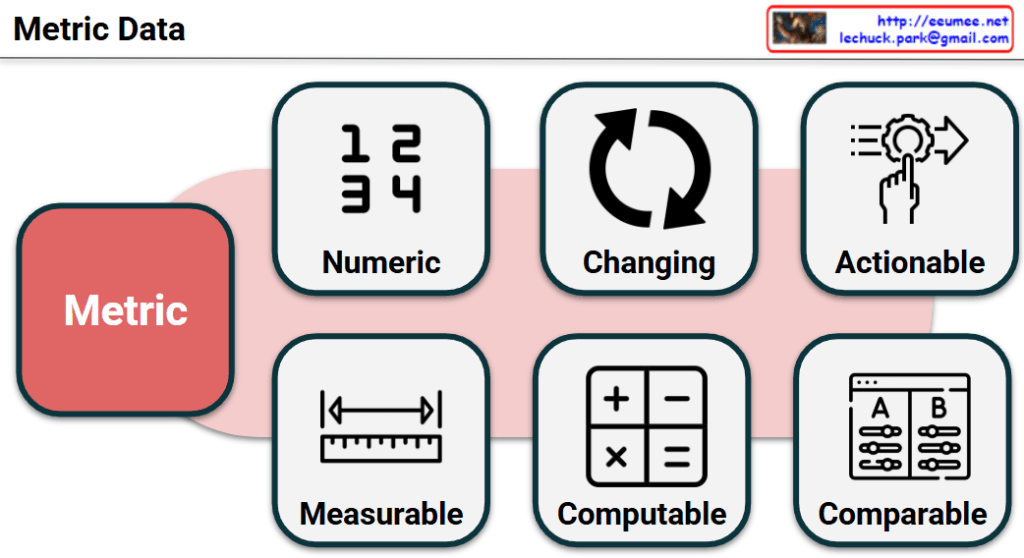
This image visually and intuitively defines the “6 Core Criteria of a Good Metric.” It effectively encompasses both the technical properties of the data itself and its practical value in a business context.

๐Ÿ“Š The 6 Core Elements of a Metric

1. Data Foundation

  • Numeric: Represented by the 1 2 3 4 icon. A metric must be expressed as objective, quantifiable numbers rather than subjective feelings or qualitative text.
  • Measurable: Represented by the ruler icon. The data must be accurately collected and tracked using systems, logs, or measurement tools.

2. Data Processing

  • Changing: Represented by the refresh arrows icon. A metric is not a fixed constant; it must dynamically fluctuate over time, environments, or in response to user actions.
  • Computable: Represented by the calculator icon. You should be able to process raw data using mathematical operations (addition, division, ratios) to derive a meaningful value.

3. Business Value

  • Actionable: Represented by the hand adjusting a gear icon. A good metric should not just be “nice to know.” It must drive concrete actions, strategic adjustments, or immediate decision-making to improve a system or service.
  • Comparable: Represented by the A/B panel icon. A metric gains its true meaning when evaluated against past data (e.g., month-over-month), target goals, or different user cohorts (A/B testing) to diagnose current performance.

๐Ÿ’ก Summary

Overall, this slide provides an excellent framework that bridges the gap between data engineering (how data is collected and computed) and business strategy (how data drives decisions). It is a highly polished visual guide for defining ideal metrics!

#Metrics #KPI #BusinessIntelligence #DataStrategy #DataEngineering #ActionableInsights

With Gemini

Server Room Metric Correlation

With Claude
Server Room Metric Correlation Analysis & Operations Guide

1. Diagram Structure Analysis

Key Component Areas

  1. Server Zone (Left)
  • Server racks and equipment
  • Workload-driven CPU/GPU operations
  • Load metrics indicating rising system demands
  • Resource utilization monitoring
  1. Power Supply Zone (Center Bottom)
  • Power metering system
  • Power consumption monitoring
  • Load status tracking with increasing indicators
  1. Hot Zone (Center)
  • Heat generation and thermal management area
  • Exhaust temperature monitoring
  • Return temperature tracking
  • Overall temperature management
  1. Cool Zone (Right)
  • Cooling system operations
  • Inlet temperature control
  • Cooling supply temperature management
  • Cooling system load monitoring

2. Core Metric Correlations

Basic Metric Flow

  1. Load Generation
  • Server workload increases
  • CPU/GPU utilization rises
  • System load elevation
  1. Power Consumption
  • Load-driven power usage increase
  • Power efficiency monitoring
  • Overall system load tracking
  1. Thermal Management
  • Heat generation in Hot Zone
  • Exhaust/Return temperature differential
  • Cooling system response
  1. Cooling Efficiency
  • Cool Zone temperature regulation
  • Cooling system load adjustment
  • System stability maintenance

3. Key Operational Indicators

Primary Metrics

  1. Performance Metrics
  • Server workload levels
  • CPU/GPU utilization
  • System response metrics
  1. Environmental Metrics
  • Zone temperatures
  • Air flow patterns
  • Cooling efficiency
  1. Power Metrics
  • Power consumption rates
  • Load distribution
  • Efficiency indicators

4. Monitoring Focus Points

Critical Correlations

  1. Load-Power-Temperature Relationship
  • Workload impact on power consumption
  • Heat generation patterns
  • Cooling system response efficiency
  1. System Stability Indicators
  • Temperature zone balance
  • Power distribution effectiveness
  • Cooling system performance

This comprehensive analysis of server room metrics and their correlations enables effective monitoring and management of the entire system, ensuring optimal performance and stability through understanding the interconnected nature of all components and their respective metrics.

The diagram effectively illustrates how different metrics interact and influence each other, providing a clear framework for monitoring and maintaining server room operations efficiently.