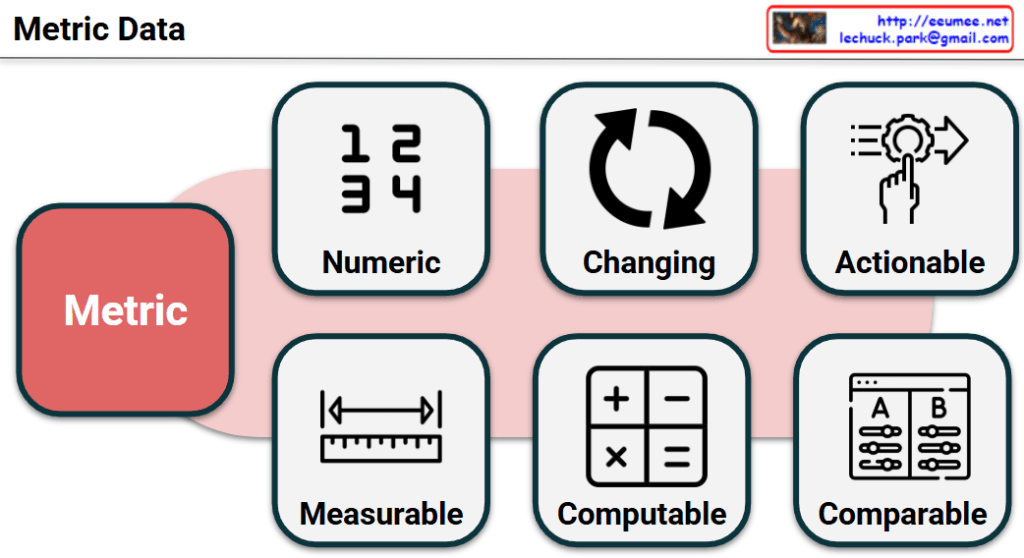
This image visually and intuitively defines the “6 Core Criteria of a Good Metric.” It effectively encompasses both the technical properties of the data itself and its practical value in a business context.
📊 The 6 Core Elements of a Metric
1. Data Foundation
- Numeric: Represented by the
1 2 3 4icon. A metric must be expressed as objective, quantifiable numbers rather than subjective feelings or qualitative text. - Measurable: Represented by the
rulericon. The data must be accurately collected and tracked using systems, logs, or measurement tools.
2. Data Processing
- Changing: Represented by the
refresh arrowsicon. A metric is not a fixed constant; it must dynamically fluctuate over time, environments, or in response to user actions. - Computable: Represented by the
calculatoricon. You should be able to process raw data using mathematical operations (addition, division, ratios) to derive a meaningful value.
3. Business Value
- Actionable: Represented by the
hand adjusting a gearicon. A good metric should not just be “nice to know.” It must drive concrete actions, strategic adjustments, or immediate decision-making to improve a system or service. - Comparable: Represented by the
A/B panelicon. A metric gains its true meaning when evaluated against past data (e.g., month-over-month), target goals, or different user cohorts (A/B testing) to diagnose current performance.
💡 Summary
Overall, this slide provides an excellent framework that bridges the gap between data engineering (how data is collected and computed) and business strategy (how data drives decisions). It is a highly polished visual guide for defining ideal metrics!
#Metrics #KPI #BusinessIntelligence #DataStrategy #DataEngineering #ActionableInsights
With Gemini


