Metric Data

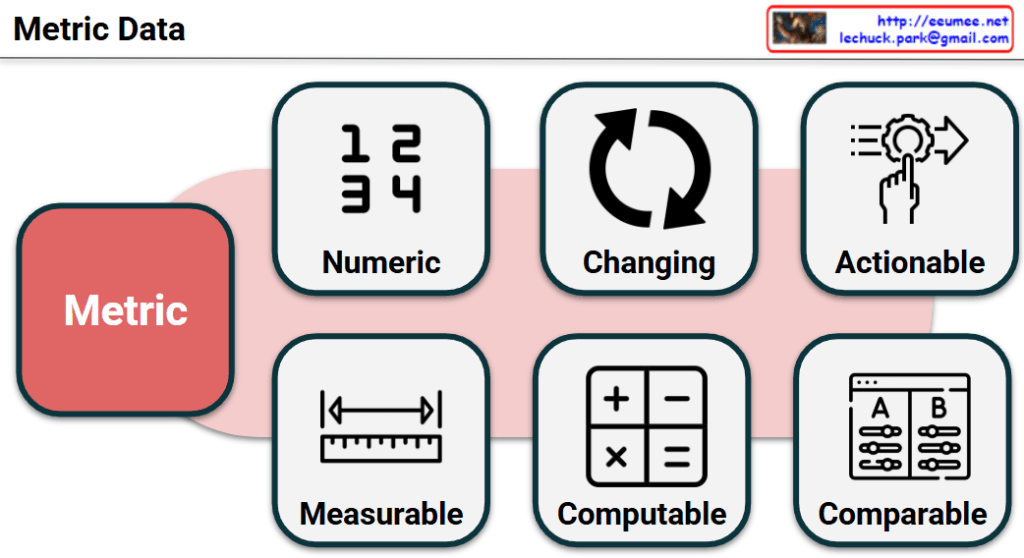
This image visually and intuitively defines the “6 Core Criteria of a Good Metric.” It effectively encompasses both the technical properties of the data itself and its practical value in a business context.

๐Ÿ“Š The 6 Core Elements of a Metric

1. Data Foundation

  • Numeric: Represented by the 1 2 3 4 icon. A metric must be expressed as objective, quantifiable numbers rather than subjective feelings or qualitative text.
  • Measurable: Represented by the ruler icon. The data must be accurately collected and tracked using systems, logs, or measurement tools.

2. Data Processing

  • Changing: Represented by the refresh arrows icon. A metric is not a fixed constant; it must dynamically fluctuate over time, environments, or in response to user actions.
  • Computable: Represented by the calculator icon. You should be able to process raw data using mathematical operations (addition, division, ratios) to derive a meaningful value.

3. Business Value

  • Actionable: Represented by the hand adjusting a gear icon. A good metric should not just be “nice to know.” It must drive concrete actions, strategic adjustments, or immediate decision-making to improve a system or service.
  • Comparable: Represented by the A/B panel icon. A metric gains its true meaning when evaluated against past data (e.g., month-over-month), target goals, or different user cohorts (A/B testing) to diagnose current performance.

๐Ÿ’ก Summary

Overall, this slide provides an excellent framework that bridges the gap between data engineering (how data is collected and computed) and business strategy (how data drives decisions). It is a highly polished visual guide for defining ideal metrics!

#Metrics #KPI #BusinessIntelligence #DataStrategy #DataEngineering #ActionableInsights

With Gemini

ML System Engineering

This image illustrates the core pillars of ML System Engineering, outlining the journey from raw data to a responsible, deployed model.


  1. Data Engineering: Data Quality & Skew Prevention
    • Focuses on building robust pipelines to ensure high-quality data. It aims to prevent “training-serving skew,” where the model performs well during training but fails in real-world production due to data inconsistencies.
  2. Model Optimization: Accuracy vs. Efficiency
    • Involves balancing competing metrics such as model size, memory usage, latency, and accuracy. The goal is to optimize models to meet specific hardware constraints without sacrificing predictive performance.
  3. Training Infrastructure: Distributed Training & Convergence
    • Highlights the technical backbone required to scale AI. It focuses on the seamless integration of hardware, data, and algorithms through distributed systems to ensure models converge efficiently and quickly.
  4. Deployment & Operations: MLOps & Edge-to-Cloud
    • Covers the lifecycle of a model in production. MLOps ensures continuous adaptation and monitoring across various environments, from massive Cloud infrastructures to resource-constrained TinyML (edge) devices.
  5. Ethics & Governance: Fairness & Accountability
    • Treats non-functional requirements like fairness, privacy, and transparency as core engineering priorities. It includes “fairness audits” to ensure the AI operates responsibly and remains accountable to its users.

Summary

  • ML System Engineering bridges the gap between theoretical research and real-world production by focusing on data integrity and hardware-aware model optimization.
  • It utilizes MLOps and distributed infrastructure to ensure scalable, continuous deployment across diverse environments, from the Cloud to the Edge.
  • The framework establishes Ethics and Governance as fundamental engineering requirements to ensure AI systems are fair, transparent, and accountable.

#MLSystemEngineering #MLOps #ModelOptimization #DataEngineering #DistributedTraining #TinyML #ResponsibleAI #EdgeComputing #AIGovernance

With Gemini