Metric Data

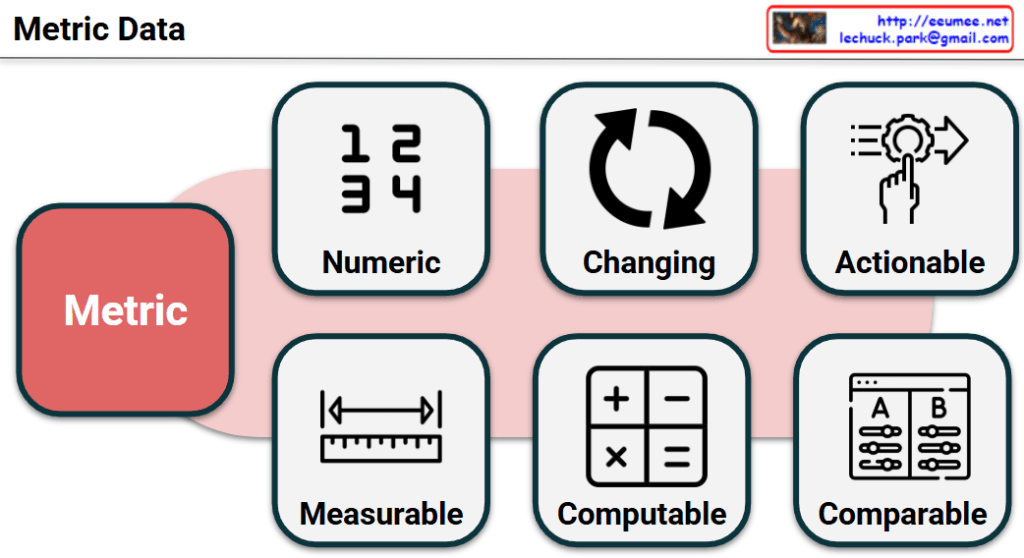
This image visually and intuitively defines the “6 Core Criteria of a Good Metric.” It effectively encompasses both the technical properties of the data itself and its practical value in a business context.

๐Ÿ“Š The 6 Core Elements of a Metric

1. Data Foundation

  • Numeric: Represented by the 1 2 3 4 icon. A metric must be expressed as objective, quantifiable numbers rather than subjective feelings or qualitative text.
  • Measurable: Represented by the ruler icon. The data must be accurately collected and tracked using systems, logs, or measurement tools.

2. Data Processing

  • Changing: Represented by the refresh arrows icon. A metric is not a fixed constant; it must dynamically fluctuate over time, environments, or in response to user actions.
  • Computable: Represented by the calculator icon. You should be able to process raw data using mathematical operations (addition, division, ratios) to derive a meaningful value.

3. Business Value

  • Actionable: Represented by the hand adjusting a gear icon. A good metric should not just be “nice to know.” It must drive concrete actions, strategic adjustments, or immediate decision-making to improve a system or service.
  • Comparable: Represented by the A/B panel icon. A metric gains its true meaning when evaluated against past data (e.g., month-over-month), target goals, or different user cohorts (A/B testing) to diagnose current performance.

๐Ÿ’ก Summary

Overall, this slide provides an excellent framework that bridges the gap between data engineering (how data is collected and computed) and business strategy (how data drives decisions). It is a highly polished visual guide for defining ideal metrics!

#Metrics #KPI #BusinessIntelligence #DataStrategy #DataEngineering #ActionableInsights

With Gemini
Cloud Resource Management

From Claude with some prompting
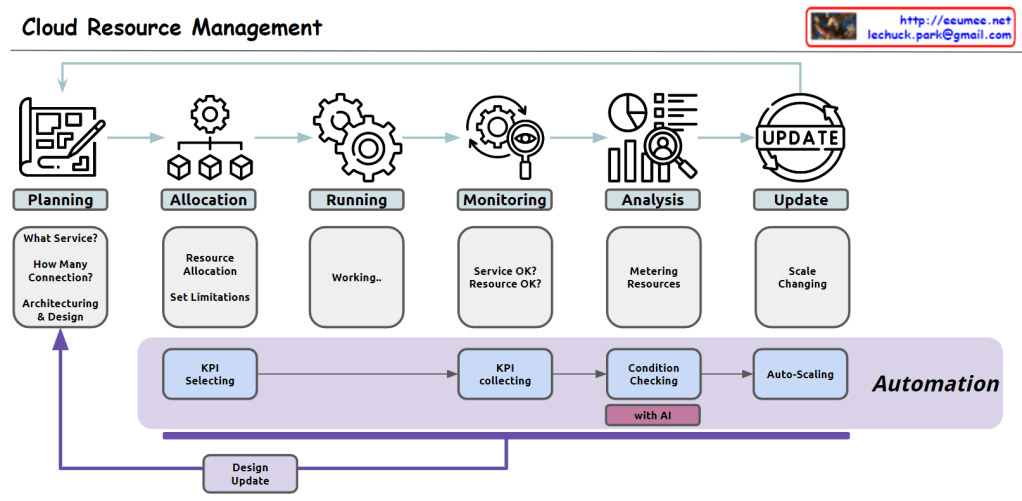
Here’s the comprehensive overview of cloud resource management in English:

  1. Planning:
    • Service selection: Determining appropriate cloud computing service types (e.g., virtual machines, containers, serverless)
    • Capacity forecasting: Estimating required resource scale based on expected traffic and workload
    • Architecture design: Designing system structure considering scalability, availability, and security
    • Infrastructure definition tool selection: Choosing tools for defining and managing infrastructure as code
  2. Allocation:
    • Resource provisioning: Creating and configuring necessary cloud resources using defined infrastructure code
    • Resource limitation setup: Configuring usage limits for CPU, memory, storage, network bandwidth, etc.
    • Access control configuration: Building a granular permission management system based on users, groups, and roles
  3. Running:
    • Application deployment management: Deploying and managing services through container orchestration tools
    • Automated deployment pipeline operation: Automating the process from code changes to production environment reflection
  4. Monitoring:
    • Real-time performance monitoring: Continuous collection and visualization of system and application performance metrics
    • Log management: Operating a centralized log collection, storage, and analysis system
    • Alert system setup: Configuring a system to send immediate notifications when performance metrics exceed thresholds
  5. Analysis:
    • Resource usage tracking: Analyzing cloud resource usage patterns and efficiency
    • Cost optimization analysis: Evaluating cost-effectiveness relative to resource usage and identifying areas for improvement
    • Performance bottleneck analysis: Identifying causes of application performance degradation and optimization points
  6. Update:
    • Dynamic resource adjustment: Implementing automatic scaling mechanisms based on demand changes
    • Zero-downtime update strategy: Applying methodologies for deploying new versions without service interruption
    • Security and patch management: Building automated processes for regularly checking and patching system vulnerabilities

Automation process:

  1. Key Performance Indicator (KPI) definition: Selecting key metrics reflecting system performance and business goals
  2. Data collection: Establishing a real-time data collection system for selected KPIs
  3. Intelligent analysis: Detecting anomalies and predicting future demand based on collected data
  4. Automatic optimization: Implementing a system to automatically adjust resource allocation based on analysis results

This approach enables efficient management of cloud resources, cost optimization, and continuous improvement of service stability and scalability.