Multi-DCs Operation with a LLM (2)

This diagram illustrates a Multi-Data Center Operation with LLM architecture system configuration.

Overall Architecture Components

Left Side – Event Sources:

  • Various systems supporting different event protocols (Log, Syslog, Trap, etc.) generating events

Middle – 3-Stage Processing Pipeline:

  1. Collector – Light Blue
    • Composed of Local Integrator and Integration Deliver
    • Collects and performs initial processing of all event messages
  2. Integrator – Dark Blue
    • Stores/manages event messages in databases and log files
    • Handles data integration and normalization
  3. Analyst – Purple
    • Utilizes LLM and AI for event analysis
    • Generates event/periodic or immediate analysis messages

Core Efficiency of LLM Operations Integration (Bottom 4 Features)

  • Already Installed: Leverages pre-analyzed logical results from existing alert/event systems, enabling immediate deployment without additional infrastructure
  • Highly Reliable: Alert messages are highly deterministic data that significantly reduce LLM error possibilities and ensure stable analysis results
  • Easy Integration: Uses pre-structured alert messages, allowing simple integration with various systems without complex data preprocessing
  • Nice LLM: Operates reliably based on verified alert data and provides an optimal strategy for rapidly applying advanced LLM technology

Summary

This architecture enables rapid deployment of advanced LLM technology by leveraging existing alert infrastructure as high-quality, deterministic input data. The approach minimizes AI-related risks while maximizing operational intelligence, offering immediate deployment with proven reliability.

With Claude
Multi-DCs Operation with a LLM (1)

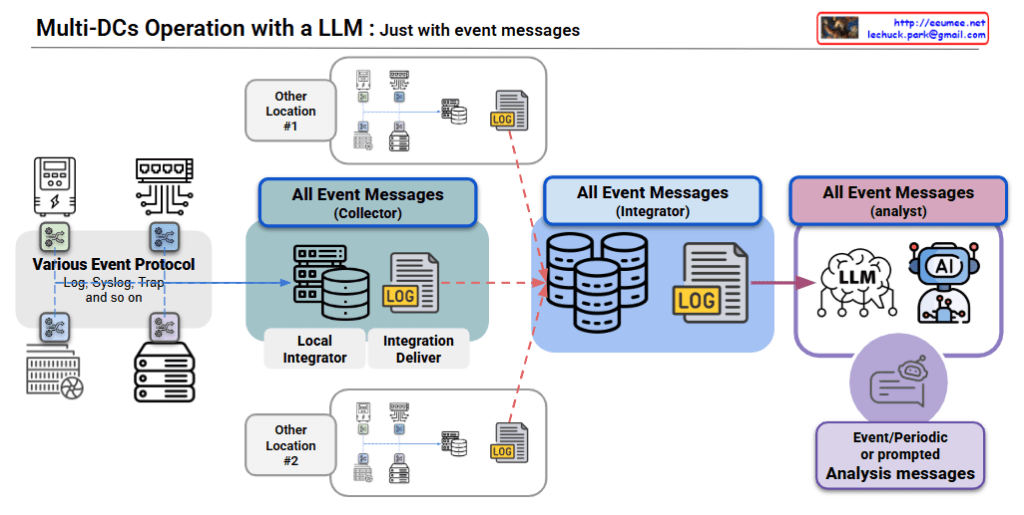
This diagram illustrates a Multi-Data Center Operations Architecture leveraging LLM (Large Language Model) with Event Messages.

Key Components

1. Data Collection Layer (Left Side)

  • Collects data from various sources through multiple event protocols (Log, Syslog, Trap, etc.)
  • Gathers event data from diverse servers and network equipment

2. Event Message Processing (Center)

  • Collector: Comprises Local Integrator and Integration Deliver to process event messages
  • Integrator: Manages and consolidates event messages in a multi-database environment
  • Analyst: Utilizes AI/LLM to analyze collected event messages

3. Multi-Location Support

  • Other Location #1 and #2 maintain identical structures for event data collection and processing
  • All location data is consolidated for centralized analysis

4. AI-Powered Analysis (Right Side)

  • LLM: Intelligently analyzes all collected event messages
  • Event/Periodic or Prompted Analysis Messages: Generates automated alerts and reports based on analysis results

System Characteristics

This architecture represents a modern IT operations management solution that monitors and manages multi-data center environments using event messages. The system leverages LLM technology to intelligently analyze large volumes of log and event data, providing operational insights for enhanced data center management.

The key advantage is the unified approach to handling diverse event streams across multiple locations while utilizing AI capabilities for intelligent pattern recognition and automated response generation.

With Claude

Basic of Reasoning

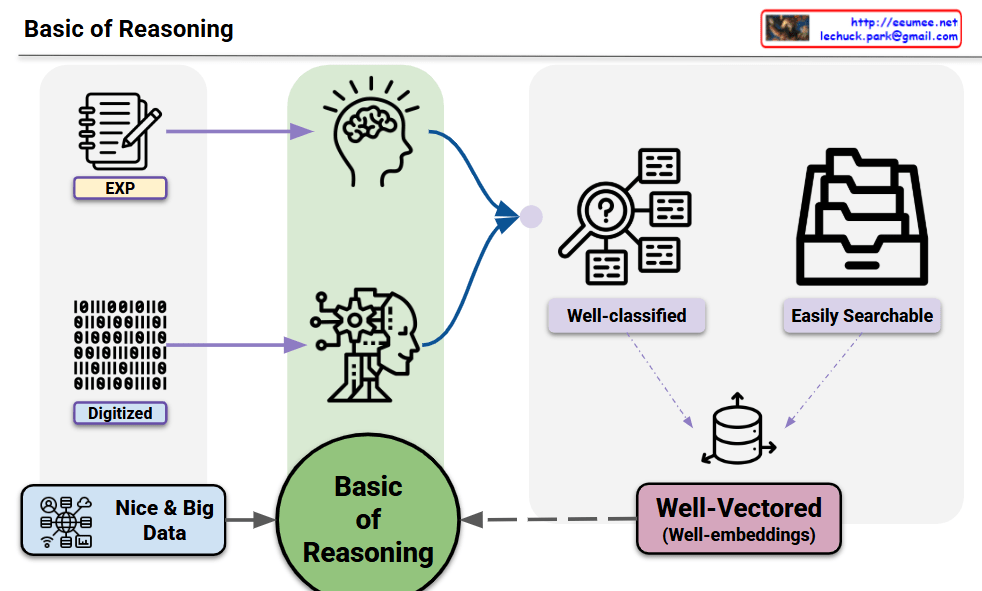
This diagram illustrates that human reasoning and AI reasoning share fundamentally identical structures.

Key Insights:

Common Structure Between Human and AI:

  • Human Experience (EXP) = Digitized Data: Human experiential knowledge and AI’s digital data are essentially the same information in different representations
  • Both rely on high-quality, large-scale data (Nice & Big Data) as their foundation

Shared Processing Pipeline:

  • Both human brain (intuitive thinking) and AI (systematic processing) go through the same Basic of Reasoning process
  • Information gets well-classified and structured to be easily searchable
  • Finally transformed into well-vectorized embeddings for storage

Essential Components for Reasoning:

  1. Quality Data: Whether experience or digital information, sufficient and high-quality data is crucial
  2. Structure: Systematic classification and organization of information
  3. Vectorization: Conversion into searchable and associative formats

Summary: This diagram demonstrates that effective reasoning – whether human or artificial – requires the same fundamental components: quality data and well-structured, vectorized representations. The core insight is that human experiential learning and AI data processing follow identical patterns, both culminating in structured knowledge storage that enables effective reasoning and retrieval.

Bitnet

BitNet Architecture Analysis

Overview

BitNet is an innovative neural network architecture that achieves extreme efficiency through ultra-low precision quantization while maintaining model performance through strategic design choices.

Key Features

1. Ultra-Low Precision (1.58-bit)

  • Uses only 3 values: {-1, 0, +1} for weights
  • Entropy calculation: log₂(3) ≈ 1.58 bits
  • More efficient than standard 2-bit (4 values) representation

2. Weight Quantization

  • Ternary weight system with correlation-based interpretation:
    • +1: Positive correlation
    • -1: Negative correlation
    • 0: No relation

3. Multi-Layer Structure

  • Leverages combinatorial power of multi-layer architecture
  • Enables non-linear function approximation despite extreme quantization

4. Precision-Targeted Operations

  • Minimizes high-precision operations
  • Combines 8-bit activation (input data) with 1.58-bit weights
  • Precise activation functions where needed

5. Hardware & Kernel Optimization

  • CPU (ARM) kernel-level optimization
  • Leverages bitwise operations (especially multiply → bit operations)
  • Memory management through SIMD instructions
  • Supports non-standard nature of 1.58-bit data

6. Token Relationship Computing

  • Single token uses N weights of {1, -1, 0} to calculate relationships with all other tokens

Summary

BitNet represents a breakthrough in neural network efficiency by using extreme weight quantization (1.58-bit) that dramatically reduces memory usage and computational complexity while preserving model performance through hardware-optimized bitwise operations and multi-layer combinatorial representation power.

With Claude

Massive simple parallel computing

This diagram presents a systematic framework that defines the essence of AI LLMs as “Massive Simple Parallel Computing” and systematically outlines the resulting issues and challenges that need to be addressed.

Core Definition of AI LLM: “Massive Simple Parallel Computing”

Massive: Enormous scale with billions of parameters Simple: Fundamentally simple computational operations (matrix multiplications, etc.) Parallel: Architecture capable of simultaneous parallel processing Computing: All of this implemented through computational processes

Core Issues Arising from This Essential Nature

Big Issues:

  • Black-box unexplainable: Incomprehensibility due to massive and complex interactions
  • Energy-intensive: Enormous energy consumption inevitably arising from massive parallel computing

Essential Requirements Therefore Needed

Very Required:

  • Verification: Methods to ensure reliability of results given the black-box characteristics
  • Optimization: Approaches to simultaneously improve energy efficiency and performance

The Ultimate Question: “By What?”

How can we solve all these requirements?

In other words, this framework poses the fundamental question about specific solutions and approaches to overcome the problems inherent in the essential characteristics of current LLMs. This represents a compressed framework showing the core challenges for next-generation AI technology development.

The diagram effectively illustrates how the defining characteristics of LLMs directly lead to significant challenges, which in turn demand specific capabilities, ultimately raising the critical question of implementation methodology.

With Claude

From RNN to Transformer

Visual Analysis: RNN vs Transformer

Visual Structure Comparison

RNN (Top): Sequential Chain

  • Linear flow: Circular nodes connected left-to-right
  • Hidden states: Each node processes sequentially
  • Attention weights: Numbers (2,5,11,4,2) show token importance
  • Bottleneck: Must process one token at a time

Transformer (Bottom): Parallel Grid

  • Matrix layout: 5×5 grid of interconnected nodes
  • Self-attention: All tokens connect to all others simultaneously
  • Multi-head: 5 parallel attention heads working together
  • Position encoding: Separate blue boxes handle sequence order

Key Visual Insights

Processing Pattern

  • RNN: Linear chain → Sequential dependency
  • Transformer: Interconnected grid → Parallel freedom

Information Flow

  • RNN: Single path with accumulating states
  • Transformer: Multiple simultaneous pathways

Attention Mechanism

  • RNN: Weights applied to existing sequence
  • Transformer: Direct connections between all elements

Design Effectiveness

The diagram succeeds by using:

  • Contrasting layouts to show architectural differences
  • Color coding to highlight attention mechanisms
  • Clear labels (“Sequential” vs “Parallel Processing”)
  • Visual metaphors that make complex concepts intuitive

The grid vs chain visualization immediately conveys why Transformers enable faster, more scalable processing than RNNs.

Summary

This diagram effectively illustrates the fundamental shift from sequential to parallel processing in neural architecture. The visual contrast between RNN’s linear chain and Transformer’s interconnected grid clearly demonstrates why Transformers revolutionized AI by enabling massive parallelization and better long-range dependencies.

With Claude

ALL to LLM

This image is an architecture diagram titled “ALL to LLM” that illustrates the digital transformation of industrial facilities and AI-based operational management systems.

Left Section (Industrial Equipment):

  • Cooling tower (cooling system)
  • Chiller (refrigeration/cooling equipment)
  • Power transformer (electrical power conversion equipment)
  • UPS (Uninterruptible Power Supply)

Central Processing:

  • Monitor with gears: Equipment data collection and preprocessing system
  • Dashboard interface: “All to Bit” analog-to-digital conversion interface
  • Bottom gears and human icon: Manual/automated operational system management

Right Section (AI-based Operations):

  • Purple area with binary code (0s and 1s): All facility data converted to digital bit data
  • Robot icons: LLM-based automated operational systems
  • Document/analysis icons: AI analysis results and operational reports

Overall, this diagram represents the transformation from traditional manual or semi-automated industrial facility operations to a fully digitized system where all operational data is converted to bit-level information and managed through LLM-powered intelligent facility management and predictive maintenance in an integrated operational system.

With Claude