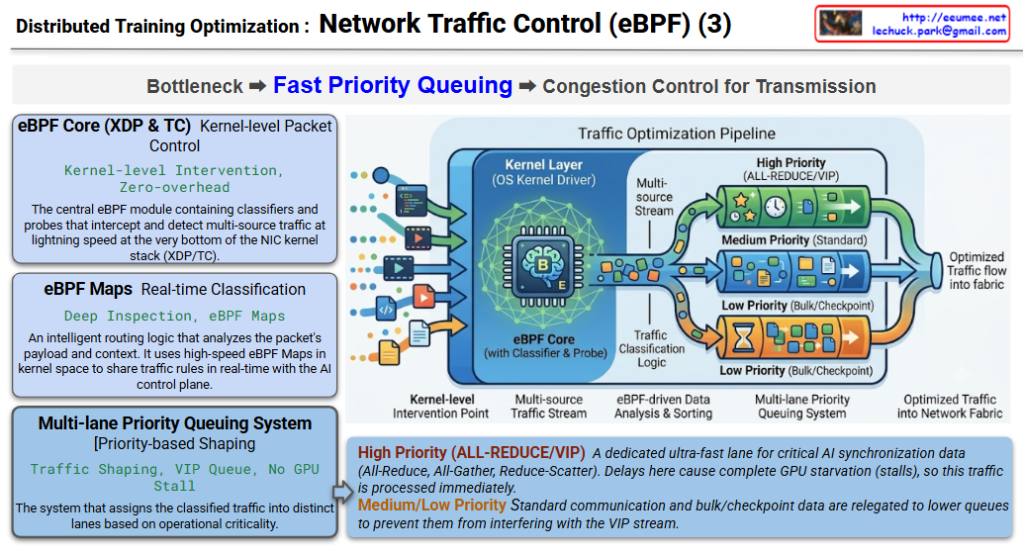
eBPF Traffic Controller Core Technologies

This section illustrates the control phase where mixed application traffic (Multi-source Stream) is intercepted at the lowest level of the OS, analyzed, and sorted into multiple lanes based on priority to ensure an optimized traffic flow into the network fabric.

  • eBPF Core (XDP & TC) [Kernel-level Packet Control]
    • Keywords: Kernel-level Intervention, Zero-overhead
    • Core: The central eBPF module containing classifiers and probes that intercept and detect multi-source traffic at lightning speed at the very bottom of the NIC kernel stack (XDP/TC).
  • Traffic Classification Logic (Powered by eBPF Maps) [Real-time Classification]
    • Keywords: Deep Inspection, eBPF Maps
    • Core: An intelligent routing logic that analyzes the packet’s payload and context. It uses high-speed eBPF Maps in kernel space to share traffic rules in real-time with the AI control plane.
  • Multi-lane Priority Queuing System [Priority-based Shaping]
    • Keywords: Traffic Shaping, VIP Queue, No GPU Stall
    • Core: The system that assigns the classified traffic into distinct lanes based on operational criticality.
      • High Priority (ALL-REDUCE/VIP): A dedicated ultra-fast lane for critical AI synchronization data (All-Reduce, All-Gather, Reduce-Scatter). Delays here cause complete GPU starvation (stalls), so this traffic is processed immediately.
      • Medium/Low Priority: Standard communication and bulk/checkpoint data are relegated to lower queues to prevent them from interfering with the VIP stream.

📝 Summary (Summary)

The eBPF Traffic Controller acts as an intelligent traffic cop inside the OS kernel. By identifying potential bottlenecks early and aggressively steering vital collective communication data (like All-Reduce) into Fast Priority Queues (VIP), it completely eliminates GPU starvation and ensures continuous, high-efficiency model training.

#eBPF #TrafficController #XDP_TC #PriorityQueuing #ZeroGPUStall #AllReduce #AllGather #NetworkOptimization

With Gemini
Distributed Training Optimization : Network Traffic Control (eBPF)

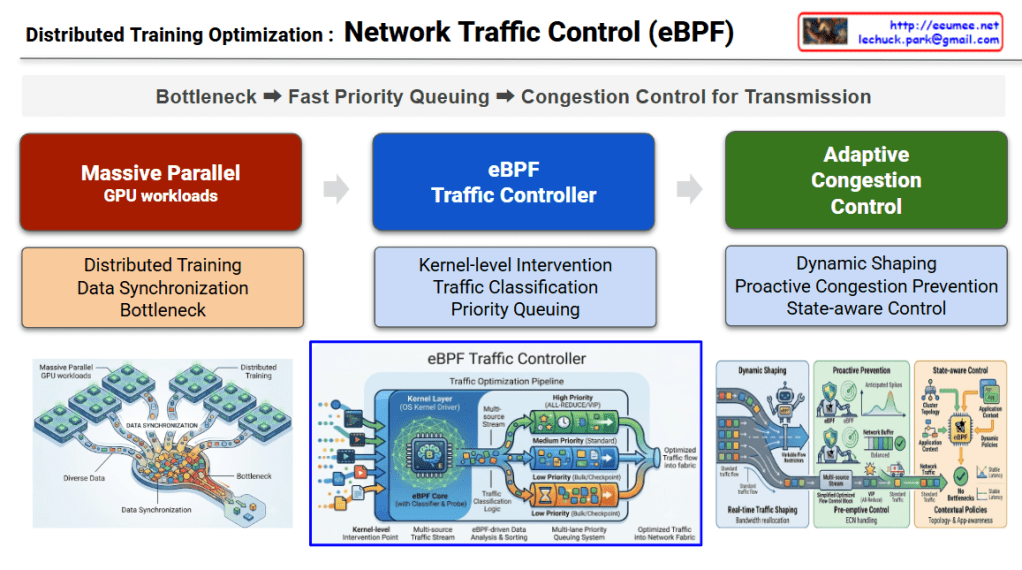
The diagram, titled “Distributed Training Optimization: Network Traffic Control,” outlines a core 3-stage optimization pipeline. It logically unfolds the process of identifying and solving the problem following the top flow path: Bottleneck ➡️ Fast Priority Queuing ➡️ Congestion Control for Transmission.

1. Massive Parallel GPU Workloads

  • Visual Description: The red section on the left and the illustration below it depict “Diverse Data” pouring out from multiple GPU cluster nodes and converging into a single, narrow bottleneck.
  • Core Meaning: It illustrates the Data Synchronization traffic that is essential during the Distributed Training of AI models. It structurally highlights the inevitable network bottleneck that occurs when countless GPUs attempt to exchange computational results simultaneously.

2. eBPF Traffic Controller

  • Visual Description: The central blue section introduces the core control engine designed to resolve the aforementioned bottleneck. The lower illustration shows complex traffic being neatly sorted into three pipes (priority lanes) at the OS Kernel Driver layer.
  • Core Meaning: It demonstrates Kernel-level Intervention, allowing access to network packets without massive overhead. Following the Traffic Classification logic, the system implements Priority Queuing: mission-critical traffic directly affecting training speed (like All-Reduce) is routed to the top ‘High Priority (VIP)’ queue, while standard storage traffic goes to the ‘Low Priority’ queue.

3. Adaptive Congestion Control

  • Visual Description: The green section on the right depicts the dynamic management of queued traffic as it is transmitted into the actual network fabric. The illustration shows eBPF agents adjusting valves in real-time (Dynamic Shaping), predicting and preventing network spikes (Proactive Prevention), and maintaining stable traffic flow based on the overall application context (State-aware Control).
  • Core Meaning: Beyond simple prioritization, it proactively monitors network switch buffer states and overall infrastructure congestion to flexibly adjust transmission rates. Ultimately, this creates a flawless, optimized data flow with zero latency.

📝 Summary

This diagram visualizes the complete pipeline for maximizing communication efficiency in AI data centers. To resolve the inevitable network bottlenecks caused by AI distributed training, it introduces an eBPF-based traffic controller operating at the lowest kernel level to prioritize traffic, and executes adaptive congestion control reflecting real-time network states to ensure seamless data transmission.

#AIDataCenter #eBPF #DistributedTraining #TrafficControl #InfrastructureEngineering #GPUCluster #AIOps #NetworkOptimization

With Gemini