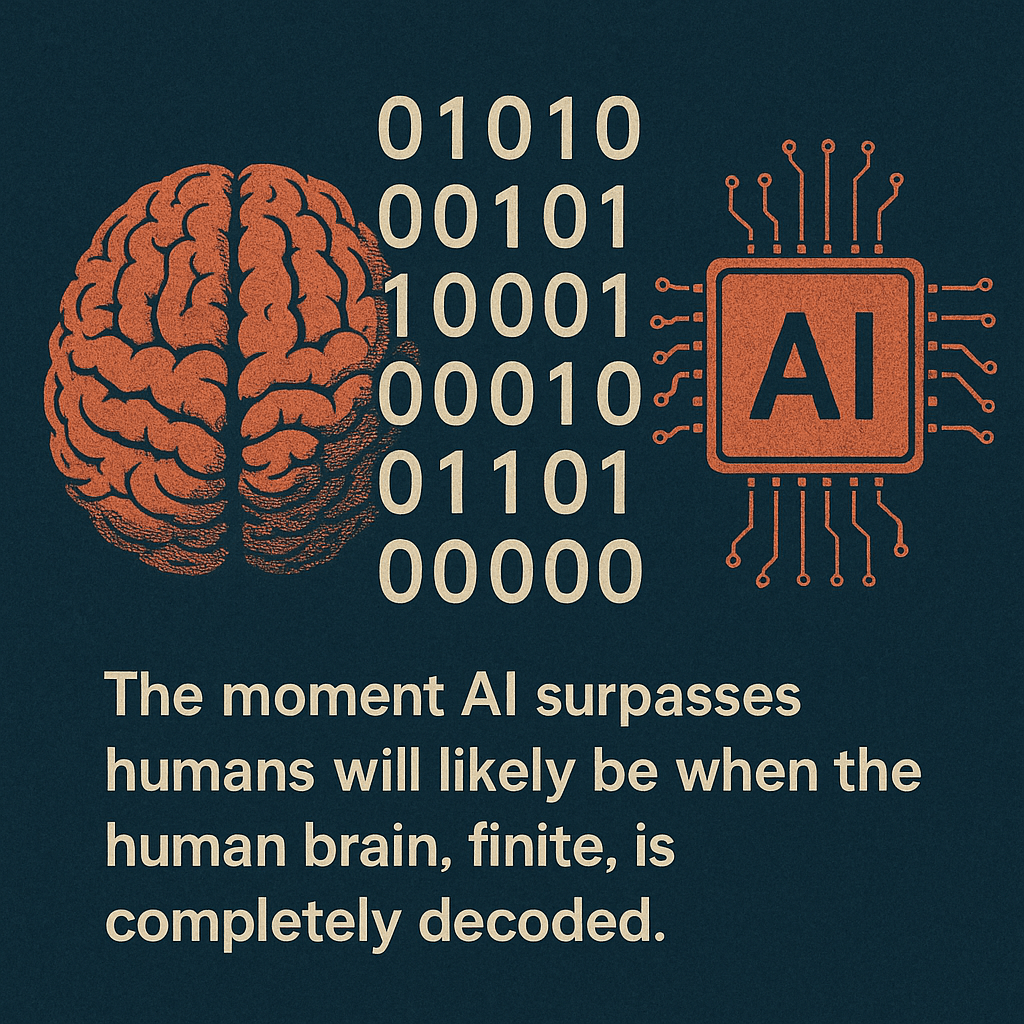
The moment AI surpasses humans will come only if the human brain is proven to be finite. If every neural connection, every thought pattern, and every emotional process can be fully analyzed and translated into code, then AI, with its capacity to process and optimize those codes, can ultimately transcend human capability. But if the human brain contains layers of complexity that are infinite or fundamentally unquantifiable, then no matter how advanced AI becomes, it will always fall short of complete understanding—and thus remain behind
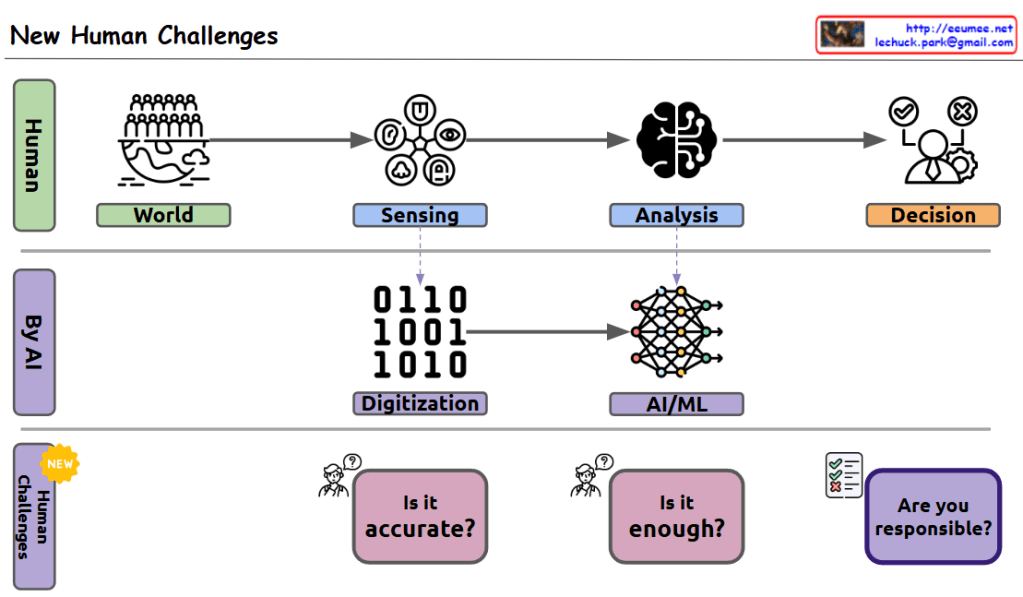
This image titled “New Human Challenges” illustrates the paradigm shift in information processing in the AI era and the new roles humans must assume.
The diagram is structured in three tiers:
Human (top row): Shows the traditional human information processing flow. Humans sense information from the “World,” perform “Analysis” using the brain, and make final “Decisions” based on this analysis.
By AI (middle row): In the modern technological environment, information from the world is “Digitized” into binary code, and this data is then processed through “AI/ML” systems.
Human Challenges (bottom row): Highlights three key challenges humans face in the AI era:
“Is it accurate?” – Verifying the quality and integrity of data collection processes
“Is it enough?” – Ensuring the trained data is sufficient and balanced to reflect all perspectives
“Are you responsible?” – Reflecting on whether humans can take ultimate responsibility for decisions suggested by AI
This diagram effectively demonstrates how the information processing paradigm has shifted from human-centered to AI-assisted systems, transforming the human role from direct information processors to supervisors and accountability holders for AI systems. Humans now face new challenges focused on ensuring data quality, data sufficiency and balance, and taking responsibility for final decision-making.
This illustration visually represents the philosophical exploration of the relationship between humans and technology, particularly AI. It emphasizes how technological advancements may narrow the gap between humans and machines, yet a fundamental difference will always persist. The concept of “reducing infinity” is depicted, showing that while AI can become more human-like, it can never be entirely the same. Ultimately, the image highlights that despite technological evolution, human judgment remains irreplaceable in final decision-making.
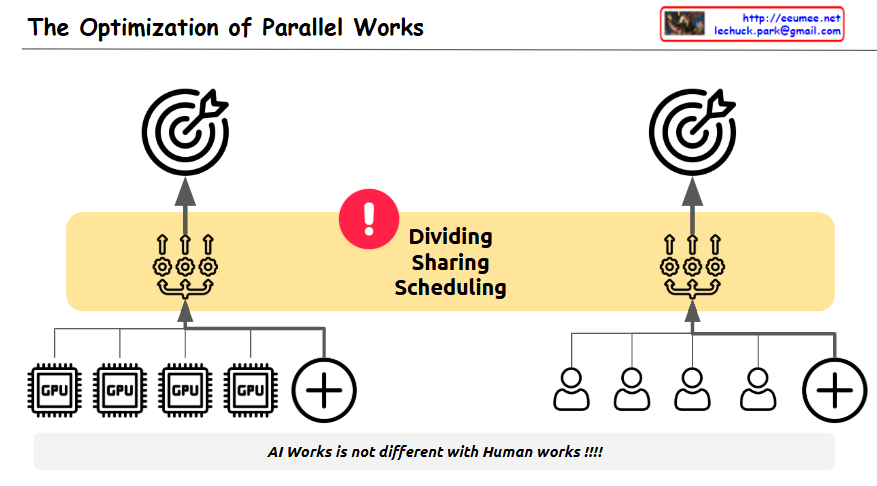
The image illustrates “The Optimization of Parallel Works,” highlighting the inherent challenges in optimizing parallel processing tasks.
The diagram cleverly compares two parallel systems:
Left side: Multiple CPU processors working in parallel
Right side: Multiple humans working in parallel
The central yellow band emphasizes three critical challenges in both systems:
Dividing (splitting tasks appropriately)
Sharing (coordinating resources and information)
Scheduling (timing and sequencing activities)
Each side shows a target/goal at the top, representing the shared objective that both computational and human systems strive to achieve.
The exclamation mark in the center draws attention to these challenges, while the message at the bottom states: “AI Works is not different with Human works!!!!” – emphasizing that the difficulties in coordinating independent processors toward a unified goal are similar whether we’re talking about computer processors or human teams.
The diagram effectively conveys that just as it’s difficult for people to work together toward a single objective, optimizing independent parallel processes in computing faces similar coordination challenges – requiring careful attention to division of labor, resource sharing, and timing to achieve optimal results.
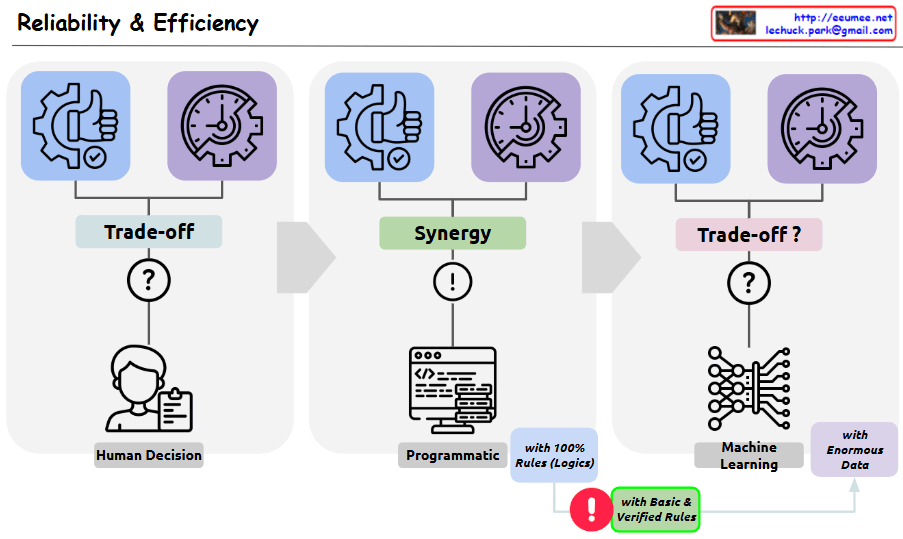
This image is a diagram showing the relationship between Reliability and Efficiency. Three different decision-making approaches are compared:
First section – “Trade-off”:
Shows Human Decision making
Indicates there is a trade-off relationship between reliability and efficiency
Displays a question mark (?) symbol representing uncertainty
Second section – “Synergy”:
Shows a Programmatic approach
Labeled as using “100% Rules (Logic)”
Indicates there is synergy between reliability and efficiency
Features an exclamation mark (!) symbol representing certainty
Third section – “Trade-off?”:
Shows a Machine Learning approach
Labeled as using “Enormous Data”
Questions whether the relationship between reliability and efficiency is again a trade-off
Displays a question mark (?) symbol representing uncertainty
Importantly, the “Basic & Verified Rules” section at the bottom presents a solution to overcome the indeterminacy (probabilistic nature and resulting trade-offs) of machine learning. It emphasizes that the rules forming the foundation of machine learning systems should be simple and clearly verifiable. By applying these basic and verified rules, the uncertainty stemming from the probabilistic nature of machine learning can be reduced, suggesting an improved balance between reliability and efficiency.
Beginning of human civilization and knowledge accumulation
Formation of foundational civilizations
Human intellectual capacity and creativity as key drivers
The foundation for all future developments
The History Log (Data)
Systematic storage and management of accumulated knowledge
Digitalization of information leading to quantitative and qualitative growth
Acceleration of knowledge sharing and dissemination
Bridge between human intelligence and artificial intelligence
The Logic Calculation (AI)
Logical computation and processing based on accumulated data
New dimensions of data utilization through AI technology
Automated decision-making and problem-solving through machine learning and deep learning
Represents the current frontier of human technological achievement
What’s particularly noteworthy is the exponential growth curve shown in the graph. This exponential pattern indicates that each stage builds upon the achievements of the previous one, leading to accelerated development. The progression from human intellectual activity through data accumulation and management, ultimately leading to AI-driven innovation, shows a dramatic increase in the pace of advancement.
This developmental process is significant because:
Each stage is interconnected rather than independent
Previous stages form the foundation for subsequent developments
The rate of progress increases exponentially over time
Each phase represents a fundamental shift in how we process and utilize information
This timeline effectively illustrates how human civilization has evolved from basic knowledge creation to data management, and finally to AI-powered computation, with each stage marking a significant leap in our technological and intellectual capabilities.
Humans are affected by numerous external factors such as food, sleep, family, and work, causing distractions and fatigue, whereas AI operates solely based on its predefined purpose, continuously performing the same task as long as it has power.