Overcome the Infinite

Overcome the Infinite – Game Interface Analysis

Overview

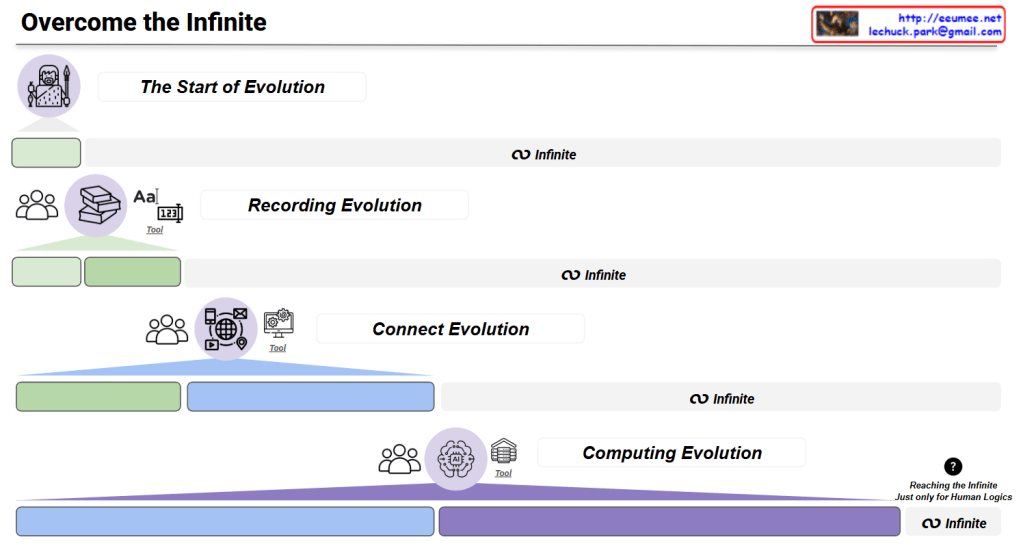
This image presents a philosophical game interface titled “Overcome the Infinite” that chronicles the evolutionary journey of human civilization through four revolutionary stages of innovation.

Game Structure

Stage 1: The Start of Evolution

  • Icon: Primitive human figure
  • Description: The beginning of human civilization and consciousness

Stage 2: Recording Evolution

  • Icon: Books and writing materials
  • Innovation: The revolution of knowledge storage through numbers, letters, and books
  • Significance: Transition from oral tradition to written documentation, enabling permanent knowledge preservation

Stage 3: Connect Evolution

  • Icon: Network/internet symbols with people
  • Innovation: The revolution of global connectivity through computers and the internet
  • Significance: Worldwide information sharing and communication breakthrough

Stage 4: Computing Evolution

  • Icon: AI/computing symbols with data centers
  • Innovation: The revolution of computational processing through data centers and artificial intelligence
  • Significance: The dawn of the AI era and advanced computational capabilities

Progress Indicators

  • Green and blue progress bars show advancement through each evolutionary stage
  • Each stage maintains the “∞ Infinite” symbol, suggesting unlimited potential at every level

Philosophical Message

“Reaching the Infinite Just only for Human Logics” (Bottom right)

This critical message embodies the game’s central philosophical question:

  • Can humanity truly overcome or reach the infinite through these innovations?
  • Even if we approach the infinite, it remains constrained within the boundaries of human perception and logic
  • Represents both technological optimism and humble acknowledgment of human limitations

Theme

The interface presents a contemplative journey through human technological evolution, questioning whether our innovations truly bring us closer to transcending infinite boundaries, or merely expand the scope of our human-limited understanding.

With Claude

AI Core Internals (1+4)

This image is a diagram titled “AI Core Internals (1+4)” that illustrates the core components of an AI system and their interconnected relationships.

The diagram contains 5 main components:

  1. Data – Located in the top left, represented by database and document icons.
  2. Hardware Infra – Positioned in the top center, depicted with a CPU/chipset icon with radiating connections.
  3. Foundation(AI) Model – Located in the top right, shown as an AI network node with multiple connection points.
  4. Energy Infra – Positioned at the bottom, represented by wind turbine and solar panel icons.
  5. User Group – On the far right, depicted as a collection of diverse people icons in various colors.

The arrows show the flow and connections between components:

  • From Data to Hardware Infrastructure
  • From Hardware Infrastructure to the AI Model
  • From the AI Model to end users
  • From Energy Infrastructure to Hardware Infrastructure (power supply)

This diagram visually explains how modern AI systems integrate data, computing hardware, AI models, and energy infrastructure to deliver services to end users. It effectively demonstrates the interdependent ecosystem required for AI operations, highlighting both the technical components (data, hardware, models) and the supporting infrastructure (energy) needed to serve diverse user communities.

With Claude

Human & Data with AI

Data Accumulation Perspective

History → Internet: All knowledge and information accumulated throughout human history is digitized through the internet and converted into AI training data. This consists of multimodal data including text, images, audio, and other formats.

Foundation Model: Large language models (LLMs) and multimodal models are pre-trained based on this vast accumulated data. Examples include GPT, BERT, CLIP, and similar architectures.

Human to AI: Applying Human Cognitive Patterns to AI

1. Chain of Thoughts

  • Implementation of human logical reasoning processes in the Reasoning stage
  • Mimicking human cognitive patterns that break down complex problems into step-by-step solutions
  • Replicating the human approach of “think → analyze → conclude” in AI systems

2. Mixture of Experts

  • AI implementation of human expert collaboration systems utilized in the Experts domain
  • Architecting the way human specialists collaborate on complex problems into model structures
  • Applying the human method of synthesizing multiple expert opinions for problem-solving into AI

3. Retrieval-Augmented Generation (RAG)

  • Implementing the human process of searching existing knowledge → generating new responses into AI systems
  • Systematizing the human approach of “reference material search → comprehensive judgment”

Personal/Enterprise/Sovereign Data Utilization

1. Personal Level

  • Utilizing individual documents, history, preferences, and private data in RAG systems
  • Providing personalized AI assistants and customized services

2. Enterprise Level

  • Integrating organizational internal documents, processes, and business data into RAG systems
  • Implementing enterprise-specific AI solutions and workflow automation

3. Sovereign Level

  • Connecting national or regional strategic data to RAG systems
  • Optimizing national security, policy decisions, and public services

Overall Significance: This architecture represents a Human-Centric AI system that transplants human cognitive abilities and thinking patterns into AI while utilizing multi-layered data from personal to national levels to evolve general-purpose AI (Foundation Models) into intelligent systems specialized for each level. It goes beyond simple data processing to implement human thinking methodologies themselves into next-generation AI systems.

With Claude

Human Vs AI

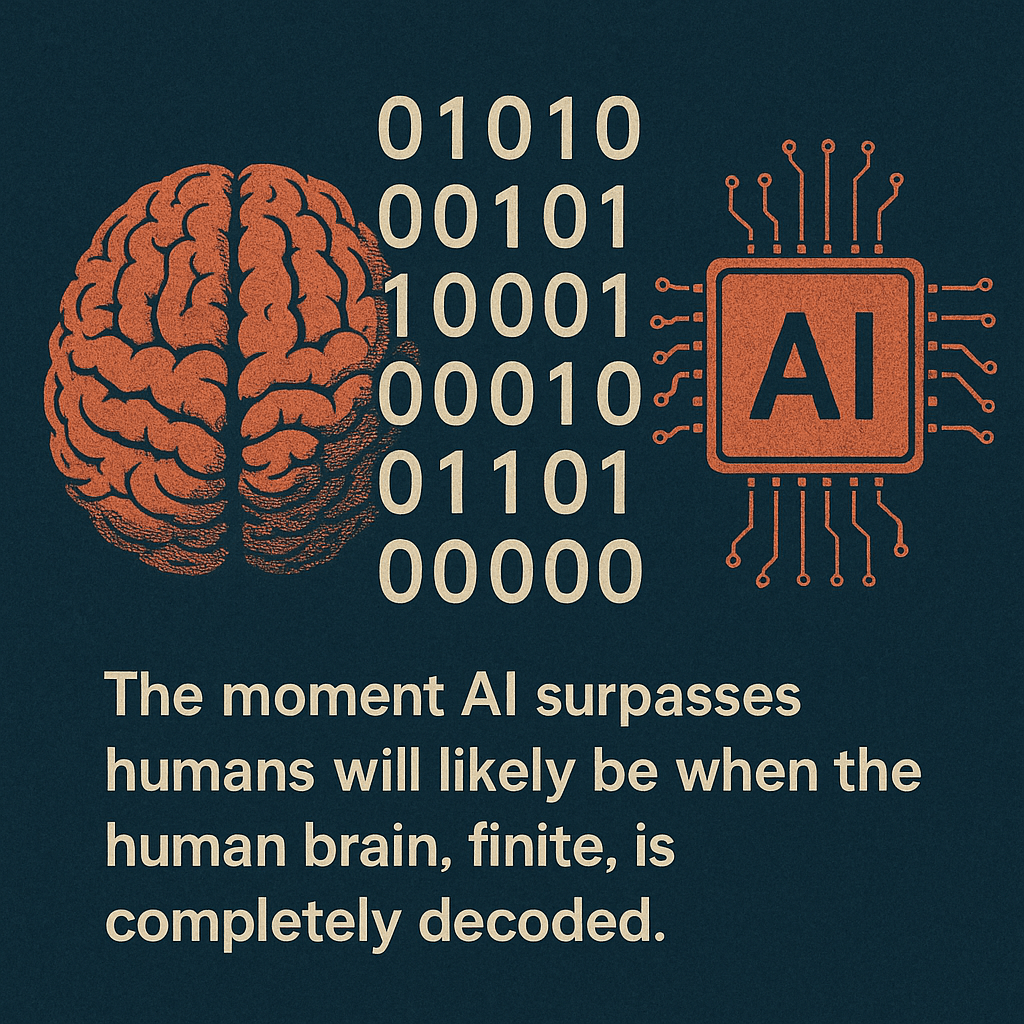
The moment AI surpasses humans will come only if the human brain is proven to be finite.
If every neural connection, every thought pattern, and every emotional process can be fully analyzed and translated into code, then AI, with its capacity to process and optimize those codes, can ultimately transcend human capability.
But if the human brain contains layers of complexity that are infinite or fundamentally unquantifiable, then no matter how advanced AI becomes, it will always fall short of complete understanding—and thus remain behind

New Human Challenges

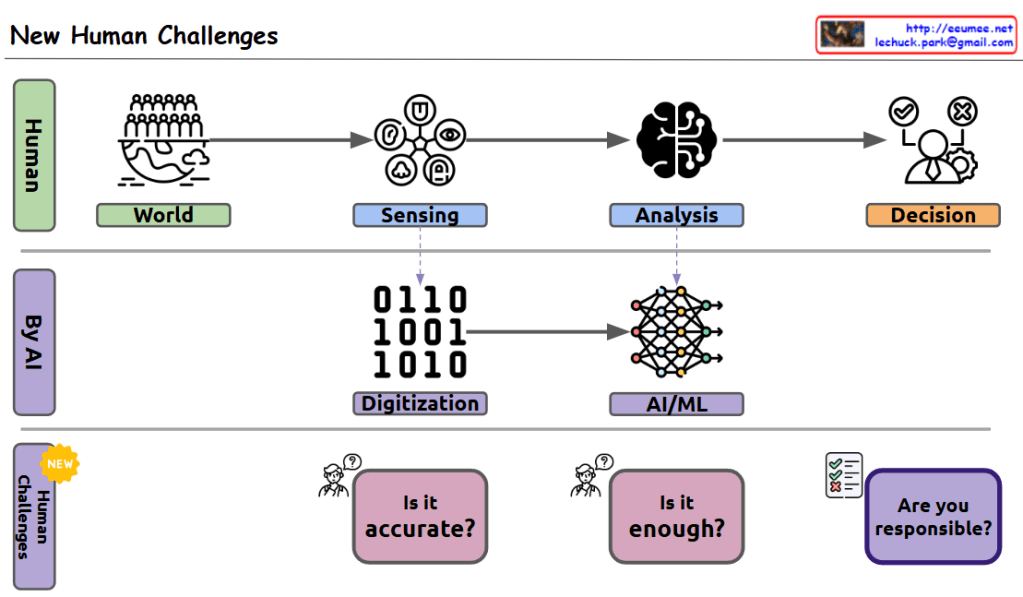
This image titled “New Human Challenges” illustrates the paradigm shift in information processing in the AI era and the new roles humans must assume.

The diagram is structured in three tiers:

  1. Human (top row): Shows the traditional human information processing flow. Humans sense information from the “World,” perform “Analysis” using the brain, and make final “Decisions” based on this analysis.
  2. By AI (middle row): In the modern technological environment, information from the world is “Digitized” into binary code, and this data is then processed through “AI/ML” systems.
  3. Human Challenges (bottom row): Highlights three key challenges humans face in the AI era:
    • “Is it accurate?” – Verifying the quality and integrity of data collection processes
    • “Is it enough?” – Ensuring the trained data is sufficient and balanced to reflect all perspectives
    • “Are you responsible?” – Reflecting on whether humans can take ultimate responsibility for decisions suggested by AI

This diagram effectively demonstrates how the information processing paradigm has shifted from human-centered to AI-assisted systems, transforming the human role from direct information processors to supervisors and accountability holders for AI systems. Humans now face new challenges focused on ensuring data quality, data sufficiency and balance, and taking responsibility for final decision-making.

With Claude

infinite Gap

This illustration visually represents the philosophical exploration of the relationship between humans and technology, particularly AI. It emphasizes how technological advancements may narrow the gap between humans and machines, yet a fundamental difference will always persist. The concept of “reducing infinity” is depicted, showing that while AI can become more human-like, it can never be entirely the same. Ultimately, the image highlights that despite technological evolution, human judgment remains irreplaceable in final decision-making.

With ChatGPT