E=mc2

From Claude with some prompting
This image provides an enhanced explanation of Einstein’s famous mass-energy equivalence equation E=mc². The key additions and contents are as follows:

  1. Units for each component have been added:
    • Energy (E): J (Joules), erg
    • Mass (m): Kg (kilograms), g (grams)
    • Celeritas (c): m/s (meters per second), cm/s (centimeters per second)
  2. Equations showing unit consistency have been included:
    • SI units: J = kg · (m/s)²
    • CGS units: erg = g · (cm/s)²
  3. The original explanations are maintained:
    • Mass: constant value that does not change, law of conservation of mass
    • Celeritas: The speed of light, “Real existence, least relativity, all same for any observer”
    • Overall equation: For understanding the relative if Mass and light, human measurements
  4. The etymology of Celeritas (from the Latin word meaning “speed” or “swiftness”) is retained.

These enhancements deepen the understanding of each component of the equation, particularly with the addition of units, which clarifies what units should be used in actual calculations. This provides crucial information for practical application and comprehension of the equation.

One Point

From Claude with some prompting
This image presents a concept diagram titled “One Point”. It illustrates the process from the smallest unit in the universe to human data collection.

Key elements include:

  1. “The Point”: Representing the smallest unit.
  2. “From the universe”:
    • Quantum: Symbolized by an atom icon
    • Energy: Depicted with a lightning bolt icon
  3. “Sensing”: Shown as a yellow arrow process
  4. “By Humans”:
    • “0 and 1”: Representing digital data
    • “Diff”: Likely indicating data processing
    • “Data”: The final output
  5. “gathering”: The process from 0 and 1 to Data

At the bottom, there’s an infinity symbol with the phrase “not much different (infinite by the view of micro & macro)”. This suggests little difference between microscopic and macroscopic perspectives.

AI DC Key

From Claude with some prompting
This image titled “AI DC Key” illustrates the key components of an AI data center. Here’s an interpretation of the diagram:

  1. On the left, there’s an icon representing “Massive Data”.
  2. The center showcases four core elements of AI:
    • “Super Power”
    • “Super Computing” (utilizing GPU)
    • “Super Cooling”
    • “Optimizing Operation”
  3. Below each core element, key considerations are listed:
    • Super Power: “Nature & Consistent”
    • Super Computing: “Super Parallel”
    • Super Cooling: “Liquid Cooling”
    • Optimizing Operation: “Data driven Auto & AI”
  4. On the right, an icon represents “Analyzed Data”.
  5. The overall flow illustrates the process of massive data being input, processed through the AI core elements, and resulting in analyzed data.

This diagram visualizes the essential components of a modern AI data center and their key considerations. It demonstrates how high-performance computing, efficient power management, advanced cooling technology, and optimized operations effectively process and analyze large-scale data, emphasizing the critical technologies or approaches for each element.

Who First

From ChatGPT with some prompting
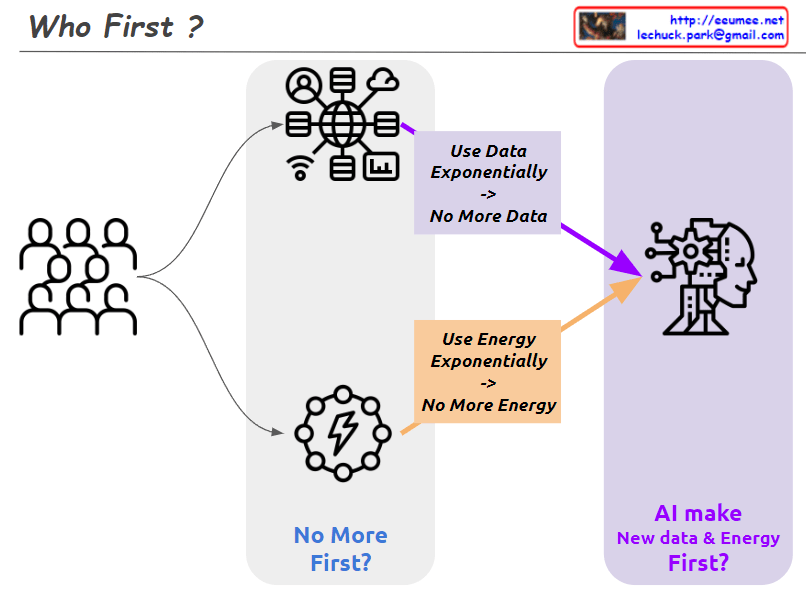
This image explores two potential scenarios related to the advancement of AI (Artificial Intelligence). It raises two main questions:

  1. Exponential Use of Data and Energy: The left side illustrates a scenario where data and energy created by humans are used exponentially by AI. This leads to the concern that data and energy might be depleted. It questions whether we will run out of data and energy first due to this exponential use.
  2. AI’s Self-Sufficiency: The right side presents the possibility that AI might be able to create new data and energy on its own. If AI can generate its own data and energy resources, it could overcome the problem of depletion.

Therefore, the image highlights a dilemma: on one hand, the rapid use of data and energy by AI might lead to their depletion, while on the other hand, AI might potentially find ways to create new data and energy to sustain itself. It questions which of these scenarios will happen first.

Data Center Efficiency Metric

From Claude with some prompting
This image is a diagram explaining “Data Center Efficiency Metrics.” It visually outlines various metrics that measure the efficiency of resource usage in data centers. The key metrics are as follows:

  1. ITUE (IT Utilization Effectiveness): Measures the ratio of useful output to input for IT equipment.
  2. PUE (Power Usage Effectiveness): Total power consumption (IT equipment and cooling systems) divided by IT equipment power consumption.
  3. DCIE (Data Center Infrastructure Efficiency): IT power divided by the sum of IT power and cooling power; it’s the inverse of PUE.
  4. WUE (Water Usage Effectiveness): Water usage divided by IT power.
  5. CUE (Carbon Usage Effectiveness): Total energy consumption multiplied by the carbon emission factor, measuring the data center’s carbon footprint.

The image also provides carbon emission factors for various energy sources (coal, natural gas, oil, wind, solar, KEPCO), showing how the energy source impacts carbon emissions.

This diagram helps data center operators comprehensively evaluate and improve their efficiency in terms of power, cooling, water usage, and carbon emissions. From my analysis, the content of this image is accurate and effectively explains the standard metrics for measuring data center efficiency.

Data is

From DALL-E with some prompting
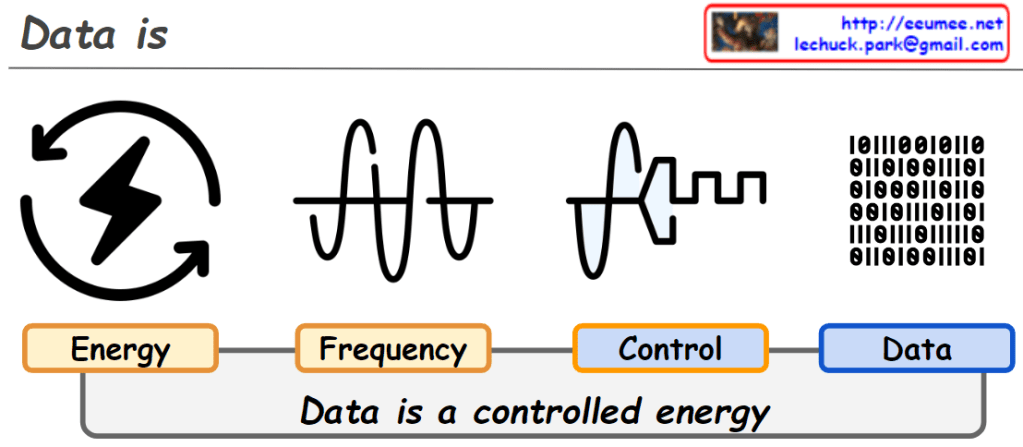
The image conveys the concept that data fundamentally stems from energy, which is harnessed and controlled to create meaningful information. It illustrates a progression from an energy symbol to a sine wave representing frequency, followed by a rectangular waveform symbolizing control, culminating in binary code blocks that represent data. The diagram encapsulates the idea that data is a form of controlled energy, systematically transformed to serve our purposes.

Digital = Energy

From DALL-E with some prompting
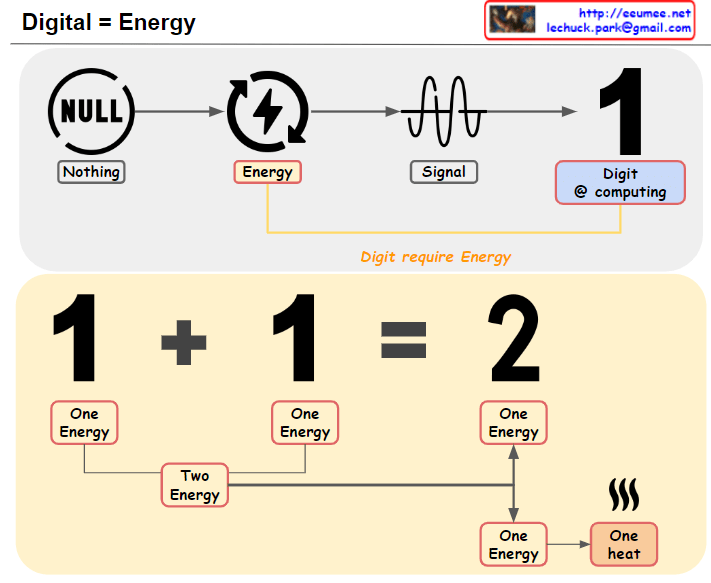
this image illustrates the concept that “Digital equals Energy.” The first row shows the transformation from ‘NULL’, which represents nothingness, into a signal through energy, and then into a digital ‘1’ for computing. The second row demonstrates that digital operations require energy by showing that adding ‘1’ and ‘1’ results in ‘2’, with each ‘1’ requiring a unit of energy and the process generating heat, indicating energy loss.