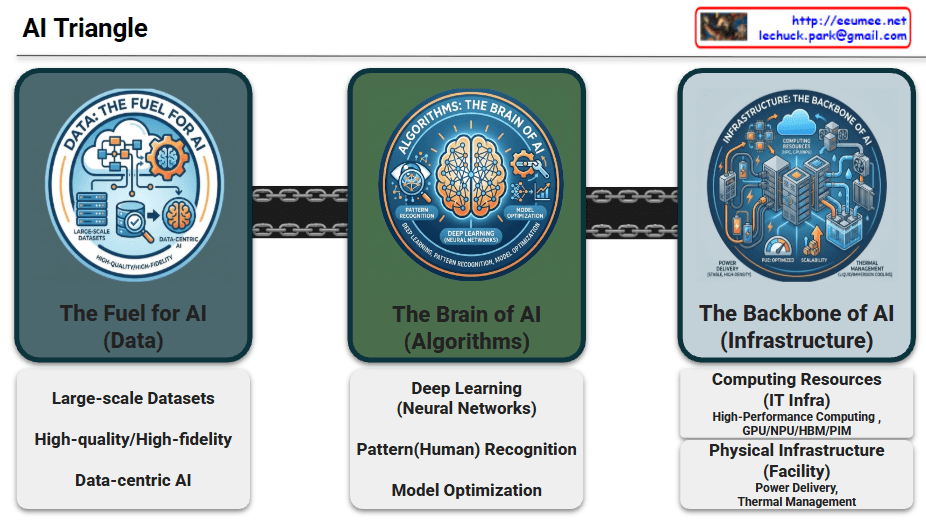
AI Triangle


๐Ÿ“ The AI Triangle: Core Pillars of Evolution

1. Data: The Fuel for AI

Data serves as the essential raw material that determines the intelligence and accuracy of AI models.

  • Large-scale Datasets: Massive volumes of information required for foundational training.
  • High-quality/High-fidelity: The emphasis on clean, accurate, and reliable data to ensure superior model performance.
  • Data-centric AI: A paradigm shift focusing on enhancing data quality rather than just iterating on model code.

2. Algorithms: The Brain of AI

Algorithms provide the logical framework and mathematical structures that allow machines to learn from data.

  • Deep Learning (Neural Networks): Multi-layered architectures inspired by the human brain to process complex information.
  • Pattern Recognition: The ability to identify hidden correlations and make predictions from raw inputs.
  • Model Optimization: Techniques to improve efficiency, reduce latency, and minimize computational costs.

3. Infrastructure: The Backbone of AI

The physical and digital foundation that enables massive computations and ensures system stability.

  • Computing Resources (IT Infra):
    • HPC & Accelerators: High-performance clusters utilizing GPUs, NPUs, and HBM/PIM for parallel processing.
  • Physical Infrastructure (Facilities):
    • Power Delivery: Reliable, high-density power systems including UPS, PDU, and smart energy management.
    • Thermal Management: Advanced cooling solutions like Liquid Cooling and Immersion Cooling to handle extreme heat from AI chips.
    • Scalability & PUE: Focus on sustainable growth and maximizing energy efficiency (Power Usage Effectiveness).

๐Ÿ“ Summary

  1. The AI Triangle represents the vital synergy between high-quality Data, sophisticated Algorithms, and robust Infrastructure.
  2. While data fuels the model and algorithms provide the logic, infrastructure acts as the essential backbone that supports massive scaling and operational reliability.
  3. Modern AI evolution increasingly relies on advanced facility management, specifically optimized power delivery and high-efficiency cooling, to sustain next-generation workloads.

#AITriangle #AIInfrastructure #DataCenter #DeepLearning #GPU #LiquidCooling #DataCentric #Sustainability #PUE #TechArchitecture

With Gemini

Parallelism (1) – Data , Expert

Parallelism Comparison: Data Parallelism vs Expert Parallelism

This image compares two major parallelization strategies used for training large language models (LLMs).

Left: Data Parallelism

Structure:

  • Data is divided into multiple batches from the database
  • Same complete model is replicated on each GPU
  • Each GPU independently processes different data batches
  • Results are aggregated to generate final output

Characteristics:

  • Scaling axis: Number of batches/samples
  • Pattern: Full model copy on each GPU, dense training
  • Communication: Gradient All-Reduce synchronization once per step
  • Advantages: Simple and intuitive implementation
  • Disadvantages: Model size must fit in single GPU memory

Right: Expert Parallelism

Structure:

  • Data is divided by layers
  • Tokens are distributed to appropriate experts through All-to-All network and router
  • Different expert models (A, B, C) are placed on each GPU
  • Parallel processing at block/thread level in GPU pool

Characteristics:

  • Scaling axis: Number of experts
  • Pattern: Sparse structure – only few experts activated per token
  • Goal: Maintain large capacity while limiting FLOPs per token
  • Communication: All-to-All token routing
  • Advantages: Can scale model capacity significantly (MoE – Mixture of Experts architecture)
  • Disadvantages: High communication overhead and complex load balancing

Key Differences

AspectData ParallelismExpert Parallelism
Model DivisionFull model replicationModel divided into experts
Data DivisionBatch-wiseLayer/token-wise
Communication PatternGradient All-ReduceToken All-to-All
ScalabilityProportional to data sizeProportional to expert count
EfficiencyDense computationSparse computation (conditional activation)

These two approaches are often used together in practice, enabling ultra-large-scale model training through hybrid parallelization strategies.


Summary

Data Parallelism replicates the entire model across GPUs and divides the training data, synchronizing gradients after each step – simple but memory-limited. Expert Parallelism divides the model into specialized experts and routes tokens dynamically, enabling massive scale through sparse activation. Modern systems combine both strategies to train trillion-parameter models efficiently.

#MachineLearning #DeepLearning #LLM #Parallelism #DistributedTraining #DataParallelism #ExpertParallelism #MixtureOfExperts #MoE #GPU #ModelTraining #AIInfrastructure #ScalableAI #NeuralNetworks #HPC

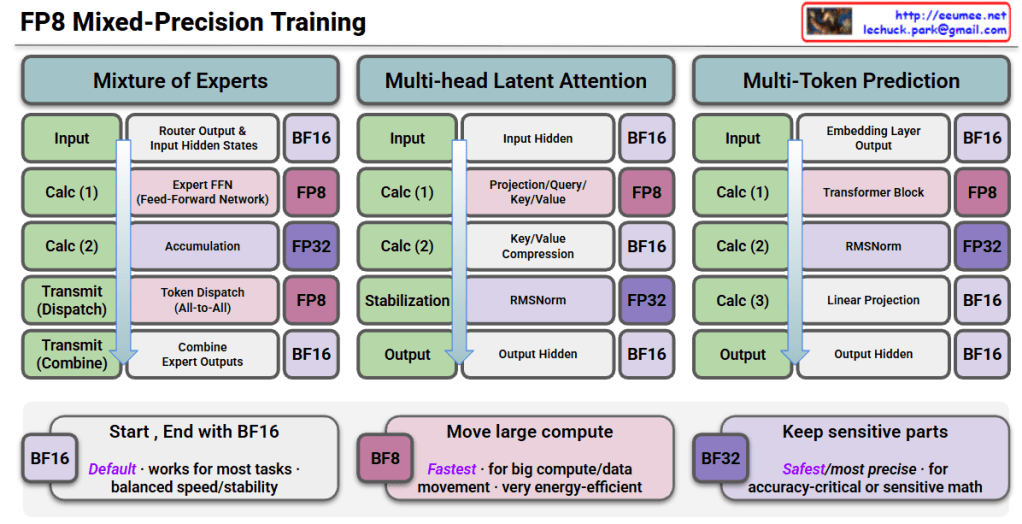
FP8 Mixed-Precision Training

FP8 Mixed-Precision Training Interpretation

This image is a technical diagram showing FP8 (8-bit Floating Point) Mixed-Precision Training methodology.

Three Main Architectures

1. Mixture of Experts (MoE)

  • Input: Starts with BF16 precision
  • Calc (1): Router output & input hidden states โ†’ BF16
  • Calc (2): Expert FFN (Feed-Forward Network) โ†’ FP8 computation
  • Calc (3): Accumulation โ†’ FP32
  • Transmit (Dispatch): Token dispatch (All-to-All) โ†’ FP8
  • Transmit (Combine): Combine expert outputs โ†’ BF16
  • Output: BF16

2. Multi-head Latent Attention

  • Input: BF16
  • Calc (1): Input hidden states โ†’ BF16
  • Calc (2): Projection/Query/Key/Value โ†’ FP8
  • Calc (3): Key/Value compression โ†’ BF16
  • Stabilization: RMSNorm โ†’ FP32
  • Output: Output hidden states โ†’ BF16

3. Multi-Token Prediction

  • Input: BF16
  • Calc (1): Embedding layer output โ†’ BF16
  • Calc (2): Transformer block โ†’ FP8
  • Calc (3): RMSNorm โ†’ FP32
  • Calc (4): Linear projection โ†’ BF16
  • Output: Output hidden states โ†’ BF16

Precision Strategy (Bottom Boxes)

๐ŸŸฆ BF16 (Default)

  • Works for most tasks
  • Balanced speed/stability

๐ŸŸช BF8 (Fastest)

  • For large compute/data movement
  • Very energy-efficient

๐ŸŸฃ BF32 (Safest/Most Precise)

  • For accuracy-critical or sensitive math operations

Summary

FP8 mixed-precision training strategically uses different numerical precisions across model operations: FP8 for compute-intensive operations (FFN, attention, transformers) to maximize speed and efficiency, FP32 for sensitive operations like accumulation and normalization to maintain numerical stability, and BF16 for input/output and communication to balance performance. This approach enables faster training with lower energy consumption while preserving model accuracy, making it ideal for training large-scale AI models efficiently.


#FP8Training #MixedPrecision #AIOptimization #DeepLearning #ModelEfficiency #NeuralNetworks #ComputeOptimization #MLPerformance #TransformerTraining #EfficientAI #LowPrecisionTraining #AIInfrastructure #MachineLearning #GPUOptimization #ModelTraining

With Claude

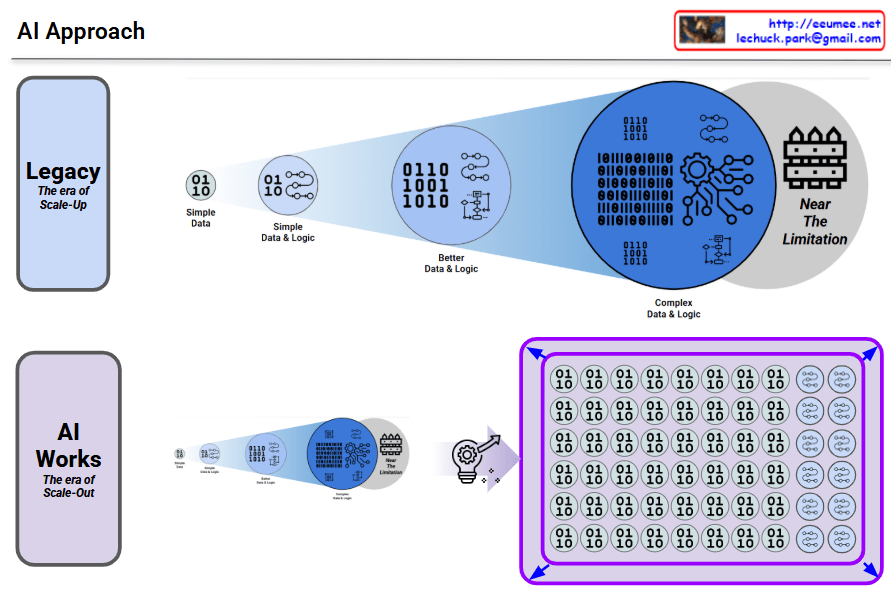
AI approach

Legacy – The Era of Scale-Up

Traditional AI approach showing its limitations:

  • Simple Data: Starting with basic data
  • Simple Data & Logic: Combining data with logic
  • Better Data & Logic: Improving data and logic
  • Complex Data & Logic: Advancing to complex data and logic
  • Near The Limitation: Eventually hitting a fundamental ceiling

This approach gradually increases complexity, but no matter how much it improves, it inevitably runs into fundamental scalability limitations.

AI Works – The Era of Scale-Out

Modern AI transcending the limitations of the legacy approach through a new paradigm:

  • The left side shows the limitations of the old approach
  • The lightbulb icon in the middle represents a paradigm shift (Breakthrough)
  • The large purple box on the right demonstrates a completely different approach:
    • Massive parallel processing of countless “01/10” units (neural network neurons)
    • Horizontal scaling (Scale-Out) instead of sequential complexity increase
    • Fundamentally overcoming the legacy limitations

Key Message

No matter how much you improve the legacy approach, there’s a ceiling. AI breaks through that ceiling with a completely different architecture.


Summary

  • Legacy AI hits fundamental limits by sequentially increasing complexity (Scale-Up)
  • Modern AI uses massive parallel processing architecture to transcend these limitations (Scale-Out)
  • This represents a paradigm shift from incremental improvement to architectural revolution

#AI #MachineLearning #DeepLearning #NeuralNetworks #ScaleOut #Parallelization #AIRevolution #Paradigmshift #LegacyVsModern #AIArchitecture #TechEvolution #ArtificialIntelligence #ScalableAI #DistributedComputing #AIBreakthrough

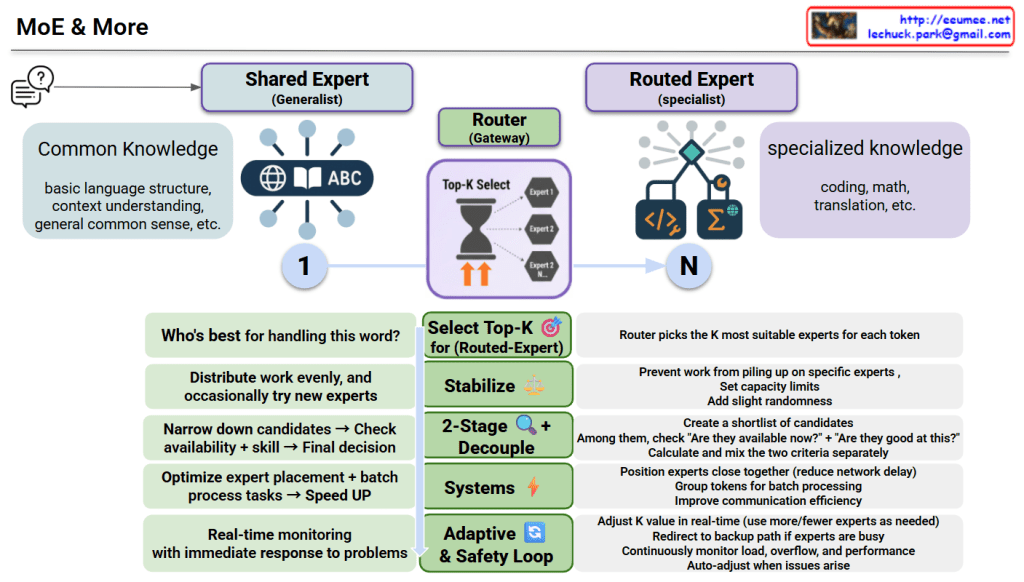
MoE & More

MoE & More – Architecture Interpretation

This diagram illustrates an advanced Mixture of Experts (MoE) model architecture.

Core Structure

1. Two Types of Experts

  • Shared Expert (Generalist)
    • Handles common knowledge: basic language structure, context understanding, general common sense
    • Applied universally to all tokens
  • Routed Expert (Specialist)
    • Handles specialized knowledge: coding, math, translation, etc.
    • Router selects the K most suitable experts for each token

2. Router (Gateway) Role

For each token, determines “Who’s best for handling this word?” by:

  • Selecting K experts out of N available specialists
  • Using Top-K selection mechanism

Key Optimization Techniques

Select Top-K ๐ŸŽฏ

  • Chooses K most suitable routed experts
  • Distributes work evenly and occasionally tries new experts

Stabilize โš–๏ธ

  • Prevents work from piling up on specific experts
  • Sets capacity limits and adds slight randomness

2-Stage Decouple ๐Ÿ”

  • Creates a shortlist of candidate experts
  • Separately checks “Are they available now?” + “Are they good at this?”
  • Calculates and mixes the two criteria separately before final decision
  • Validates availability and skill before selection

Systems โšก

  • Positions experts close together (reduces network delay)
  • Groups tokens for batch processing
  • Improves communication efficiency

Adaptive & Safety Loop ๐Ÿ”„

  • Adjusts K value in real-time (uses more/fewer experts as needed)
  • Redirects to backup path if experts are busy
  • Continuously monitors load, overflow, and performance
  • Auto-adjusts when issues arise

Purpose

This system enhances both efficiency and performance through:

  • Optimized expert placement
  • Accelerated batch processing
  • Real-time monitoring with immediate problem response

Summary

MoE & More combines generalist experts (common knowledge) with specialist experts (domain-specific skills), using an intelligent router to dynamically select the best K experts for each token. Advanced techniques like 2-stage decoupling, stabilization, and adaptive safety loops ensure optimal load balancing, prevent bottlenecks, and enable real-time adjustments for maximum efficiency. The result is a faster, more efficient, and more reliable AI system that scales intelligently.

#MixtureOfExperts #MoE #AIArchitecture #MachineLearning #DeepLearning #LLM #NeuralNetworks #AIOptimization #ScalableAI #RouterMechanism #ExpertSystems #AIEfficiency #LoadBalancing #AdaptiveAI #MLOps

With Claude