Data Explosion in Data Center

This image titled “Data Explosion in Data Center” illustrates three key challenges faced by modern data centers:

  1. Data/Computing:
    • Shows the explosive growth of data from computing servers to internet/cloud infrastructure and AI technologies.
    • Visualizes the exponential increase in data volume from 1X to 100X, 10,000X, and ultimately to 1,000,000,000X (one billion times).
    • Depicts how servers, computers, mobile devices, and global networks connect to massive data nodes, generating and processing enormous amounts of information.
  2. Power:
    • Addresses the increasing power supply requirements needed to support the data explosion in data centers.
    • Shows various energy sources including traditional power plants, wind turbines, solar panels, and battery storage systems to meet the growing energy demands.
    • Represents energy efficiency and sustainable power supply through a cyclical system indicated by green arrows.
  3. Cooling:
    • Illustrates the heat management challenges resulting from increased data processing and their solutions.
    • Explains the shift from traditional air cooling methods to more efficient server liquid cooling technologies.
    • Visualizes modern cooling solutions with blue circular arrows representing the cooling cycle.

This diagram comprehensively explains how the exponential growth of data impacts data center design and operations, particularly highlighting the challenges and innovations in power consumption and thermal management.

With Claude
New Human Challenges

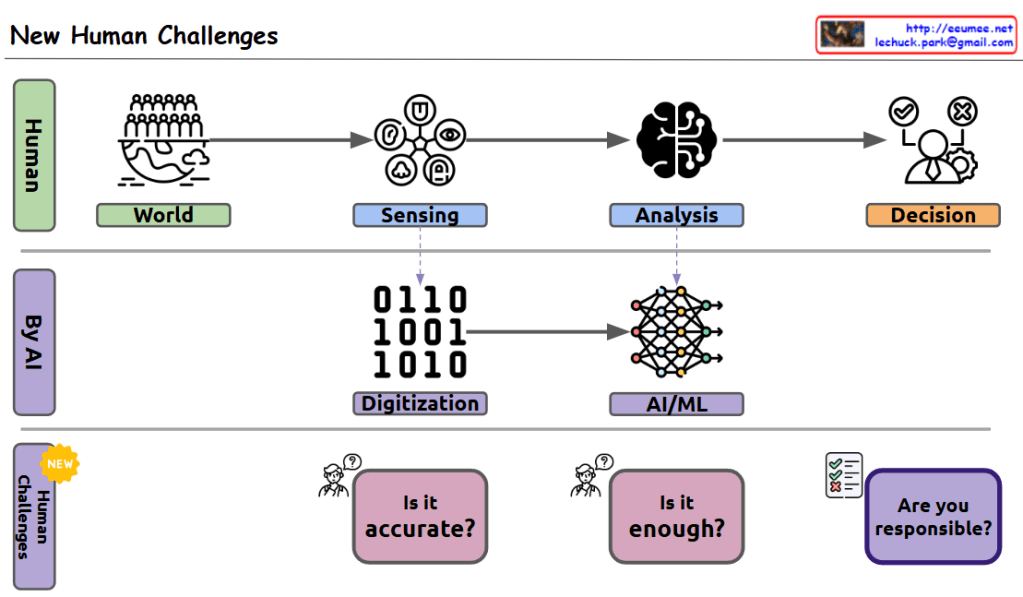
This image titled “New Human Challenges” illustrates the paradigm shift in information processing in the AI era and the new roles humans must assume.

The diagram is structured in three tiers:

  1. Human (top row): Shows the traditional human information processing flow. Humans sense information from the “World,” perform “Analysis” using the brain, and make final “Decisions” based on this analysis.
  2. By AI (middle row): In the modern technological environment, information from the world is “Digitized” into binary code, and this data is then processed through “AI/ML” systems.
  3. Human Challenges (bottom row): Highlights three key challenges humans face in the AI era:
    • “Is it accurate?” – Verifying the quality and integrity of data collection processes
    • “Is it enough?” – Ensuring the trained data is sufficient and balanced to reflect all perspectives
    • “Are you responsible?” – Reflecting on whether humans can take ultimate responsibility for decisions suggested by AI

This diagram effectively demonstrates how the information processing paradigm has shifted from human-centered to AI-assisted systems, transforming the human role from direct information processors to supervisors and accountability holders for AI systems. Humans now face new challenges focused on ensuring data quality, data sufficiency and balance, and taking responsibility for final decision-making.

With Claude

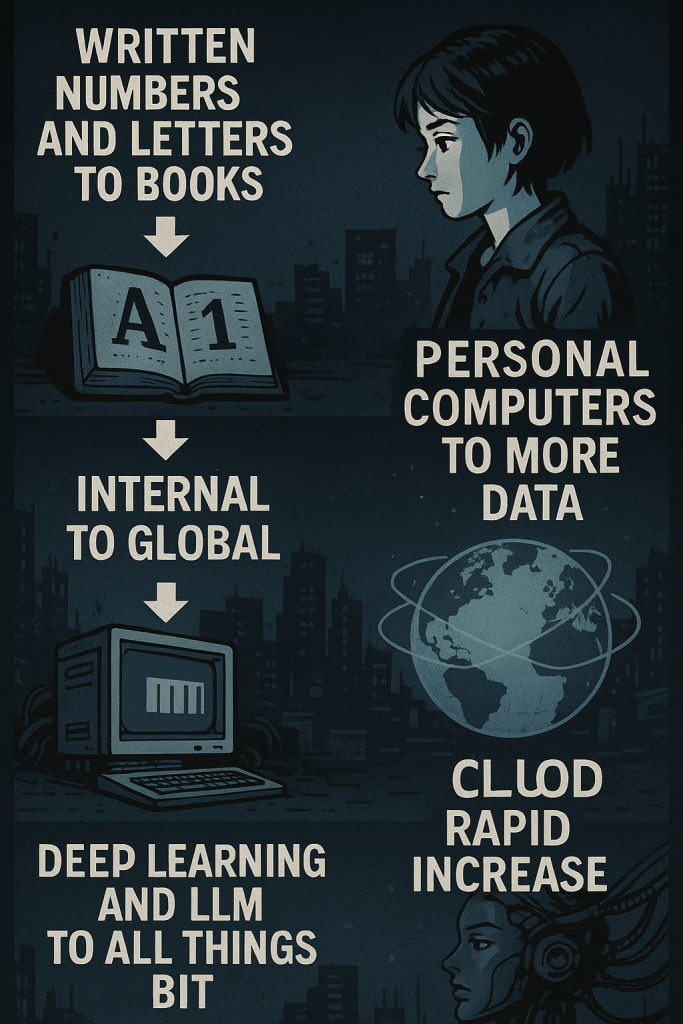
Massive increase in data

The Explosive Growth of Data – Step by Step

  1. Writing and Books
    Humans started recording information with letters and numbers in books.
    Data was physical and limited.
  2. Computers and Servers
    We began creating and storing digital data using computers and internal servers.
    Data became digitized.
  3. Personal Computers
    PCs allowed individuals to create, store, and use data on their own.
    Data became personalized and widespread.
  4. The Internet
    Data moved beyond local use and spread globally through the internet.
    Data became connected worldwide.
  5. Cloud Computing
    With cloud technology, data storage and processing expanded rapidly.
    Big data was born.
  6. AI, Deep Learning, and LLMs
    Data now powers AI. Deep learning and large language models analyze and generate human-like content.
    Everything is becoming data.
  7. Beyond – Total Bit Transformation
    In the future, we will digitize everything—from thoughts to actions—into bits.
    Data will define all reality.

As data has grown explosively, computing has evolved to process it—from early machines to AI and LLMs—and soon, everything will be digitized into data.

With ChatGPT

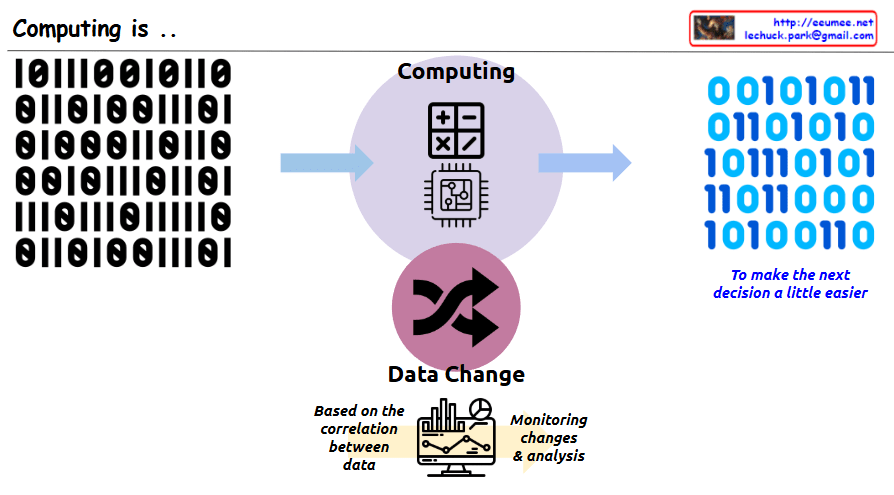
Computing is ..

This image illustrates the core concept of “Computing.” The key message is that computing is a process of transforming data to make people’s next decisions easier.

In the center, there is a circle with the title “Computing” along with calculator and computer chip icons. On the left side, there is binary input data (0s and 1s), which is shown being transformed through the central computing process into different binary output on the right side. Next to the binary output on the right is blue italic text saying “To make the next decision a little easier,” emphasizing that the purpose of this data transformation is to aid human decision-making.

At the bottom of the image, there is a section titled “Data Change” with cycling arrows representing data transformation. Below that, there’s a monitor displaying charts and graphs with descriptions “Based on the correlation between data” and “Monitoring changes & analysis,” showing that analyzing relationships between data is important for supporting decision-making.

With Claude

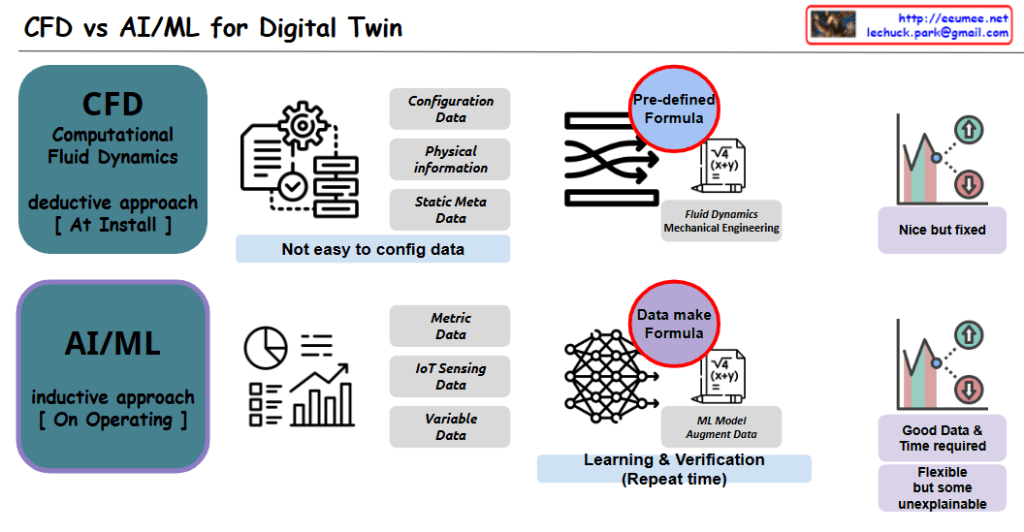
CFD & AI/ML

CFD (Computational Fluid Dynamics) – Deductive Approach [At Installation]

  • Data Characteristics
    • Configuration Data
    • Physical Information
    • Static Meta Data
  • Features
    • Complex data configuration
    • Predefined formula usage
    • Result: Fixed and limited
    • Stable from engineering perspective

AI/ML – Inductive Approach [During Operation]

  • Data Characteristics
    • Metric Data
    • IoT Sensing Data
    • Variable Data
  • Features
    • Data-driven formula generation
    • Continuous learning and verification
    • Result: Flexible but partially unexplainable
    • High real-time adaptability

Comprehensive Comparison

Harmonious integration of both approaches is key to future digital twin technologies

CFD: Precise but rigid modeling

AI/ML: Adaptive but complex modeling

The key insight here is that both CFD and AI/ML approaches have unique strengths. CFD provides a rigorous, physics-based model with predefined formulas, while AI/ML offers dynamic, adaptive learning capabilities. The future of digital twin technology likely lies in finding an optimal balance between these two methodologies, leveraging the precision of CFD with the flexibility of machine learning.

With Claude

Experience Selling

Experience Selling: Transforming Domain Expertise into Intellectual Capital

Paradigm Shift in Knowledge Economy

Core Value Proposition

  • Transforming specialized domain experience into structured digital data
  • Converting tacit knowledge into explicit, scalable intellectual assets

AI-Powered Knowledge Transformation

  • Digitalization of expert experiences
  • Large Language Model (LLM) training on domain-specific datasets
  • Creating replicable decision-making models from individual expertise

Key Message: In the AI era, experience is no longer a limited personal resource but a dynamic, expandable intellectual asset that can be transformed, shared, and monetized globally.

Data Quality

The image shows a data quality infographic with key dimensions that affect AI systems.

At the top of the image, there’s a header titled “Data Quality”. Below that, there are five key data quality dimensions illustrated with icons:

  • Accuracy – represented by a target with a checkmark. This is essential for AI models to produce correct results, as data with fewer errors and biases enables more accurate predictions.
  • Consistency – shown with circular arrows forming a cycle. This maintains consistent data formats and meanings across different sources and over time, enabling stable learning and inference in AI models.
  • Timeliness – depicted by a clock/pie chart with checkmarks. Providing up-to-date data in a timely manner allows AI to make decisions that accurately reflect current circumstances.
  • Resolution – illustrated with “HD” text and people icons underneath. This refers to increasing detailed accuracy through higher data density obtained by more frequent sampling per unit of time. High-resolution data allows AI to detect subtle patterns and changes, enabling more sophisticated analysis and prediction.
  • Quantity – represented by packages/boxes with a hand underneath. AI systems, particularly deep learning models, perform better when trained on large volumes of data. Sufficient data quantity allows for learning diverse patterns, preventing overfitting, and enabling recognition of rare cases or exceptions. It also improves the model’s generalization capability, ensuring reliable performance in real-world environments.

The bottom section features a light gray background with a conceptual illustration showing how these data quality dimensions contribute to AI. On the left side is a network of connected databases, devices, and information systems. An arrow points from this to a neural network representation on the right side, with the text “Data make AI” underneath.

The image appears to be explaining that these five quality dimensions are essential for creating effective AI systems, emphasizing that the quality of data directly impacts AI performance.

With Claude