per Watt with AI

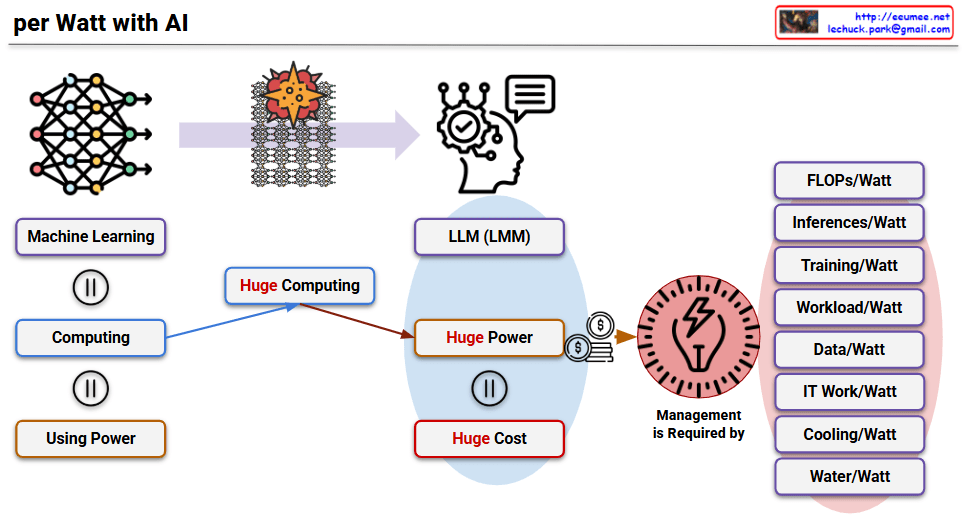
This image titled “per Watt with AI” is a diagram explaining the paradigm shift in power efficiency following the AI era, particularly after the emergence of LLMs.

Overall Context

Core Structure of AI Development:

  • Machine Learning = Computing = Using Power
  • The equal signs (=) indicate that these three elements are essentially the same concept. In other words, AI machine learning inherently means large-scale computing, which inevitably involves power consumption.

Characteristics of LLMs: As AI, particularly LLMs, have proven their effectiveness, tremendous progress has been made. However, due to their technical characteristics, they have the following structure:

  • Huge Computing: Massively parallel processing of simple tasks
  • Huge Power: Enormous power consumption due to this parallel processing
  • Huge Cost: Power costs and infrastructure expenses

Importance of Power Efficiency Metrics

With hardware advancements making this approach practically effective, power consumption has become a critical issue affecting even the global ecosystem. Therefore, power is now used as a performance indicator for all operations.

Key Power Efficiency Metrics

Performance-related:

  • FLOPs/Watt: Floating-point operations per watt
  • Inferences/Watt: Number of inferences processed per watt
  • Training/Watt: Training performance per watt

Operations-related:

  • Workload/Watt: Workload processing capacity per watt
  • Data/Watt: Data processing capacity per watt
  • IT Work/Watt: IT work processing capacity per watt

Infrastructure-related:

  • Cooling/Watt: Cooling efficiency per watt
  • Water/Watt: Water usage efficiency per watt

This diagram illustrates that in the AI era, power efficiency has become the core criterion for all performance evaluations, transcending simple technical metrics to encompass environmental, economic, and social perspectives.

With Claude
Power Efficiency Cost

AI Data Center Power Efficiency Analysis

The Power Design Dilemma in AI Data Centers

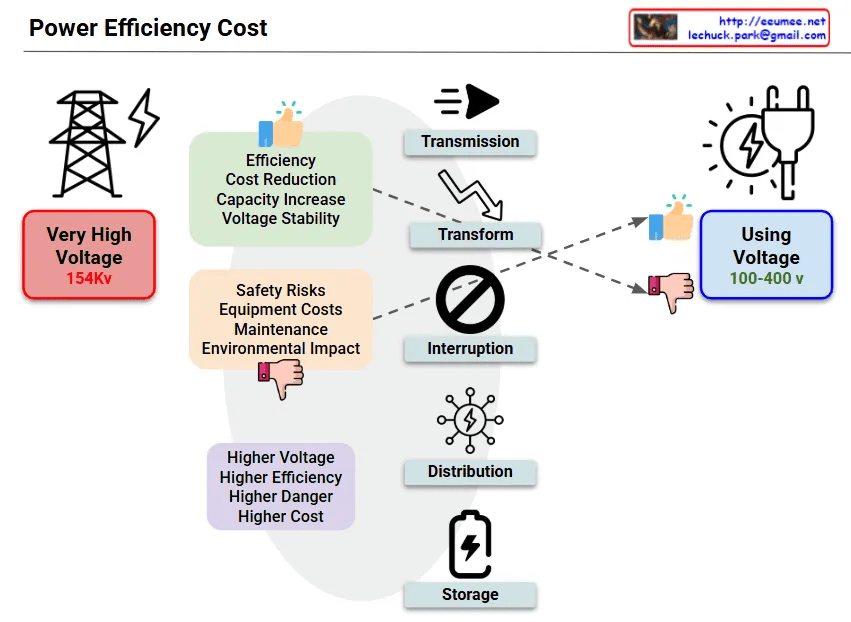
AI data centers, comprised of power-hungry GPU clusters and high-performance servers, face critical decisions where power efficiency directly impacts operational costs and performance capabilities.

The Need for High-Voltage Distribution Systems

  • AI Workload Characteristics: GPU training operations consume hundreds of kilowatts to megawatts continuously
  • Power Density: High power density of 50-100kW per rack demands efficient power transmission
  • Scalability: Rapid power demand growth following AI model size expansion

Efficiency vs Complexity Trade-offs

Advantages (Efficiency Perspective):

  • Minimized Power Losses: High-voltage transmission dramatically reduces I²R losses (potential 20-30% power cost savings)
  • Cooling Efficiency: Reduced power losses mean less heat generation, lowering cooling costs
  • Infrastructure Investment Optimization: Fewer, larger cables can deliver massive power capacity

Disadvantages (Operational Complexity):

  • Safety Risks: High-voltage equipment requires specialized expertise, increased accident risks
  • Capital Investment: Expensive high-voltage transformers, switchgear, and protection equipment
  • Maintenance Complexity: Specialized technical staff required, extended downtime during outages
  • Regulatory Compliance: Complex permitting processes for electrical safety and environmental impact

AI DC Power Architecture Design Strategy

  1. Medium-Voltage Distribution: 13.8kV → 480V stepped transformation balancing efficiency and safety
  2. Modularization: Pod-based power delivery for operational flexibility
  3. Redundant Backup Systems: UPS and generator redundancy preventing AI training interruptions
  4. Smart Monitoring: Real-time power quality surveillance for proactive fault prevention

Financial Impact Analysis

  • CAPEX: 15-25%(?) higher initial investment for high-voltage infrastructure
  • OPEX: 20-35%(?) reduction in power and cooling costs over facility lifetime
  • ROI: Typically 18-24(?) months payback period for hyperscale AI facilities

Conclusion

AI data centers must identify the optimal balance between power efficiency and operational stability. This requires prioritizing long-term operational efficiency over initial capital costs, making strategic investments in sophisticated power infrastructure that can support the exponential growth of AI computational demands while maintaining grid-level reliability and safety standards.

with Claude

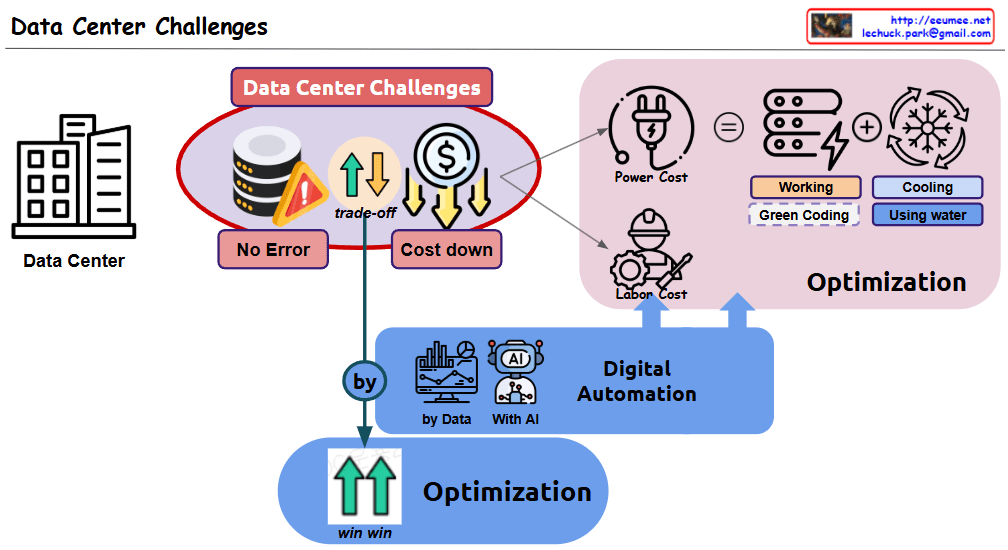
Data Center Challenges

This diagram illustrates “Data Center Challenges” by visually explaining the key challenges faced by data centers and their potential solutions.

The central red circle highlights the main challenges:

  • “No Error” – representing reliable operations
  • “Cost down” – representing economic efficiency
  • Between these two goals, there typically exists a “trade-off” relationship

The “Optimization” section on the right breaks down the cost structure:

  1. “Power Cost”:
    • “Working” – representing IT power that can be optimized through “Green Coding”
    • “Cooling” – can be significantly optimized with “Using water” (liquid cooling) technologies
  2. “Labor Cost”:
    • Personnel costs that can be reduced through automation

The middle “Digital Automation” section shows:

  • “by Data” decision-making approaches
  • “With AI” methodologies

At the bottom, the final outcome shows:

  • “win win” – upward arrows and “Optimization” indicating that both goals can be achieved simultaneously

This diagram demonstrates how digital automation leveraging data and AI can help data centers achieve the seemingly conflicting goals of reliable operations and cost reduction simultaneously.

With Claude

Operation with system

Key Analysis of Operation Cost Diagram

This diagram illustrates the cost structure of system implementation and operation, highlighting the following key concepts:

  1. High Initial Deployment Cost: At the beginning of a system’s lifecycle, deployment costs are substantial. This represents a one-time investment but requires significant capital.
  2. Perpetual Nature of Operation Costs: Operation costs continue indefinitely as long as the system exists, making them a permanent expense factor.
  3. Components of Operation Cost: Operation costs consist of several key elements:
    • Energy Cost
    • Labor Cost
    • Disability Cost
    • Additional miscellaneous costs (+@)
  4. Role of Automation Systems: As shown on the right side of the diagram, implementing automation systems can significantly reduce operation costs over time.
  5. Timing of Automation Investment: While automation systems also require initial investment during the early phases, they deliver long-term operation cost reduction benefits, ultimately improving the overall cost structure.

This diagram effectively visualizes the relationship between initial costs and long-term operational expenses, as well as the cost optimization strategy through automation.

With Claude

EXP with AI

From Claude with some prompting
Here’s the analysis of the AI Experience (EXP) curve:

  1. Three-Phase Structure

Initial Phase

  • Slow cost increase period
  • Efficient progress relative to investment
  • Importance of clear goals and scope setting

Middle Phase

  • Steeper cost increase progression
  • Critical focus on ROI and resource allocation
  • Need for continuous cost-benefit monitoring

Final Phase

  • Exponential cost increase occurs
  • Practical goal setting rather than perfection
  • Importance of determining optimal investment timing
  1. Unreachable Area Complementary Factors and Implications

Key Complementary Elements

  • Human Decision
  • Experience Know-How
  • AI/ML Integration

Practical Implications

  • Setting realistic goals at 80-90% rather than pursuing 100% perfection
  • Balanced utilization of human expertise and AI technology
  • Development of phase-specific management strategies

This analysis demonstrates that AI projects require strategic approaches considering cost efficiency and practicality, rather than mere technology implementation.

The graph illustrates that as AI project completion approaches 100%, costs increase exponentially, and beyond a certain point, success depends on the integration of human judgment, experience, and AI/ML capabilities.