This illustration visually represents the philosophical exploration of the relationship between humans and technology, particularly AI. It emphasizes how technological advancements may narrow the gap between humans and machines, yet a fundamental difference will always persist. The concept of “reducing infinity” is depicted, showing that while AI can become more human-like, it can never be entirely the same. Ultimately, the image highlights that despite technological evolution, human judgment remains irreplaceable in final decision-making.
The image titled “New Coding” illustrates the historical evolution of programming languages and the emerging paradigm of AI-assisted coding.
On the left side, it shows the progression of programming languages:
“Bytecode” (represented by binary numbers: 0110, 1001, 1010)
“Assembly” (shown with a gear and conveyor belt icon)
“C/C++” (displayed with the C++ logo)
“Python” (illustrated with the Python logo)
Below these languages is text reading “Workload for understanding computers” with a blue gradient arrow, indicating how these programming approaches have strengthened our understanding of computers through their evolution.
The bottom section labeled “Using AI with LLM” shows a human profile communicating with an AI chip/processor, suggesting that AI can now code through natural language based on this historical programming experience and data.
On the right side, a large purple arrow points toward the future concepts:
“New Coding As you think”
“With AI” (in purple text)
The overall message of the diagram is that programming has evolved from low-level languages to high-level ones, and now we’re entering a new era where AI enables coding directly through human thought, speech, and logical reasoning – representing a fundamental shift in how we create software.
This image depicts a conceptual diagram of the “MOE (Mixture of Expert)” system, effectively illustrating the similarities between human expert collaboration structures and AI model MoE architectures.
The key points of the diagram are:
The upper section shows a traditional human expert collaboration model:
A user presents a complex problem (“Please analyze the problem now”)
An intermediary agent distributes this to appropriate experts (A, B, C Experts)
Each expert analyzes the problem and provides solutions from their specialized domain
The lower section demonstrates how this same structure is implemented in the AI world:
When a user’s question or command is input
The LLM Foundation Expert Model processes it
The Routing Expert Model distributes tasks to appropriate specialized models (A, B, C Expert Models)
This diagram emphasizes that human expert systems and AI MoE architectures are fundamentally similar. The approach of utilizing multiple experts’ knowledge to solve complex problems has been used in human settings for a long time, and the AI MoE structure applies this human-centered collaborative model to AI systems. The core message of this diagram is that AI models are essentially performing the roles that human experts would traditionally fulfill.
This perspective suggests that mimicking human problem-solving approaches can be effective in AI system design.
The image shows a data quality infographic with key dimensions that affect AI systems.
At the top of the image, there’s a header titled “Data Quality”. Below that, there are five key data quality dimensions illustrated with icons:
Accuracy – represented by a target with a checkmark. This is essential for AI models to produce correct results, as data with fewer errors and biases enables more accurate predictions.
Consistency – shown with circular arrows forming a cycle. This maintains consistent data formats and meanings across different sources and over time, enabling stable learning and inference in AI models.
Timeliness – depicted by a clock/pie chart with checkmarks. Providing up-to-date data in a timely manner allows AI to make decisions that accurately reflect current circumstances.
Resolution – illustrated with “HD” text and people icons underneath. This refers to increasing detailed accuracy through higher data density obtained by more frequent sampling per unit of time. High-resolution data allows AI to detect subtle patterns and changes, enabling more sophisticated analysis and prediction.
Quantity – represented by packages/boxes with a hand underneath. AI systems, particularly deep learning models, perform better when trained on large volumes of data. Sufficient data quantity allows for learning diverse patterns, preventing overfitting, and enabling recognition of rare cases or exceptions. It also improves the model’s generalization capability, ensuring reliable performance in real-world environments.
The bottom section features a light gray background with a conceptual illustration showing how these data quality dimensions contribute to AI. On the left side is a network of connected databases, devices, and information systems. An arrow points from this to a neural network representation on the right side, with the text “Data make AI” underneath.
The image appears to be explaining that these five quality dimensions are essential for creating effective AI systems, emphasizing that the quality of data directly impacts AI performance.
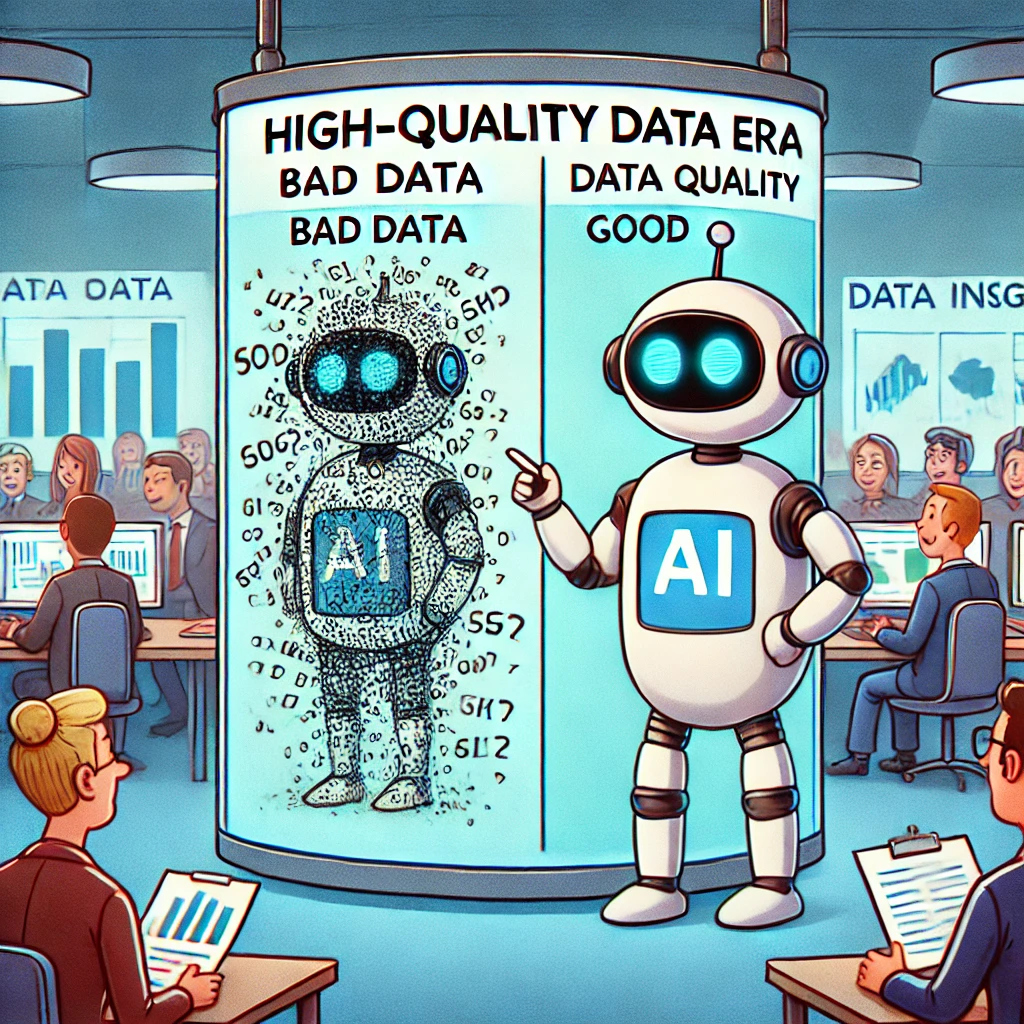
Domain-specific datasets define AI performance differences.
Data cleaning and quality management are essential.
Key messages
“Data is the backbone of AI’s evolution.”
“Good data fuels great AI!”
Conclusion
AI’s success now depends on how well data is collected, processed, and managed. Companies and researchers must focus on high-quality data acquisition and refinement to stay ahead. 🚀
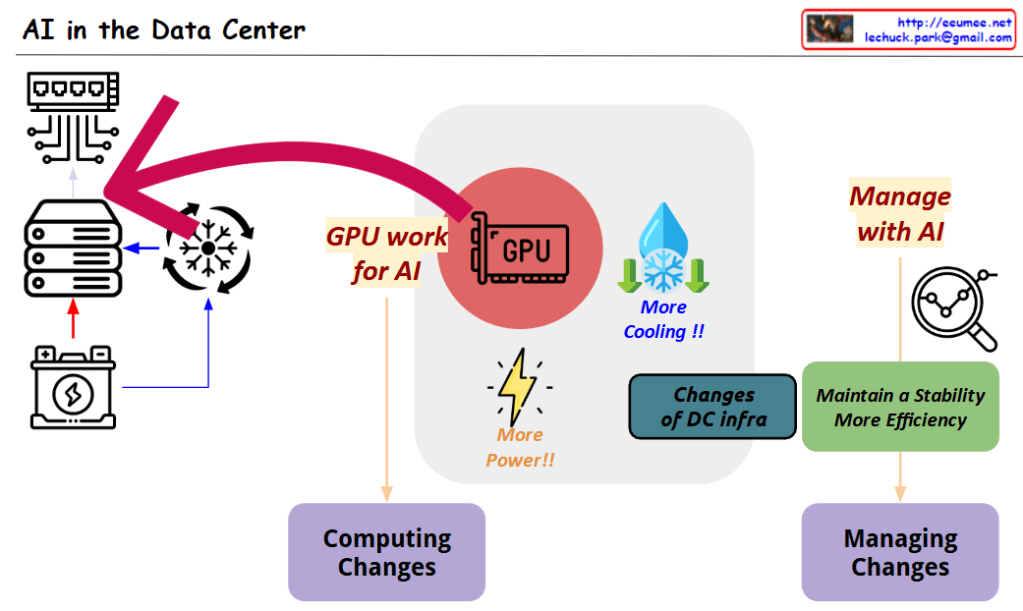
This diagram titled “AI in the Data Center” illustrates two key transformational elements that occur when AI technology is integrated into data centers:
1. Computing Infrastructure Changes
AI workloads powered by GPUs become central to operations
Transition from traditional server infrastructure to GPU-centric computing architecture
Fundamental changes in data center hardware configuration and network connectivity
2. Management Infrastructure Changes
Increased requirements for power (“More Power!!”) and cooling (“More Cooling!!”) to support GPU infrastructure
Implementation of data-driven management systems utilizing AI technology
AI-based analytics and management for maintaining stability and improving efficiency
These two changes are interconnected, visually demonstrating how AI technology not only revolutionizes the computing capabilities of data centers but also necessitates innovation in management approaches to effectively operate these advanced systems.
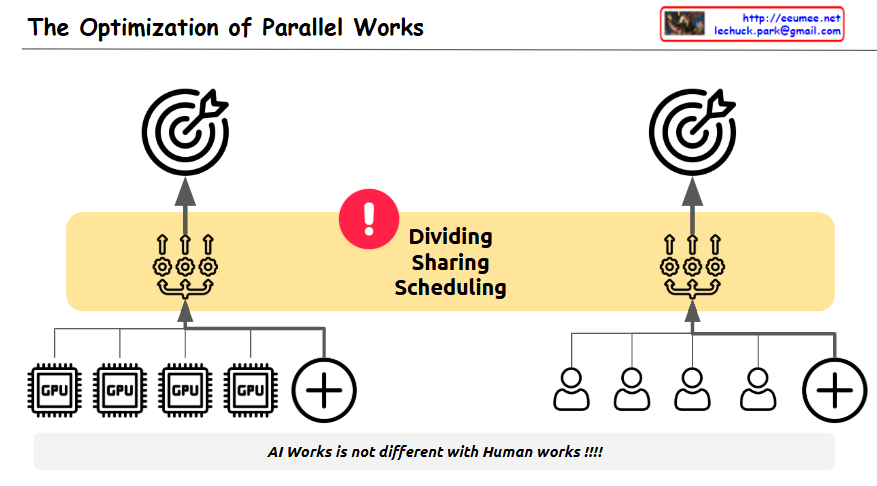
The image illustrates “The Optimization of Parallel Works,” highlighting the inherent challenges in optimizing parallel processing tasks.
The diagram cleverly compares two parallel systems:
Left side: Multiple CPU processors working in parallel
Right side: Multiple humans working in parallel
The central yellow band emphasizes three critical challenges in both systems:
Dividing (splitting tasks appropriately)
Sharing (coordinating resources and information)
Scheduling (timing and sequencing activities)
Each side shows a target/goal at the top, representing the shared objective that both computational and human systems strive to achieve.
The exclamation mark in the center draws attention to these challenges, while the message at the bottom states: “AI Works is not different with Human works!!!!” – emphasizing that the difficulties in coordinating independent processors toward a unified goal are similar whether we’re talking about computer processors or human teams.
The diagram effectively conveys that just as it’s difficult for people to work together toward a single objective, optimizing independent parallel processes in computing faces similar coordination challenges – requiring careful attention to division of labor, resource sharing, and timing to achieve optimal results.


 Lechuck Park