Modular vs Rack Cluster DC

This image illustrates a comparison between two main data center architecture approaches: “Rack Cluster DC” and “Modular DC.”

On the left side, there are basic infrastructure elements depicted, representing power supply components (transformers, generators), cooling systems, and network equipment. On the right side, two different data center configuration methods are presented.

Rack Cluster Data Center (Left)

  • Features: “Dense Computing, High Power and Cooling, Scaling Unit”
  • Organized at the rack level within a cluster
  • Shows structure connected by red solid and dotted lines
  • Multiple server racks arranged in a regular pattern

Modular Data Center (Right)

  • Features: “Modular Design, Flexible Scaling, Rapid Deployment”
  • Organized at the module level, including power, cooling, and racks as integrated units
  • Shows structure connected by blue solid and dotted lines
  • Functional elements (power, cooling, servers) integrated into single modules

Both approaches display expansion units labeled “NEW” at the bottom, demonstrating the scalability of each approach.

This diagram visually compares the structural differences, scalability, and component arrangements between the traditional rack cluster approach and the modular approach to data center design.

With Claude

NVLink, Infiniband

This diagram compares two GPU networking technologies: NVLink and InfiniBand, both essential for parallel computing expansion.

On the left side, the “NVLink” section shows multiple GPUs connected vertically through purple interconnect bars. This represents the “Scale UP” approach, where GPUs are vertically scaled within a single system for tight integration.

On the right side, the “InfiniBand” section demonstrates how multiple server nodes connect through an InfiniBand network. This illustrates the “Scale Out” approach, where computing power expands horizontally across multiple independent systems.

Both technologies share the common goal of expanding parallel processing capabilities, but they do so in different architectural approaches. NVLink focuses on high-speed, direct connections between GPUs in a single system, while InfiniBand specializes in networking across multiple systems to support distributed computing environments.

The optimization of these expansion configurations is crucial for maximizing performance in high-performance computing, AI training, and other compute-intensive applications. System architects must carefully consider workload characteristics, data movement patterns, and scaling requirements when choosing between these technologies or determining how to best implement them together in hybrid configurations.

With Claude

Make Better Questions

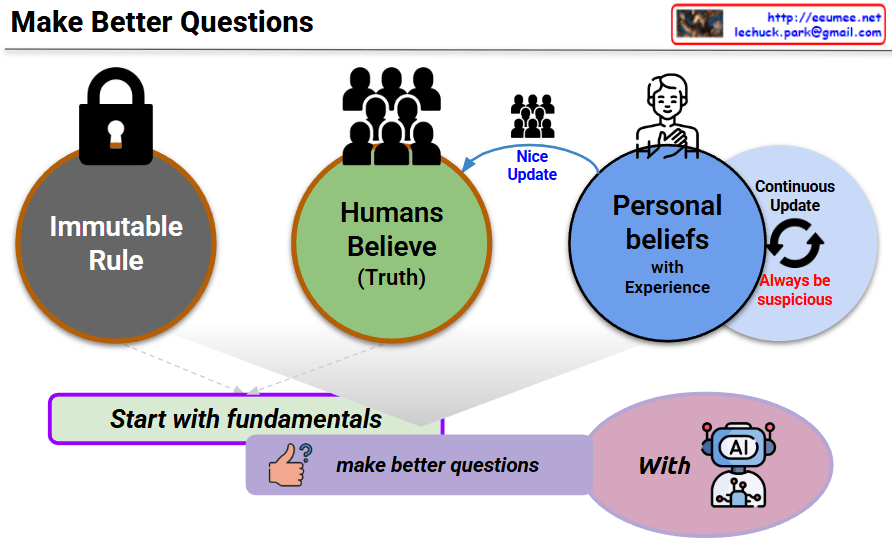
This diagram titled “Make Better Questions” illustrates a methodology for effective questioning. The key concepts are:

  1. Continuous Skepticism and Updates: Personal beliefs should be continuously updated following the principle “Always be suspicious.” This suggests that our knowledge and understanding should not remain static but should evolve constantly.
  2. Fluidity of Collective Truth: “Humans Believe (Truth)” represents collectively accepted truths, which are also subject to change and interact with personal beliefs through “Nice Update,” creating a reciprocal influence.
  3. Immutable Foundations: Some basic principles (“Immutable Rule”) provide an unchanging foundation, but flexible thinking should be developed based on these foundations.
  4. Starting with Fundamentals: “Start with fundamentals” emphasizes the importance of beginning with basic principles when approaching complex questions or problems.
  5. Collaboration with AI: By utilizing this thinking framework in conjunction with AI, we can create better questions and gain richer insights.

This diagram ultimately suggests a method for optimizing interactions with AI through constant skepticism and adherence to fundamentals while maintaining flexible thinking. It emphasizes the importance of not settling for fixed beliefs but continuously learning and evolving.

With Claude

Connected in AI DC

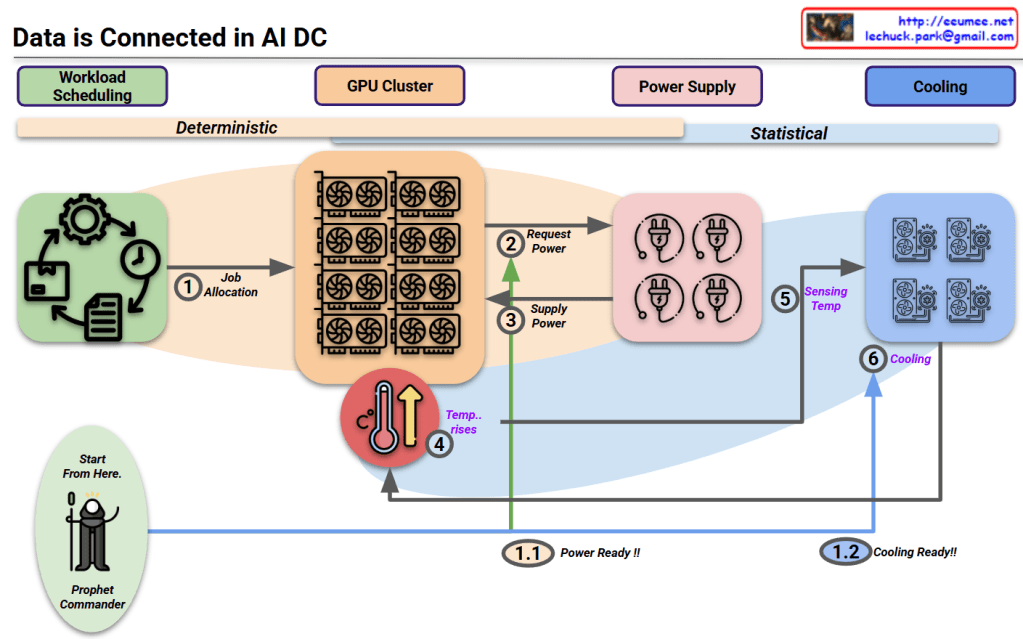
This diagram titled “Data is Connected in AI DC” illustrates the relationships starting from workload scheduling in an AI data center.

Key aspects of the diagram:

  1. The entire system’s interconnected relationships begin with workload scheduling.
  2. The diagram divides the process into two major phases:
    • Deterministic phase: Primarily concerned with power requirements that operate in a predictable, planned manner.
    • Statistical phase: Focused on cooling requirements, where predictions vary based on external environmental conditions.
  3. The “Prophet Commander” at the workload scheduling stage can predict/direct future requirements, allowing the system to prepare power (1.1 Power Ready!!) and cooling (1.2 Cooling Ready!!) in advance.
  4. Process flow:
    • Job allocation from workload scheduling to GPU cluster
    • GPUs request and receive power
    • Temperature rises due to operations
    • Cooling system detects temperature and activates cooling

This diagram illustrates the interconnected workflow in AI data centers, beginning with workload scheduling that enables predictive resource management. The process flows from deterministic power requirements to statistical cooling needs, with the “Prophet Commander” enabling proactive preparation of power and cooling resources. This integrated approach demonstrates how workload prediction can drive efficient resource allocation throughout the entire AI data center ecosystem.

With Claude

Data Center

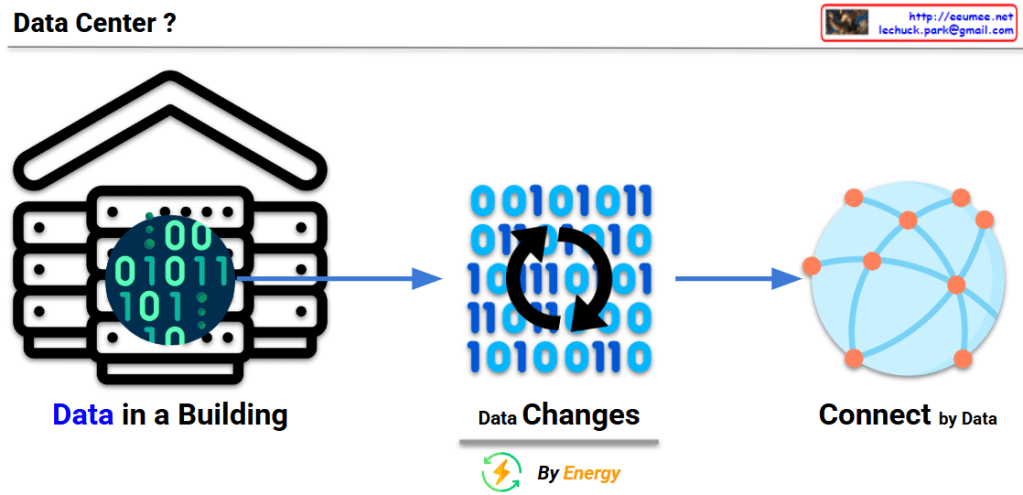
This image explains the fundamental concept and function of a data center:

  1. Left: “Data in a Building” – Illustrates a data center as a physical building that houses digital data (represented by binary code of 0s and 1s).
  2. Center: “Data Changes” – With the caption “By Energy,” showing how data is processed and transformed through the consumption of energy.
  3. Right: “Connect by Data” – Demonstrates how processed data from the data center connects to the outside world, particularly the internet, forming networks.

This diagram visualizes the essential definition of a data center – a physical building that stores data, consumes energy to process that data, and plays a crucial role in connecting this data to the external world through the internet.

With Claude