Time Series Data in a DC

From Claude with some prompting
This image illustrates the concept of time series data analysis in a data center environment. It shows various infrastructure components like IT servers, networking, power and cooling systems, security systems, etc. that generate continuous data streams around the clock (24 hours, 365 days).

This time series data is then processed and analyzed using different machine learning and deep learning techniques such as autoregressive integrated moving average models, generalized autoregressive conditional heteroskedasticity, isolation forest algorithms, support vector machines, local outlier factor, long short-term memory models, and autoencoders.

The goal of this analysis is to gain insights, make predictions, and uncover patterns from the continuous data streams generated by the data center infrastructure components. The analysis results can be further utilized for applications like predictive maintenance, resource optimization, anomaly detection, and other operational efficiency improvements within the data center.

LLM Tuning

From Claude with some prompting
This diagram illustrates various fine-tuning techniques to improve the performance of large language models.

At the center, there is a Tuning Module connected to an Inference Module (for generating answers). The Tuning Module is linked to the Weight DataBase (Parameter), indicating that it fine-tunes the weights and parameters of the model.

On the left, there are Knowledge Base and Vector DataBase, which store the model’s knowledge and data.

In the top right, the RAG (Retrieval Augmented Generation) block retrieves relevant information from Domain Specific External Sources to augment the generation process.

The Prompt Engineering block involves Prompt Tuning to generate massive prompts with expert knowledge.

At the bottom, various parameter-efficient fine-tuning techniques are presented, such as PEFT, Fine Tuning, Bias Fine Tuning, Prefix Tuning, Adapter, and LoRA.

Regarding Prefix Tuning, the description “Attach a virtual prefix sequence” suggests that it involves adding virtual prompt tokens at the beginning of the input sequence.

Overall, this diagram comprehensively illustrates the integration of knowledge, prompt engineering, and diverse fine-tuning methods for enhancing large language models’ performance across various domains.

Linux with ML

From Claude with some prompting
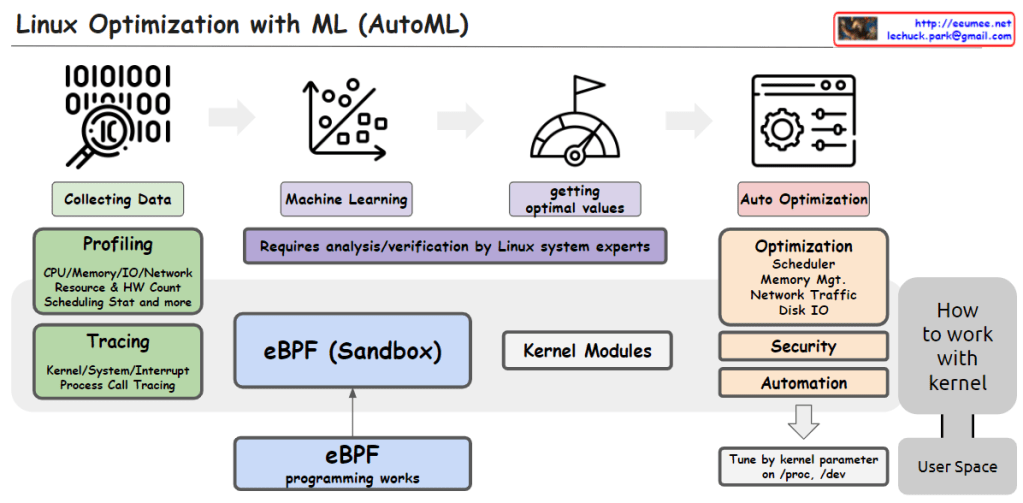
This image illustrates the process of utilizing Machine Learning (ML) and AutoML techniques for system optimization in Linux.

It starts with collecting data through profiling techniques that gather statistics on CPU, memory, I/O, network resource usage, hardware counters, scheduling information, etc. Tracing is also employed to capture kernel/system/interrupt events and process call traces.

The collected data is then used to train machine learning models. This step requires analysis and verification by Linux system experts.

The trained models help determine optimal values, which are then applied to optimize various system components such as the scheduler, memory management, network traffic, and disk I/O. Optimization can also target security and automation aspects.

The eBPF (Enhanced Berkeley Packet Filter) sandbox, situated in the center, allows safe execution within the kernel, enabling eBPF programs to interact with the kernel.

Kernel modules provide another way to implement optimization logic and integrate it directly into the kernel.

Finally, kernel parameters can be tuned from user space to perform optimizations.

In summary, the image depicts an AutoML-based process that leverages data collection, machine learning modeling, deriving optimal values, eBPF, kernel modules, and parameter tuning to automate system optimization in Linux across various kernel subsystems like the scheduler, memory management, network, and disk I/O.C

Unexplainable

From DALL-E with some prompting
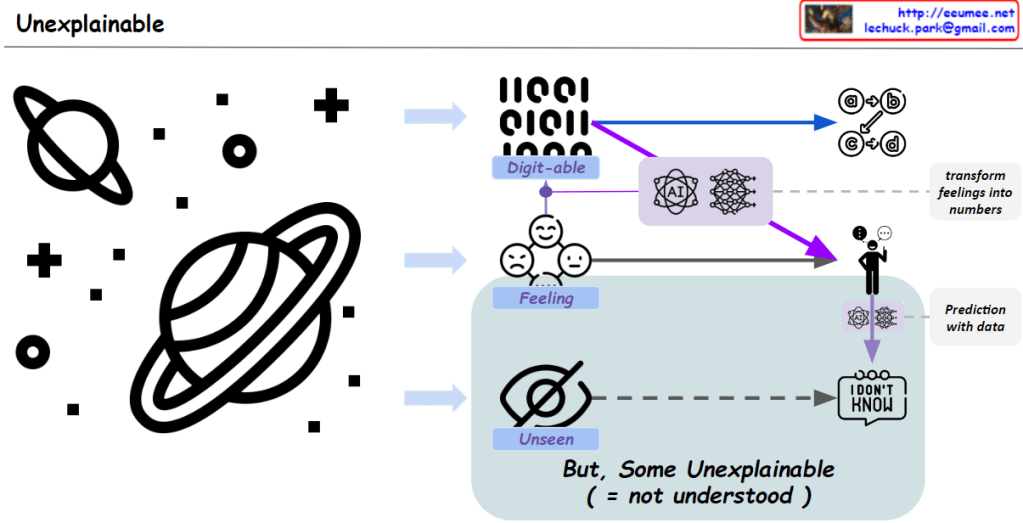
The image intends to explain two critical perspectives of AI/ML. First, it illustrates that while traditionally digitalized data was defined by rules, AI/ML enables us to judge human ‘feelings’ as data based on a more extensive dataset. Second, AI/ML allows for the prediction of the future using data; however, some parts of these significant advancements remain unexplainable and difficult for humans to comprehend fully. This interpretation suggests that while AI aims to quantify and use non-visible elements like emotions for predictions through data standardization and optimized processing, there are aspects that cannot be fully articulated or understood.

AI 3 Types

From DALL-E with some prompting
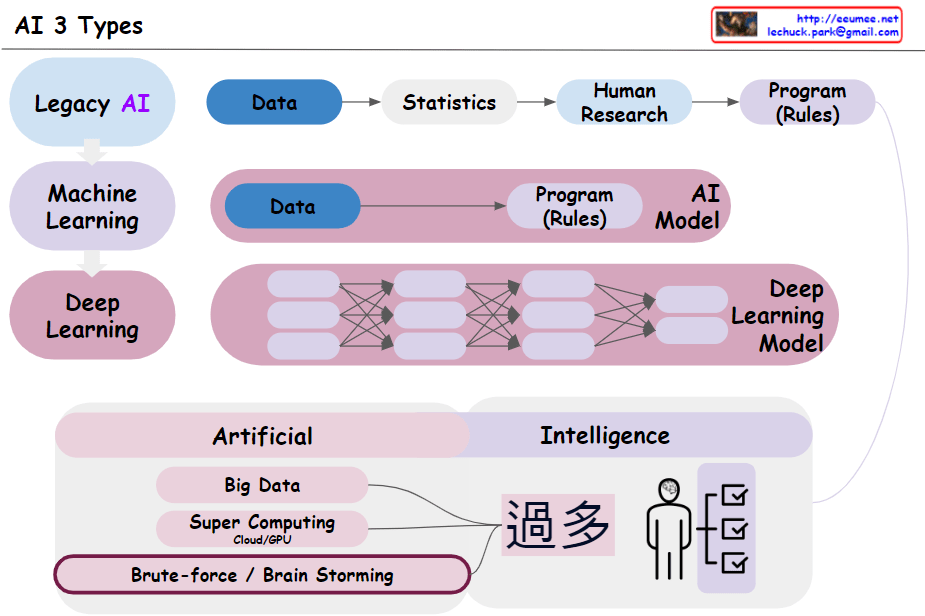
The image depicts the three stages of AI forming artificial intelligence through repeated classification tasks based on data:

  1. Legacy AI derives statistics from data and transforms them into rule-based programs through human research.
  2. Machine Learning evolves these rules into AI models capable of executing more complex functions.
  3. Deep Learning uses deep neural networks to process data and create complex models that perform cognitive tasks.

In this process, AI leverages extensive data for repetitive classification tasks, and the result is what we refer to as ‘intelligence.’ However, this intelligence is not an emulation of human thought processes but rather a product of data processing and algorithms, which qualifies it as ‘artificial intelligence.’ This underlines that the ‘artificial’ in AI corresponds to intelligence derived artificially rather than naturally through human cognition.

AI with humans

From DALL-E with some prompting
This image illustrates the process of how AI and humans interact with data. Initially, data undergoes computation, followed by human-led analysis. Rules are then discovered, which inform the creation or improvement of models. These processes lead to the sharing and generation of new ideas, feeding into an acceleration of AI capabilities.

The analysis and AI-discovered rules are used to construct or enhance models, which are then verified by AI to confirm the outcomes. Ultimately, the new ideas, products, or services developed through this process are shared and disseminated across society. This entire cycle fosters rapid advancements in AI, enabling improvements in human efficiency and task execution.

Data Make RULES

From DALL-E with some prompting
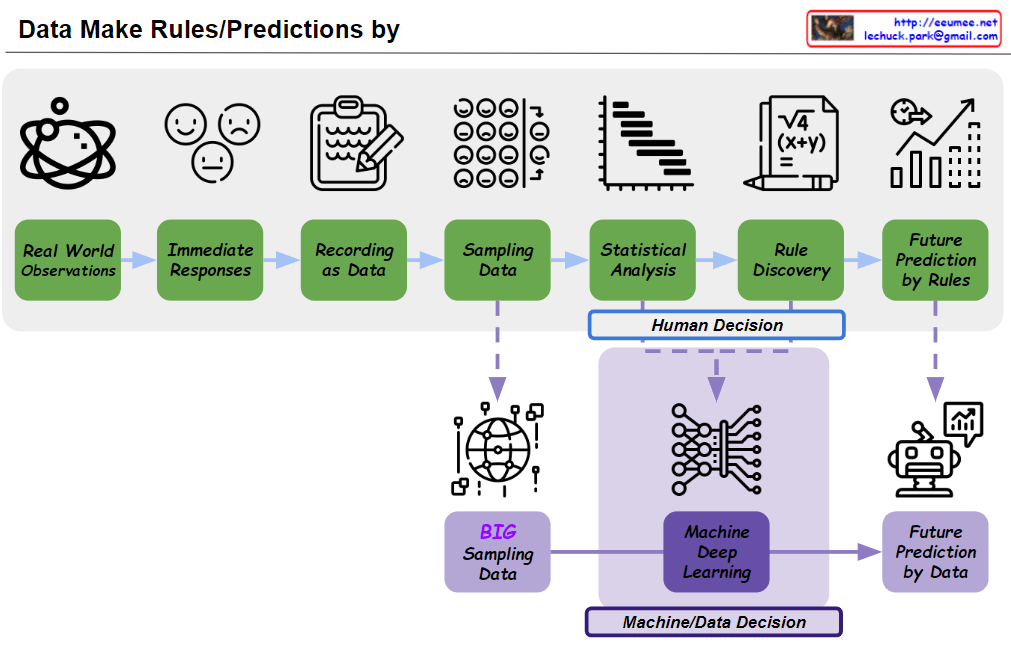
The image depicts the evolution of the decision-making process from data collection to conclusion. Where decisions were once made entirely by humans before the advent of AI/ML, the progress in big data processing and machine learning/deep learning now allows machines or the data itself to make decisions. Initially, the process was human-centric, starting from real-world observations to data recording, followed by statistical analysis and rule discovery to predict the future. With advancements, we now extract large samples from large datasets and utilize deep learning to recognize complex patterns, leading to a machine-centric process that predicts the future based on data. This shift emphasizes the power of data and the significance of machine learning.