

The Computing for the Fair Human Life.

From Claude with some prompting
This image describes a programming problem titled “Grumpy bookstore owner”. Here’s a summary of the key points:
This problem appears to be solvable using a sliding window technique for an efficient algorithmic solution.
From Claude with some prompting
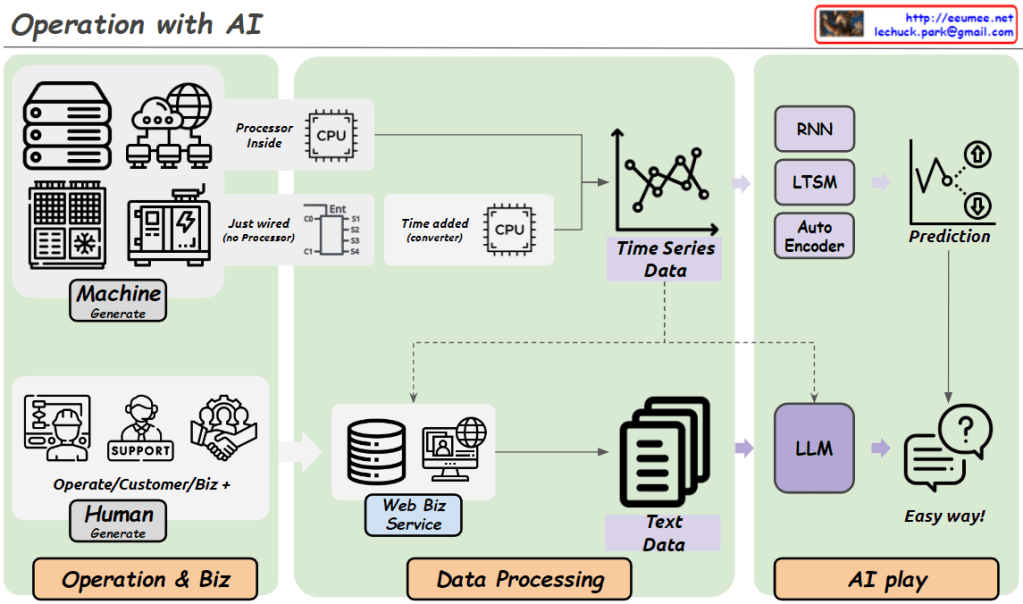
This diagram illustrates an integrated approach to modern operational management. The system is divided into three main components: data generation, data processing, and AI application.
The Operation & Biz section shows two primary data sources. First, there’s metric data automatically generated by machines such as servers and network equipment. Second, there’s textual data created by human operators and customer service representatives, primarily through web portals.
These collected data streams then move to the central Data Processing stage. Here, metric data is processed through CPUs and converted into time series data, while textual data is structured via web business services.
Finally, in the AI play stage, different AI models are applied based on data types. For time series data, models like RNN, LSTM, and Auto Encoder are used for predictive analytics. Textual data is processed through a Large Language Model (LLM) to extract insights.
This integrated system effectively utilizes data from various sources to improve operational efficiency, support data-driven decision-making, and enable advanced analysis and prediction through AI. Ultimately, it facilitates easy and effective management even in complex operational environments.
The image emphasizes how different types of data – machine-generated metrics and human-generated text – are processed and analyzed using appropriate AI techniques, all from the perspective of operational management.

From Claude with some prompting
explain the image in more detail from the data collection perspective and how the data analysis platform facilitates the expansion of AI services.
First, we can see the data collection stage where data is gathered from various systems within the data center building, such as electrical, mechanical, security, and so on, through subsystems like EPMS, BAS, ETC. This collected data is stored in the Data Gathering DB.
Next, this accumulated data is transmitted to the Data Analysis Platform via an API. The necessity of the data analysis platform arises from the need to process the vast amount of collected data and derive meaningful insights.
Within the Data Analysis Platform, tools like Query, Program, and Visualization are utilized for data analysis and monitoring purposes. Based on this, services such as Energy Optimization and Predictive Failure Detection are provided.
Furthermore, by integrating AI technology, data-driven insights can be enhanced. AI models can leverage the data and services from the data analysis platform to perform advanced analytics, automated decision-making, and more.
In summary, the flow is as follows: Data Collection -> Data Processing/Analysis on the Data Analysis Platform -> Provision of services like Energy Optimization and Failure Prediction -> Integration of AI technology for advanced analysis and automation, all contributing to effective data center management.
From Claude with some prompting
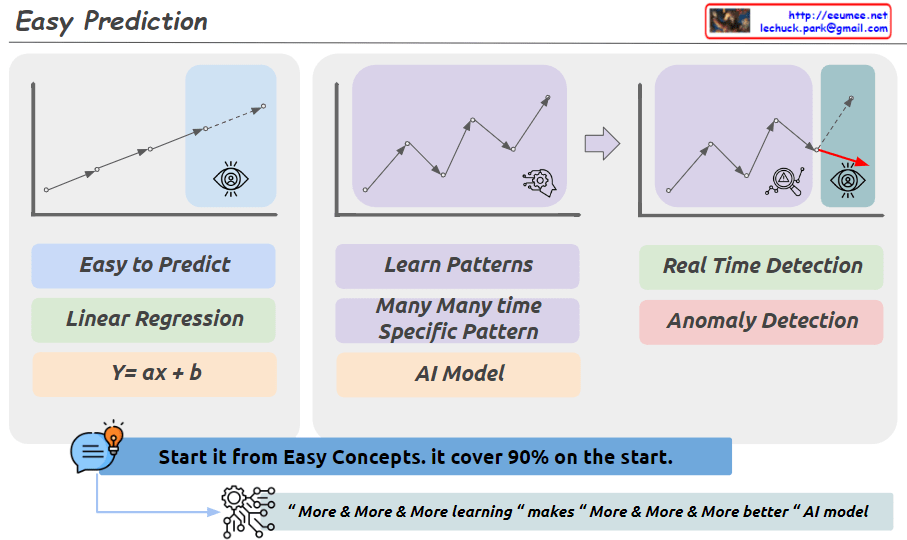
This image illustrates three main approaches to prediction and pattern recognition.
First, for easy prediction, a linear regression model (Linear Regression, y=ax+b) can be used. This is represented by a simple upward trendline. While a basic concept, it is emphasized that this can cover 90% of cases.
Second, for learning complex patterns that recur over time, an AI model is required. This is depicted by the jagged line shape.
Third, for real-time anomaly detection, sudden spike patterns need to be identified.
Additionally, at the bottom of the image, a new phrase has been added: “More & More & More learning makes More & More & More better AI model.” This conveys the idea that as an AI model learns from more and more data, its performance continues to improve.
In summary, the image highlights a step-by-step approach: starting with simple concepts to build a foundation, then utilizing AI models to learn complex patterns, and continuously improving the models through ongoing data learning and training. The key emphasis is on starting with the basics, while recognizing the potential of advanced AI techniques when combined with extensive learning from data.

From Claude with some prompting
The image depicts the effects of digitalization in three distinct stages:
Stage 1: Long-Term Accumulated Efficiency Gains Initially, efforts towards digitalization, such as standardization, automation, system and data-based work, may not yield visible results for a considerable amount of time. However, during this period, continuous improvement and optimization gradually lead to an accumulation of efficiency gains.
Stage 2: Eventual Leaps Once the efforts from Stage 1 reach a critical point, significant performance improvements and innovative breakthroughs occur, backed by the experience and learning acquired. The previously accumulated data and process improvement know-how enable these sudden leaps forward.
Stage 3: Extensive Huge Upturn with Big Data & AI Through digitalization, big data is built, and when combined with artificial intelligence technologies, unprecedented and massive levels of performance can be achieved. Data-driven predictions and automated decision-making enable disruptive value creation across a wide range of domains.
Therefore, while the initial stage of digital transformation may seem to yield minimal visible gains, persevering with continuous efforts will allow the accumulation of experience and data, eventually opening up opportunities for rapid innovation and large-scale growth. The key is to maintain patience and commitment, as the true potential of digitalization can be unlocked through the combination of data and advanced technologies like AI.
From Claude with some prompting
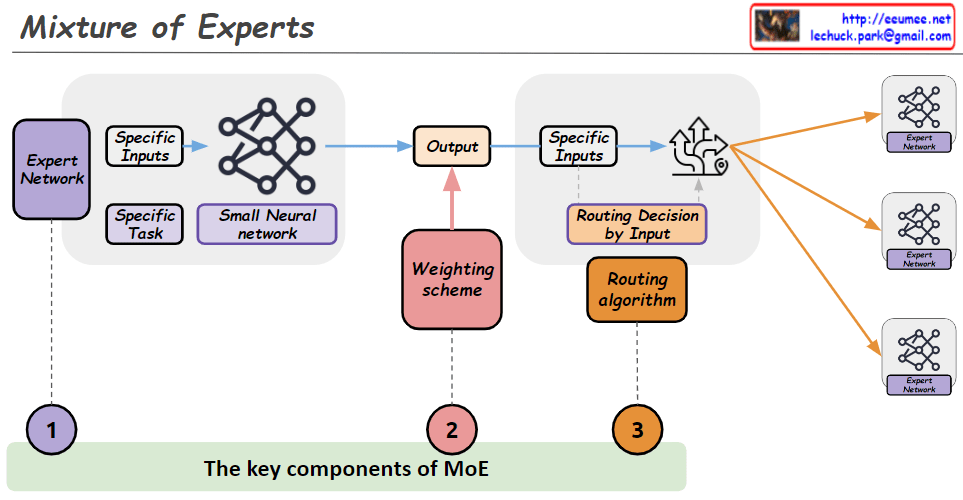
This image illustrates the key components of a Mixture of Experts (MoE) model architecture. An MoE model combines the outputs of multiple expert networks to produce a final output.
The main components are:
The workflow is as follows: The specific inputs are fed into the routing algorithm (3), which decides which expert network(s) should process those inputs. The selected expert network(s) (1) process the inputs and generate outputs. The weighting scheme (2) then combines these expert outputs into a final output based on a small neural network.
The key idea is that different expert networks can specialize in different types of inputs or tasks, and the MoE architecture can leverage their collective expertise by routing inputs to the appropriate experts and combining their outputs intelligently.
 Lechuck Park