Where it is?

From Bard with some prompting

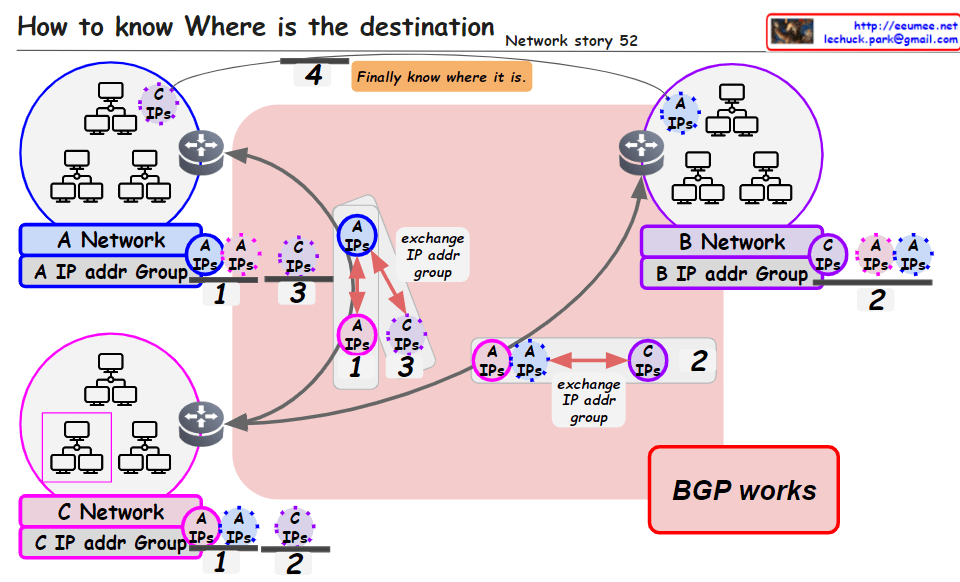
1. The sender sends a packet using the destination IP address.

2. Routers use the destination IP address to determine the path to forward the packet.

3. Routers use the BGP protocol to share routing information with other routers.

4. The packet travels through multiple routers until it reaches the destination network.

5. The router in the destination network uses the destination IP address to forward the packet to the destination host.

6. The destination host receives and processes the packet.

Note:

  • This summary only explains the basic concepts, and the actual network environment can be more complex.
  • For more information, please refer to networking books or websites.


3 for Datacenter

From DALL-E with some prompting
This image visually represents “3 Key Strategies for DC Operation.”

  1. Transform
    • Digitalization: Transitioning data centers to digital technology.
      • KPI (Key Performance Indicators)
      • PUE (Power Usage Effectiveness) & Monitoring
      • Automation
      • Data API Service
  2. Use
    • Data Platform: Establishing platforms for data management and utilization.
      • Standardization
      • Platform
      • Continuous Upgrade
      • New!!
  3. Verify
    • AI: Validating efficiency and performance of data centers through AI.
      • Real AI
      • Early Warning
      • Energy Operation

These three strategies are interconnected with three objectives: “Experience to Digital,” “Continuous Innovation,” and “AI DC Now!!” This illustrates that the operation of data centers is moving towards impacting humans through digitalization, innovation, and the application of AI technology, driving transformation across the industry.

Linux RUN LEVEL

From DALL-E with some prompting
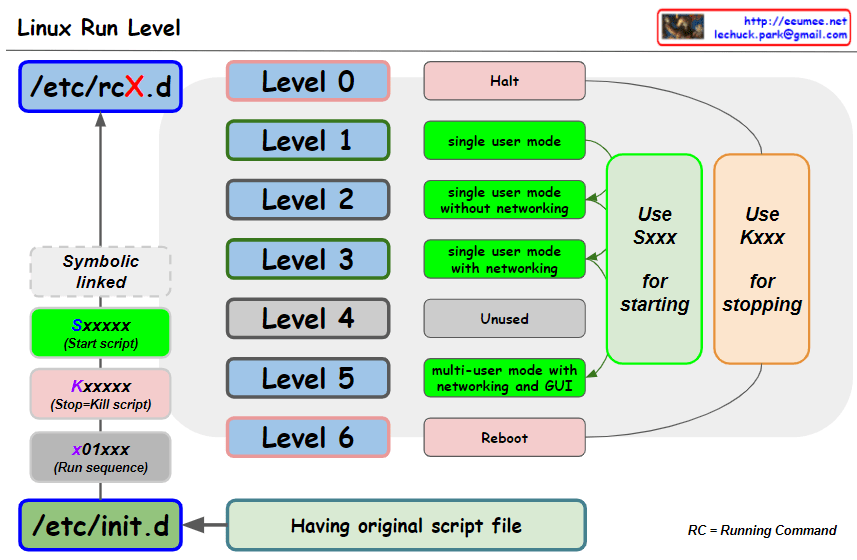
The image describes the Linux Run Levels, which are modes of operation in Unix-like operating systems. It explains the directories /etc/rcX.d where X is the run level number, and /etc/init.d which contains the original script files. The various levels are highlighted:

  • Level 0: Halt the system.
  • Level 1: Single user mode.
  • Level 2: Single user mode without networking.
  • Level 3: Single user mode with networking.
  • Level 4: Unused.
  • Level 5: Multi-user mode with networking and GUI.
  • Level 6: Reboot.

Scripts starting with S are used to start services, and those starting with K are used to stop services. The scripts are symbolically linked and have a naming convention that usually starts with S or K followed by a number indicating the order of execution.

IP network

From DALL-E with some prompting
The image presents an overview of IP network operation, emphasizing that there are two main methods by which data moves across the network. The focus is on the second method, where:

  • IP Address: Acts as the unique identifier within the internet, similar to a physical address in the real world.
  • Transmission Devices: These are network devices like switches and routers that facilitate the movement of data packets through the network.
  • Packets and Physical Connections: Data packets are routed based on their IP addresses through physical connections established within the network infrastructure.

The core message is that in an IP network, data doesn’t move on its own; it is routed based on IP addresses through devices that make the transport decisions, highlighting the importance of network infrastructure in the efficient delivery of data packets to their intended destinations.


Exp to the AI

From DALL-E with some prompting
The image outlines a transformative process in AI development:

Experience to Data: This depicts the conversion of real-world experiences into digital data. Icons indicate a brain or cognition and a gear mechanism, symbolizing the process of understanding and systematizing experiences.

Digital to Platform: The transformed data is then standardized on a platform. Icons of servers and a microchip suggest data storage and processing.

Platform Makes New & AI: Utilizing the standardized data, the platform facilitates the creation of new AI services. Icons of an AI chip and a symbol for ‘new’ represent the innovation and development of AI applications.

Overall, the image emphasizes the value of converting experiences into a digital format that can be standardized on a platform to drive the creation of innovative AI services.

The minority

From DALL-E with some prompting
The image appears to illustrate a concept related to network dynamics, specifically how a minority within a network can gain influence or power. It shows a progression of three stages:

  1. A central node with uniform connections around it, representing an initial state of a network.
  2. The same network, but with the central node now having a dashed outline, possibly indicating the beginning of a decentralization process or the distribution of control.
  3. In the final stage, two nodes labeled “Min” are highlighted, suggesting that these minority nodes have gained significant influence within the network. The question “Bad Minority??” implies a potential concern about the intentions or impact of this empowered minority.

The overarching message could be about the changing nature of influence in increasingly shared, Internet-enabled, and distributed networks, and the potential for smaller or previously less influential actors to become powerful, with an open question about whether this influence is positive or negative.