Predictive 2 Reactions for AI HIGH Fluctuation

Image Interpretation: Predictive 2-Stage Reactions for AI Fluctuation

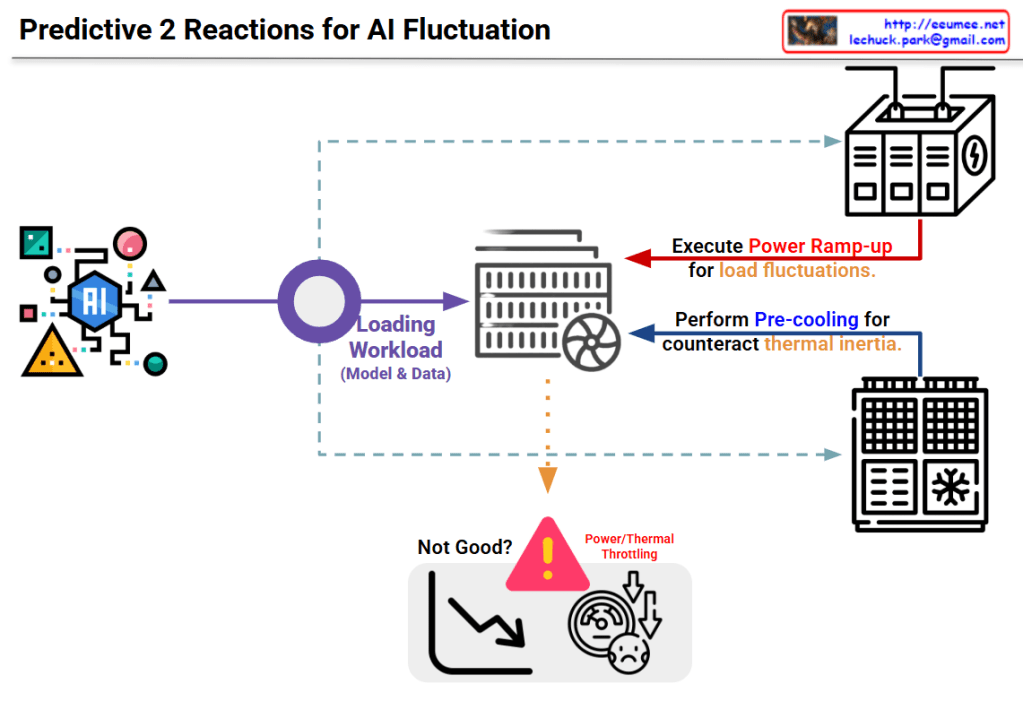
This diagram illustrates a two-stage predictive strategy to address load fluctuation issues in AI systems.

System Architecture

Input Stage:

  • The AI model on the left generates various workloads (model and data)

Processing Stage:

  • Generated workloads are transferred to the central server/computing system

Two-Stage Predictive Reaction Mechanism

Stage 1: Power Ramp-up

  • Purpose: Prepare for load fluctuations
  • Method: The power supply system at the top proactively increases power in advance
  • Preventive measure to secure power before the load increases

Stage 2: Pre-cooling

  • Purpose: Counteract thermal inertia
  • Method: The cooling system at the bottom performs cooling in advance
  • Proactive response to lower system temperature before heat generation

Problem Scenario

The warning area at the bottom center shows problems that occur without these responses:

  • Power/Thermal Throttling
  • Performance degradation (downward curve in the graph)
  • System dissatisfaction state

Key Concept

This system proposes an intelligent infrastructure management approach that predicts rapid fluctuations in AI workloads and proactively adjusts power and cooling before actual loads occur, thereby preventing performance degradation.


Summary

This diagram presents a predictive two-stage reaction system for AI workload management that combines proactive power ramp-up and pre-cooling to prevent thermal throttling. By anticipating load fluctuations before they occur, the system maintains optimal performance without degradation. The approach represents a shift from reactive to predictive infrastructure management in AI computing environments.


#AIInfrastructure #PredictiveComputing #ThermalManagement #PowerManagement #AIWorkload #DataCenterOptimization #ProactiveScaling #AIPerformance #ThermalThrottling #SmartCooling #MLOps #AIEfficiency #ComputeOptimization #InfrastructureAsCode #AIOperations

With Claude
LLM goes with Computing-Power-Cooling

LLM’s Computing-Power-Cooling Relationship

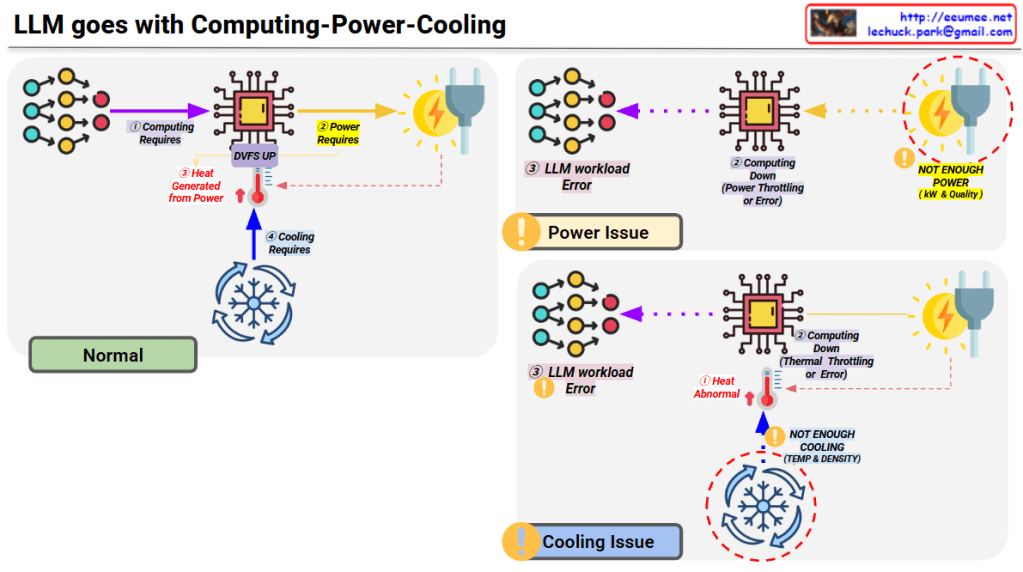
This diagram illustrates the technical architecture and potential issues that can occur when operating LLMs (Large Language Models).

Normal Operation (Top Left)

  1. Computing Requires – LLM workload is delivered to the processor
  2. Power Requires – Power supplied via DVFS (Dynamic Voltage and Frequency Scaling)
  3. Heat Generated – Heat is produced during computing processes
  4. Cooling Requires – Temperature management through proper cooling systems

Problem Scenarios

Power Issue (Top Right)

  • Symptom: Insufficient power (kW & Quality)
  • Results:
    • Computing performance degradation
    • Power throttling or errors
    • LLM workload errors

Cooling Issue (Bottom Right)

  • Symptom: Insufficient cooling (Temperature & Density)
  • Results:
    • Abnormal heat generation
    • Thermal throttling or errors
    • Computing performance degradation
    • LLM workload errors

Key Message

For stable LLM operations, the three elements of Computing-Power-Cooling must be balanced. If any one element is insufficient, it leads to system-wide performance degradation or errors. This emphasizes that AI infrastructure design must consider not only computing power but also adequate power supply and cooling systems together.


Summary

  • LLM operation requires a critical balance between computing, power supply, and cooling infrastructure.
  • Insufficient power causes power throttling, while inadequate cooling leads to thermal throttling, both resulting in workload errors.
  • Successful AI infrastructure design must holistically address all three components rather than focusing solely on computational capacity.

#LLM #AIInfrastructure #DataCenter #ThermalManagement #PowerManagement #AIOperations #MachineLearning #HPC #DataCenterCooling #AIHardware #ComputeOptimization #MLOps #TechInfrastructure #AIatScale #GreenAI

WIth Claude

Power/Cooling impacts to AI Work

Power/Cooling Impacts on AI Work – Analysis

This slide summarizes research findings on how AI workloads impact power grids and cooling systems.

Key Findings:

๐Ÿ“Š Reliability & Failure Studies

  • Large-Scale ML Cluster Reliability (Meta, 2024/25)
    • 1024-GPU job MTTF (Mean Time To Failure): 7.9 hours
    • 8-GPU job: 47.7 days
    • 16,384-GPU job: 1.8 hours
    • โ†’ Larger jobs = higher failure risk due to cooling/power faults amplifying errors

๐Ÿ”Œ Silent Data Corruption (SDC)

  • SDC in LLM Training (2025)
    • Meta report: 6 SDC failures in 54-day pretraining run
    • Power droop, thermal stress โ†’ hardware faults โ†’ silent errors โ†’ training divergence

โšก Inference Energy Efficiency

  • LLM Inference Energy Consumption (2025)
    • GPT-4o query benchmarks:
      • Short: 0.43 Wh
      • Medium: ~3.71 Wh
    • Batch 4โ†’8: ~43% savings
    • Batch 8โ†’16: ~43% savings per prompt
    • โ†’ PUE & infrastructure efficiency significantly impact inference cost, delay, and carbon footprint

๐Ÿญ Grid-Level Instability

  • AI-Induced Power Grid Disruptions (2024)
    • Model training causes power transients
    • Dropouts โ†’ hardware resets
    • Grid-level instability โ†’ node-level errors (SDC, restarts) โ†’ LLM job failures

๐ŸŽฏ Summary:

  1. Large-scale AI workloads face exponentially higher failure rates – bigger jobs are increasingly vulnerable to power/cooling system issues, with 16K-GPU jobs failing every 1.8 hours.
  2. Silent data corruption from thermal/power stress causes undetected training failures, while inference efficiency can be dramatically improved through batch optimization (43% energy reduction).
  3. AI training creates a vicious cycle of grid instability – power transients trigger hardware faults that cascade into training failures, requiring robust infrastructure design for power stability and fault tolerance.

#AIInfrastructure #MLOps #DataCenterEfficiency #PowerManagement #AIReliability #LLMTraining #SilentDataCorruption #EnergyEfficiency #GridStability #AIatScale #HPC #CoolingSystem #AIFailures #SustainableAI #InferenceOptimization

With Claude