Server Room Stability & Optimization

From Claude with some prompting
Server Room Stability & Optimization

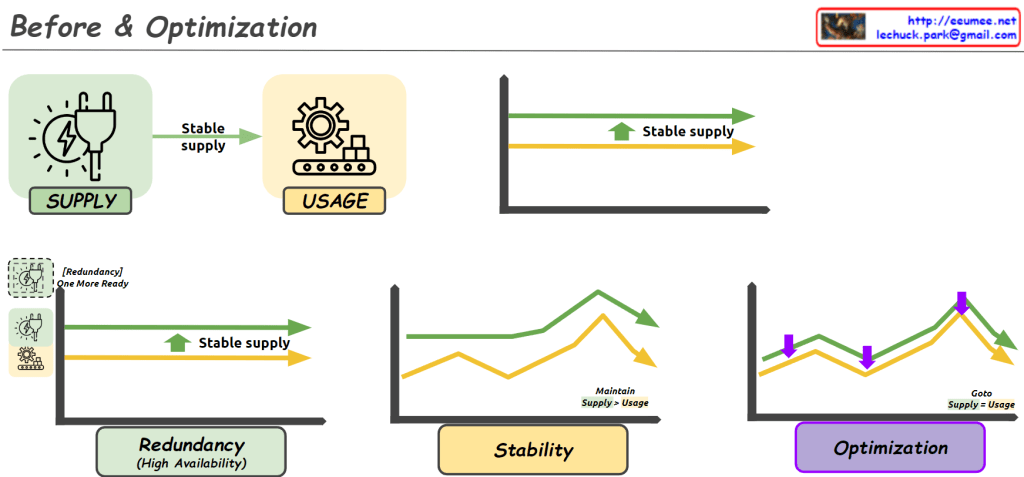
  1. Cooling Supply: Ensuring sufficient cooling capacity to effectively dissipate the heat generated by the servers
  2. Power Usage: Monitoring and managing the power consumption of the servers
  3. Power Supply: Maintaining a stable and reliable power supply to the server room
  4. Resource Check:
    • Power Resource: Verifying the ability to provide the necessary power supply for the server usage
    • Cooling Resource: Checking the cooling capacity to effectively handle the heat generated by the servers
  5. Anomaly Detection: Identifying any anomalies or unusual patterns in the server room’s behavior
  6. Stability: Maintaining the power and cooling resource supply to meet or exceed the server usage requirements
  7. Optimizing: Based on the stability analysis, optimizing the power and cooling resource supply to match the server usage

The key focus is on the appropriate management and provisioning of both power and cooling resources to ensure the overall stability and optimization of the server room operations.

Optimization 2

From Claude with some prompting
This image titled “Optimization II” illustrates the process of optimization between Supply and Usage. Here’s a comprehensive interpretation:

  1. The top shows a simple diagram depicting the basic relationship between Supply and Usage.
  2. The middle section presents graphs showing the fluctuations of Supply and Usage over time, comparing the states before and after optimization.
  3. The equation “Supply – Usage = Optimization Target” is provided, clearly defining the optimization goal.
  4. The bottom diagram illustrates the optimization process. It shows that optimization continues until the ‘Optimization Target Cost’ is less than the ‘Supply – Usage Cost’. This is to ensure that the cost of optimization doesn’t exceed the cost difference between supply and usage.
  5. The right-side graphs and explanation demonstrate that as the rate of change in usage increases (with high and low frequency), the need for optimization work becomes greater.
  6. The question “By What? By Manual? Software system?” is posed, prompting consideration of how to address this increased need for optimization – whether through manual processes or software systems.

Overall, this diagram emphasizes the importance of the optimization process between supply and usage, the efficiency of optimization costs, the increased need for optimization as usage patterns change, and the necessity to consider practical solutions for implementing these optimizations.

By Software System

From Claude with some prompting
This image illustrates the improvement of work processes through a software system. It’s divided into two parts, with the left side showing manual work and the right side depicting work done through a software system.

Left side (Manual):

  1. Work: Represented by a wrench icon
  2. Process: Shown as a flowchart-like icon
  3. Stability and Efficiency are shown in a trade-off relationship with arrows

Right side (Software System):

  1. Automation: Depicted by a rotating gear icon
  2. Optimization: Represented by an ascending graph icon
  3. Long Jump: Shown with a clock and hourglass icon
    • Described as “Get great results over a long period of time”
  4. Both Stability and Efficiency are shown to increase with upward arrows

The image demonstrates that implementing a software system can simultaneously improve stability and efficiency, and through automation and optimization, achieve significant long-term results.

This diagram effectively contrasts the limitations of manual processes with the benefits of implementing a software system for work processes.

Optimization

From Claude with some prompting
This image illustrates the concept of “Optimization” through four graphs representing different optimization levels:

  1. Optimization Level 1: Shows basic usage and supply curves.
  2. Optimization Level 2: Similar to Level 1, but with supply (green arrows) managed more efficiently.
  3. Optimization Level 3: Demonstrates both usage and supply being managed more efficiently. Green arrows (supply) are adjusted at multiple points.
  4. Optimization Level 4: Usage and supply curves almost align, indicating optimal efficiency achieved.

In each graph, the orange line represents usage, while green arrows indicate supply. As the optimization level increases, the two lines become more aligned, showing improved efficiency.

The image title “Optimization” is at the top. The legend in the bottom left correctly shows that green arrows represent supply and orange arrows represent usage.

Why digitalization?

From Claude with some prompting
The image depicts the effects of digitalization in three distinct stages:

Stage 1: Long-Term Accumulated Efficiency Gains Initially, efforts towards digitalization, such as standardization, automation, system and data-based work, may not yield visible results for a considerable amount of time. However, during this period, continuous improvement and optimization gradually lead to an accumulation of efficiency gains.

Stage 2: Eventual Leaps Once the efforts from Stage 1 reach a critical point, significant performance improvements and innovative breakthroughs occur, backed by the experience and learning acquired. The previously accumulated data and process improvement know-how enable these sudden leaps forward.

Stage 3: Extensive Huge Upturn with Big Data & AI Through digitalization, big data is built, and when combined with artificial intelligence technologies, unprecedented and massive levels of performance can be achieved. Data-driven predictions and automated decision-making enable disruptive value creation across a wide range of domains.

Therefore, while the initial stage of digital transformation may seem to yield minimal visible gains, persevering with continuous efforts will allow the accumulation of experience and data, eventually opening up opportunities for rapid innovation and large-scale growth. The key is to maintain patience and commitment, as the true potential of digitalization can be unlocked through the combination of data and advanced technologies like AI.

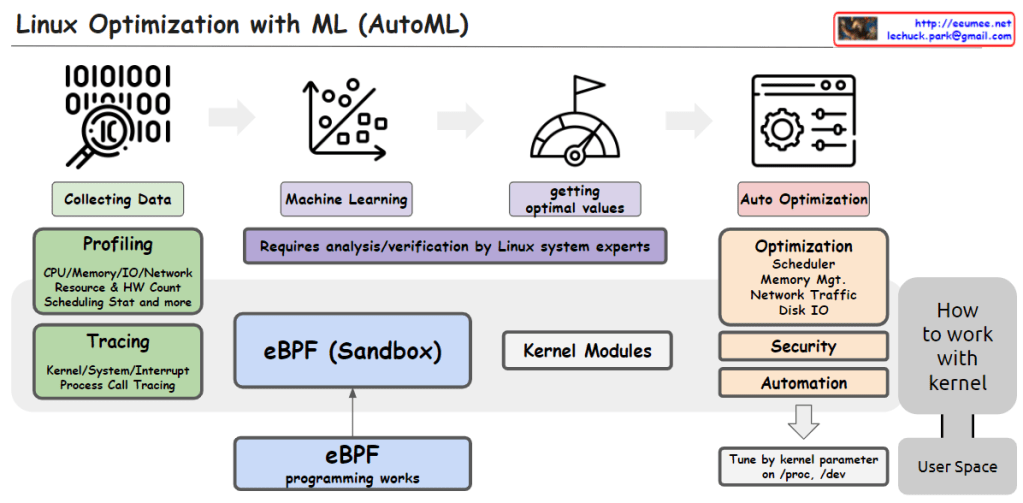
Linux with ML

From Claude with some prompting
This image illustrates the process of utilizing Machine Learning (ML) and AutoML techniques for system optimization in Linux.

It starts with collecting data through profiling techniques that gather statistics on CPU, memory, I/O, network resource usage, hardware counters, scheduling information, etc. Tracing is also employed to capture kernel/system/interrupt events and process call traces.

The collected data is then used to train machine learning models. This step requires analysis and verification by Linux system experts.

The trained models help determine optimal values, which are then applied to optimize various system components such as the scheduler, memory management, network traffic, and disk I/O. Optimization can also target security and automation aspects.

The eBPF (Enhanced Berkeley Packet Filter) sandbox, situated in the center, allows safe execution within the kernel, enabling eBPF programs to interact with the kernel.

Kernel modules provide another way to implement optimization logic and integrate it directly into the kernel.

Finally, kernel parameters can be tuned from user space to perform optimizations.

In summary, the image depicts an AutoML-based process that leverages data collection, machine learning modeling, deriving optimal values, eBPF, kernel modules, and parameter tuning to automate system optimization in Linux across various kernel subsystems like the scheduler, memory management, network, and disk I/O.C

Data Standardization

From DALL-E with some prompting
The image emphasizes the importance of data quality in the digital transformation of large-scale operations. By securing “Data Quality” through data standardization, optimized operations based on verified data enable reliable decision-making, monitoring, and optimization. AI-enhanced analysis and optimization accelerate business transformation, drive data-led innovation, and achieve sustainable operation and customer satisfaction.

  1. Data Standardization: Emphasizes the importance of “Data Quality,” indicating that high-quality, standardized data is foundational.
  2. Operation based on verified data/system: Shows the use of verified data to ensure reliable decision-making, monitoring, and optimization, leading to sustainable operations, business intelligence, and customer satisfaction.
  3. Accelerating (AI) digital business transformation: Describes how optimized and customized processing, along with an AI data analysis platform, can accelerate digital transformation. This leads to work automation, user customization, resource optimization, data-driven innovation, AI predictions and analytics, and expanding standardization.

The overall message suggests that standardizing data quality is crucial for building AI systems that can drive digital transformation and improve business operations and customer satisfaction.