AI DC : CAPEX to OPEX (2) inside


AI DC: The Chain Reaction from CAPEX to OPEX Risk

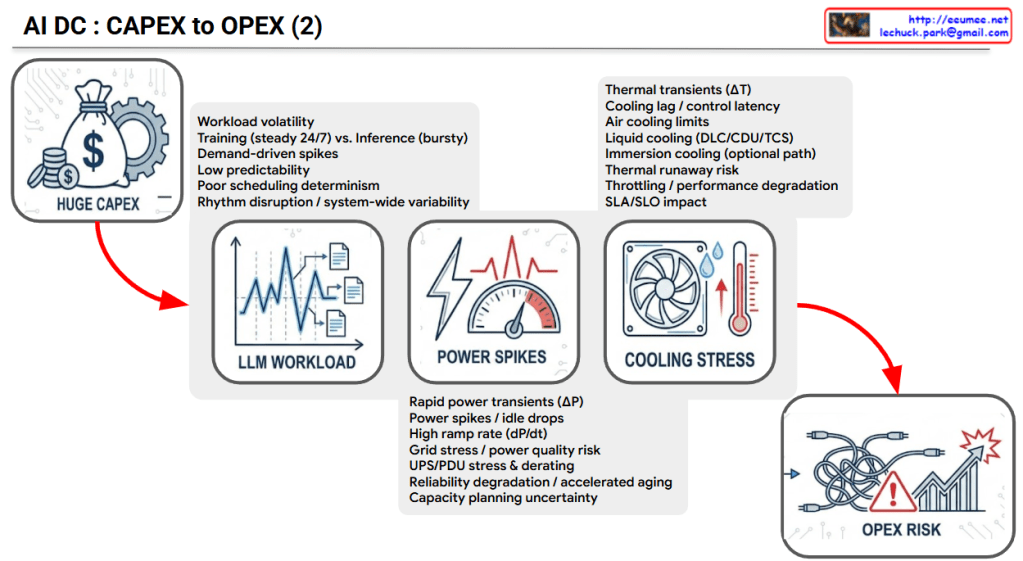
The provided image logically illustrates the sequential mechanism of how the massive initial capital expenditure (CAPEX) of an AI Data Center (AI DC) translates into complex operational risks and increased operating expenses (OPEX).

1. HUGE CAPEX (Massive Initial Investment)

  • Context: Building an AI data center requires enormous capital expenditure (CAPEX) due to high-cost GPU servers, high-density racks, and specialized networking infrastructure.
  • Flow: However, the challenge does not end with high initial costs. Driven by the following three factors, this massive infrastructure investment inevitably cascades into severe operational risks.

2. LLM WORKLOAD (The Root Cause)

  • Characteristics: Unlike traditional IT workloads, AI (especially LLM) workloads are highly volatile and unpredictable.
  • Key Factors: * The continuous, heavy load of Training (steady 24/7) mixed with the bursty, erratic nature of Inference.
    • Demand-driven spikes and low predictability, which lead to poor scheduling determinism and system-wide rhythm disruption.

3. POWER SPIKES (Electrical Infrastructure Stress)

  • Characteristics: The extreme volatility of LLM workloads causes sudden, extreme fluctuations in server power consumption.
  • Key Factors:
    • Rapid power transients (ΔP) and high ramp rates (dP/dt) create sudden power spikes and idle drops.
    • These fluctuations cause significant grid stress, accelerate the aging of power distribution equipment (UPS/PDU stress & derating), degrade overall system reliability, and create major capacity planning uncertainty.

4. COOLING STRESS (Thermal System Stress)

  • Characteristics: Sudden surges in power consumption immediately translate into rapid temperature increases (Thermal transients, ΔT).
  • Key Factors:
    • Cooling lag / control latency: There is an inevitable delay between the sudden heat generation and the cooling system’s physical response.
    • Physical limits: Traditional air cooling hits its limits, forcing transitions to Liquid cooling (DLC/CDU) or Immersion cooling. Failure to manage this latency increases the risk of thermal runaway, triggers system throttling (performance degradation), and negatively impacts SLAs/SLOs.

5. OPEX RISK (The Final Operational Consequence)

  • Context: The combination of unpredictable LLM workloads, power infrastructure stress, and cooling system limitations culminates in severe OPEX Risk.
  • Conclusion: Ultimately, this chain reaction exponentially increases daily operational costs and uncertainties—ranging from accelerated equipment replacement costs and higher power bills (due to degraded PUE) to massive expenses related to frequent incident responses and infrastructure instability.

Summary:

The slide delivers a powerful message: While the physical construction of an AI data center is highly expensive (CAPEX), the true danger lies in the unique volatility of AI workloads. This volatility triggers extreme power (ΔP) and thermal (ΔT) spikes. If these physical transients are not strictly managed, the operational costs and risks (OPEX) will spiral completely out of control.

#AIDataCenter #AIDC #CAPEX #OPEX #LLMWorkload #PowerSpikes #CoolingStress #LiquidCooling #ThermalManagement #DataCenterInfrastructure #GPUInfrastructure #OPEXRisk

With Gemini
AI DC : CAPEX to OPEX

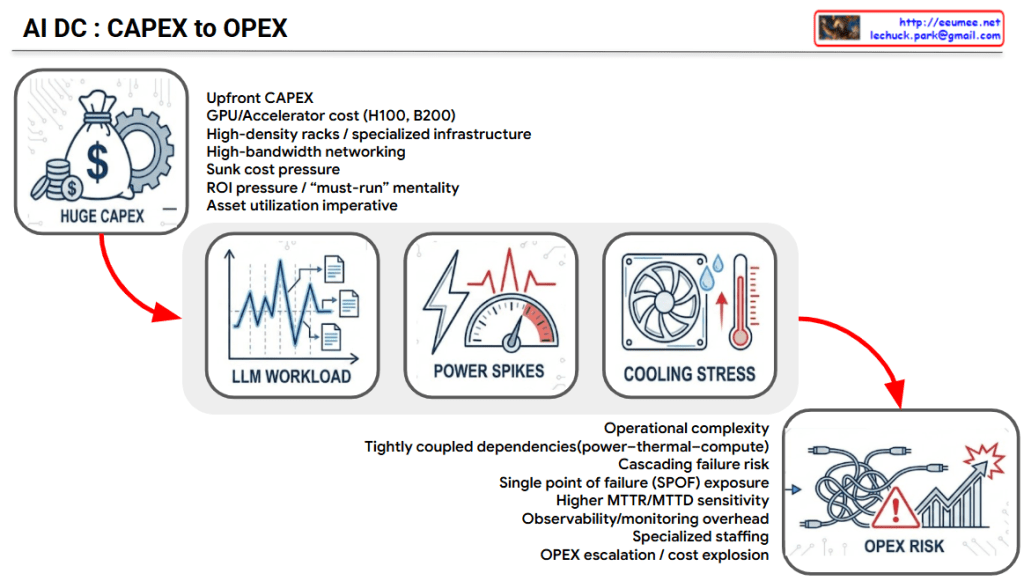
Thinking of an AI Data Center (DC) through the lens of a Rube Goldberg Machine is a brilliant way to visualize the “cascading complexity” of modern infrastructure. In this setup, every high-tech component acts as a trigger for the next, often leading to unpredictable and costly outcomes.


The AI DC Rube Goldberg Chain: From CAPEX to OPEX

1. The Heavy Trigger: Massive CAPEX

The machine starts with a massive “weighted ball”—the Upfront CAPEX.

  • The Action: Billions are poured into H100/B200 GPUs and specialized high-density racks.
  • The Consequence: This creates immense “Sunk Cost Pressure.” Because the investment is so high, there is a “must-run” mentality to ensure maximum asset utilization. You cannot afford to let these expensive chips sit idle.

2. The Erratic Spinner: LLM Workload Volatility

As the ball rolls, it hits an unpredictable spinner: the Workload.

  • The Action: Unlike traditional steady-state cloud tasks, LLM workloads (training vs. inference) are highly “bursty”.
  • The Consequence: The demand for compute fluctuates wildly and unpredictably, making it impossible to establish a smooth operational rhythm.

3. The Power Lever: Energy Spikes

The erratic workload flips a lever that controls the Power Grid.

  • The Action: When the LLM workload spikes, the power draw follows instantly. This creates Power Spikes ($\Delta P$) that strain the electrical infrastructure.
  • The Consequence: These spikes threaten grid stability and increase the sensitivity of Power Distribution Units (PDUs) and UPS systems.

4. The Thermal Valve: Cooling Stress

The surge in power generates intense heat, triggering the Cooling System.

  • The Action: Heat is the literal byproduct of energy consumption. As power spikes, the temperature rises sharply, forcing cooling fans and liquid cooling loops into overdrive.
  • The Consequence: This creates Cooling Stress. If the cooling cannot react as fast as the power spike, the system faces “Thermal Throttling,” which slows down the compute and ruins efficiency.

5. The Tangled Finish: Escalating OPEX Risk

Finally, all these moving parts lead to a messy, high-risk conclusion: Operational Complexity.

  • The Action: Because power, thermal, and compute are “Tightly Coupled,” a failure in one area causes a Cascading Failure across the others.
  • The Consequence: You now face a “Single Point of Failure” (SPOF) risk. Managing this requires specialized staffing and expensive observability tools, leading to an OPEX Explosion.

Summary

  1. Massive CAPEX creates a “must-run” pressure that forces GPUs to operate at high intensity to justify the investment.
  2. The interconnected volatility of workloads, power, and cooling creates a fragile “Rube Goldberg” chain where a single spike can cause a system-wide failure.
  3. This complexity shifts the financial burden from initial hardware costs to unpredictable OPEX, requiring expensive specialized management to prevent a total crash.

#AIDC #CAPEXtoOPEX #LLMWorkload #DataCenterManagement #OperationalRisk #InfrastructureComplexity #GPUComputing


With Gemini

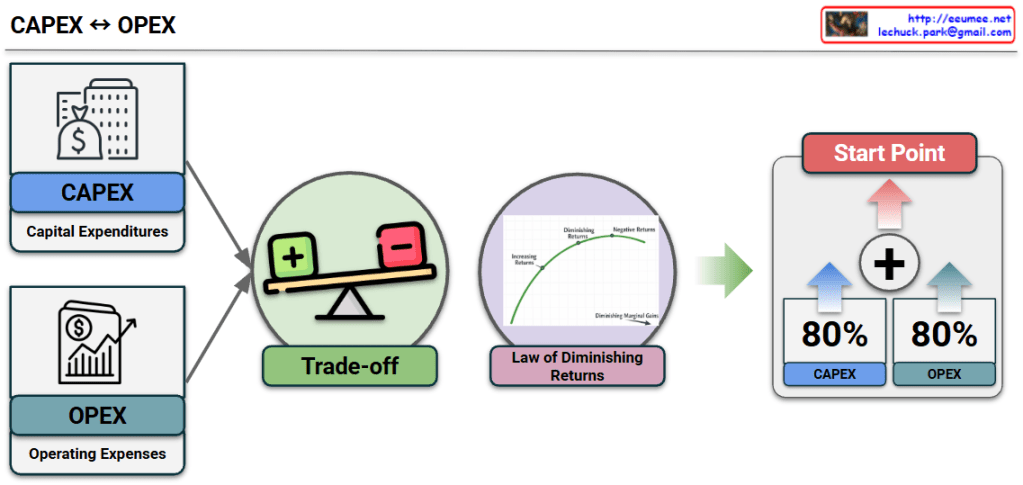
CAPEX & OPEX

1. Definitions (The Pillars)

  • CAPEX (Capital Expenditures): Upfront investments for physical assets (e.g., hardware, infrastructure) to create future value.
  • OPEX (Operating Expenses): Ongoing costs required to run the day-to-day operations (e.g., maintenance, utilities, subscriptions).

2. The Economic Logic

  • Trade-off: There is a natural tension between the two; higher upfront investment (CAPEX) can lower future operating costs (OPEX), and vice versa.
  • Law of Diminishing Returns: This graph warns that striving for 100% perfection in optimization yields progressively smaller benefits relative to the effort and cost invested.

3. Strategic Conclusion: The 80% Rule

  • The infographic proposes a pragmatic “Start Point.”
  • Instead of delaying for perfection, it suggests that achieving 80% readiness in CAPEX and 80% efficiency in OPEX is the sweet spot. This balance allows for a timely launch without falling into the trap of diminishing returns.

Summary

  1. While CAPEX and OPEX involve a necessary trade-off, striving for 100% optimization in both leads to diminishing returns.
  2. Over-optimization drains resources and delays execution without proportional gains.
  3. The most efficient strategy is to define the “Start Point” at 80% readiness for both, favoring speed and agility over perfection.

#CAPEXvsOPEX #BusinessStrategy #CostOptimization #DiminishingReturns #TechInfrastructure #OperationalEfficiency #Infographic #TechVisualizer #DecisionMaking