AI with humans

From DALL-E with some prompting
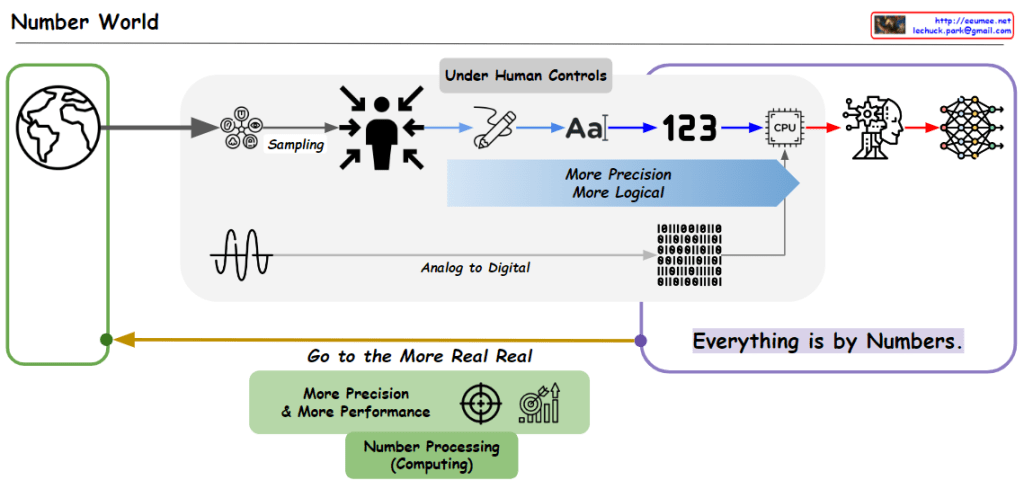
This image illustrates the process of how AI and humans interact with data. Initially, data undergoes computation, followed by human-led analysis. Rules are then discovered, which inform the creation or improvement of models. These processes lead to the sharing and generation of new ideas, feeding into an acceleration of AI capabilities.

The analysis and AI-discovered rules are used to construct or enhance models, which are then verified by AI to confirm the outcomes. Ultimately, the new ideas, products, or services developed through this process are shared and disseminated across society. This entire cycle fosters rapid advancements in AI, enabling improvements in human efficiency and task execution.

IF/THEN with AI/DT

From DALL-E with some prompting
The image depicts the evolution of decision-making processes from manual to automated, facilitated by AI and Digital Transformation (DT). Initially, decisions were made by humans based on specific conditions (IF condition THEN action). This manual approach did not involve computing. With DT, the process becomes automated through computing, making it faster and more efficient. The transition to AI and Machine Learning (ML) marks a further evolution where decisions are not just automated but are also data-driven, increasing accuracy and the ability to adapt to complex situations. The visual suggests a shift from human-based decision-making to a more sophisticated, automated, and intelligent system of processing and action-taking, indicative of modern advancements in technology.

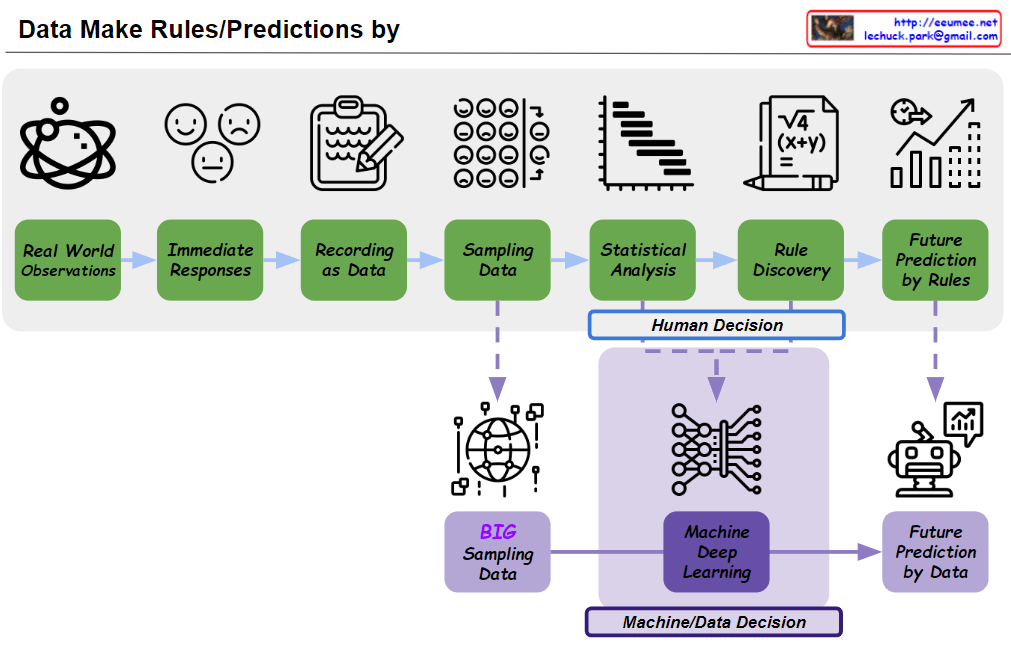
Data Make RULES

From DALL-E with some prompting
The image depicts the evolution of the decision-making process from data collection to conclusion. Where decisions were once made entirely by humans before the advent of AI/ML, the progress in big data processing and machine learning/deep learning now allows machines or the data itself to make decisions. Initially, the process was human-centric, starting from real-world observations to data recording, followed by statistical analysis and rule discovery to predict the future. With advancements, we now extract large samples from large datasets and utilize deep learning to recognize complex patterns, leading to a machine-centric process that predicts the future based on data. This shift emphasizes the power of data and the significance of machine learning.

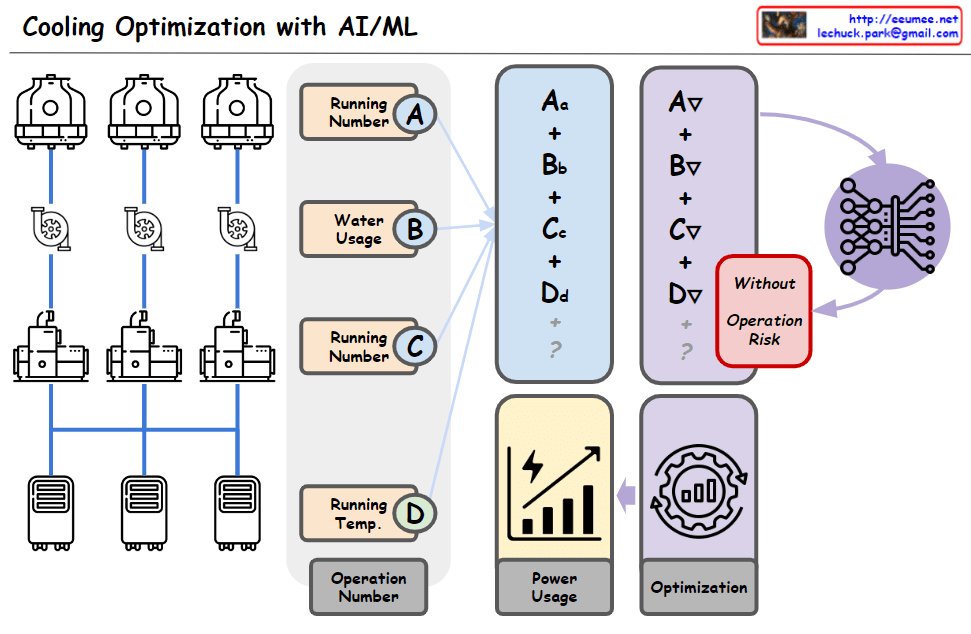
Cooling Optimization

From DALL-E with some prompting
The illustration depicts a process where key operational metrics related to energy usage in cooling systems are analyzed by AI to achieve energy optimization. The AI model evaluates essential data such as running numbers, water usage, and operational temperature to continuously optimize the system while emphasizing stable operation without disruptions. This represents an advanced approach to managing cooling systems that enhances energy efficiency while minimizing operational risks.