AI DC Changes

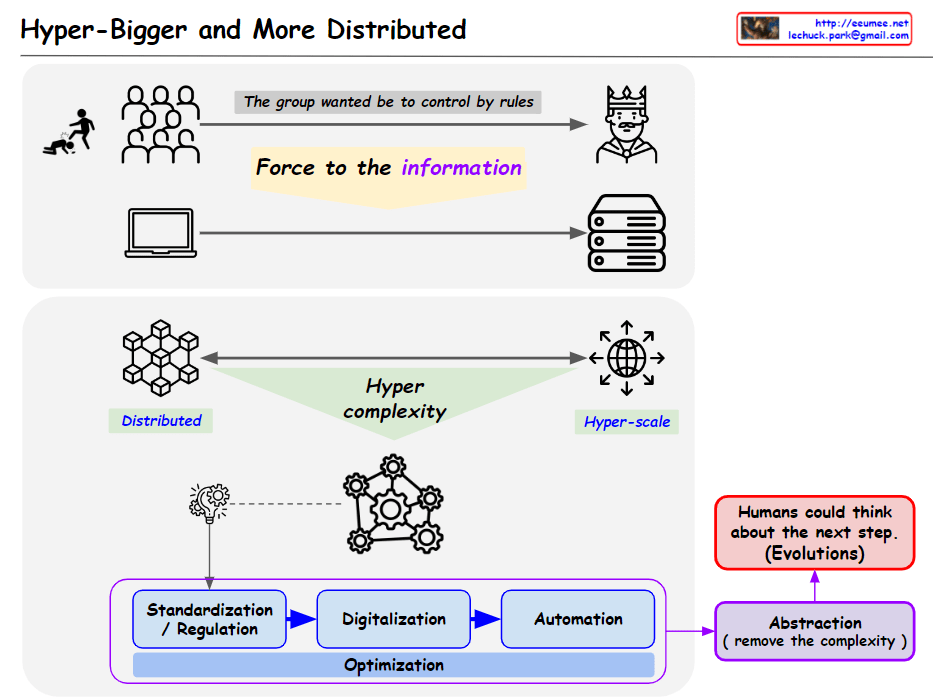
The evolution of AI data centers has progressed through the following stages:

  1. Legacy – The initial form of data centers, providing basic computing infrastructure.
  2. Hyperscale – Evolved into a centralized (Centric) structure with these characteristics:
    • Led by Big Tech companies (Google, Amazon, Microsoft, etc.)
    • Focused on AI model training (Learning) with massive computing power
    • Concentration of data and processing capabilities in central locations
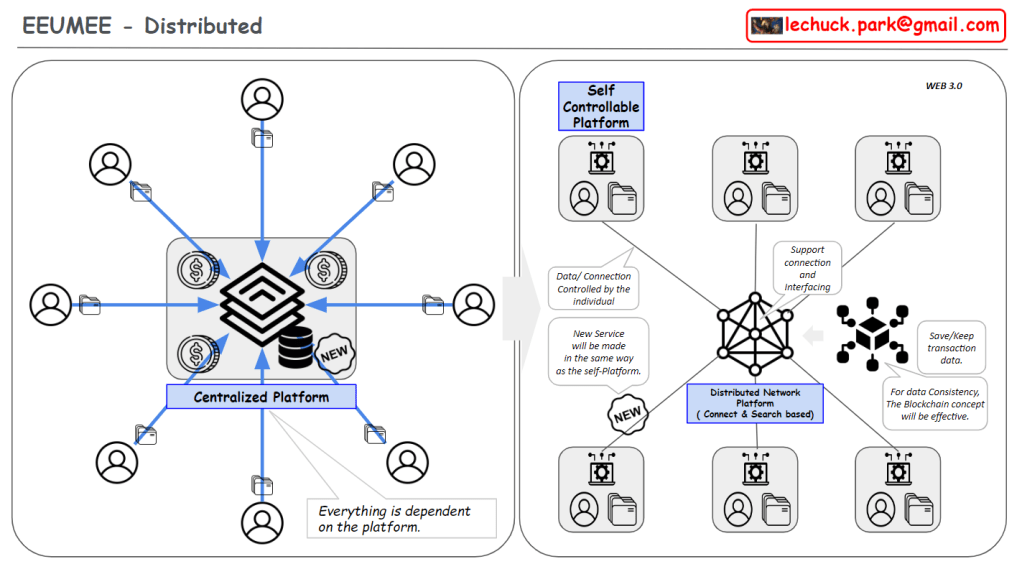
  3. Distributed – The current evolutionary direction with these features:
    • Expansion of Edge/On-device computing
    • Shift from AI training to inference-focused operations
    • Moving from Big Tech centralization to enterprise and national data sovereignty
    • Enabling personalization for customized user services

This evolution represents a democratization of AI technology, emphasizing data sovereignty, privacy protection, and the delivery of optimized services tailored to individual users.

AI data centers have evolved from legacy systems to hyperscale centralized structures dominated by Big Tech companies focused on AI training. The current shift toward distributed architecture emphasizes edge/on-device computing, inference capabilities, data sovereignty for enterprises and nations, and enhanced personalization for end users.

with Claude

Distributed System

From Claude with some prompting
This distributed system architecture can be broadly divided into five core areas:

1. CAP Theory-Based System Structure

  • CP (Consistency + Partition Tolerance) Systems
    • Supports real-time synchronization
    • Ensures strong data consistency
  • AP (Availability + Partition Tolerance) Systems
    • Continues service operation even in fault situations (Fault but Services OK)
    • Ensures availability through failover

2. Data Replication Strategies

  • Write (Master): Write operations are centered on the master node.
  • Read: Read-only nodes handle data reading.
  • Write & Read: Supports both read and write operations.
  • Multiple Node Writes (1, 2, 3): Supports distributed write operations across multiple nodes.

3. Scalability Patterns

  • Scale Up: Vertical scaling
  • Scale Out: Horizontal scaling
  • Provides flexible system scalability.

4. Partition Tolerance

  • Handles network partitioning
  • Ensures service continuity even in disconnected states (disconnected but Services OK)
  • Maintains independence between nodes

5. Fault Tolerance Mechanisms

  • Duplication: Data replication
  • Error Correction: Error correction mechanisms
  • Fault Block: Fault isolation
  • Ensures stable system operations

Key Design Considerations:

Trade-off Management:

  • Choose between CP and AP systems
  • Balance consistency and availability

Service-Specific Approach:

  • For single services: Focus on managing the service in a distributed environment

Data Management:

  • Real-time synchronization
  • Replication strategies
  • Fault recovery

System Stability:

  • Error handling
  • Fault isolation
  • Service continuity

These elements should be implemented in an integrated manner, considering their interconnections in distributed system design. Finding the right balance according to business requirements is essential.

The minority

From DALL-E with some prompting
The image appears to illustrate a concept related to network dynamics, specifically how a minority within a network can gain influence or power. It shows a progression of three stages:

  1. A central node with uniform connections around it, representing an initial state of a network.
  2. The same network, but with the central node now having a dashed outline, possibly indicating the beginning of a decentralization process or the distribution of control.
  3. In the final stage, two nodes labeled “Min” are highlighted, suggesting that these minority nodes have gained significant influence within the network. The question “Bad Minority??” implies a potential concern about the intentions or impact of this empowered minority.

The overarching message could be about the changing nature of influence in increasingly shared, Internet-enabled, and distributed networks, and the potential for smaller or previously less influential actors to become powerful, with an open question about whether this influence is positive or negative.