Data Center Digitalization

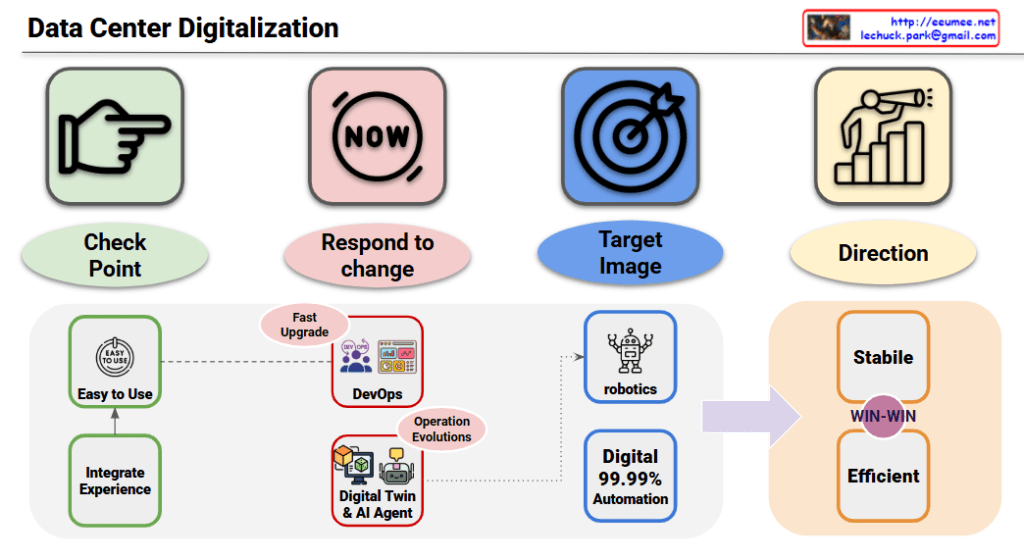
This image presents a roadmap for “Data Center Digitalization” showing the evolutionary process. Based on your explanation, here’s a more accurate interpretation:

Top 4 Core Concepts (Purpose for All Stages)

  • Check Point: Current state inspection and verification point for each stage
  • Respond to change: Rapid response system to quick changes
  • Target Image: Final target state to be achieved
  • Direction: Overall strategic direction setting

Digital Transformation Evolution Stages

Stage 1: Experience-Based Digital Environment Foundation

  • Easy to Use: Creating user-friendly digital environments through experience
  • Integrate Experience: Integrating existing data center operational experience and know-how into the digital environment
  • Purpose: Utilizing existing operational experience as checkpoints to establish a foundation for responding to changes

Stage 2: DevOps Integrated Environment Configuration

  • DevOps: Development-operations integrated environment supporting Fast Upgrade
  • Building efficient development-operations integrated systems based on existing operational experience and know-how
  • Purpose: Implementing DevOps environment that can rapidly respond to changes based on integrated experience

Stage 3: Evolution to Intelligent Digital Environment

  • Digital Twin & AI Agent(LLM): Accumulated operational experience and know-how evolve into digital twins and AI agents
  • Intelligent automated decision-making through Operation Evolutions
  • Purpose: Establishing intelligent systems toward the target image and confirming operational direction

Stage 4: Complete Automation Environment Achievement

  • Robotics: Unmanned operations through physical automation
  • Digital 99.99% Automation: Nearly complete digital automation environment integrating all experience and know-how
  • Purpose: Achieving the final target image – complete digital environment where all experience is implemented as automation

Final Goal: Simultaneous Development of Stability and Efficiency

WIN-WIN Achievement:

  • Stable: Ensuring high availability and reliability based on accumulated operational experience
  • Efficient: Maximizing operational efficiency utilizing integrated know-how

This diagram presents a strategic roadmap where data centers systematically integrate existing operational experience and know-how into digital environments, evolving step by step while reflecting the top 4 core concepts as purposes for each stage, ultimately achieving both stability and efficiency simultaneously.

With Claude

STEP BY STEP

This image depicts a problem-solving methodology diagram titled “STEP by STEP.”

The diagram illustrates an efficient step-by-step approach to problem solving:

  1. “Do It First!! (Confirmation)” – This initial stage focuses on the fundamental and easy-to-solve portions (80%). The approach here emphasizes “Divide and conquer with MECE” (Mutually Exclusive, Collectively Exhaustive), “Logicalization,” and “Digitalization” as key perspectives for tackling problems.
  2. The second “DO IT” stage – This addresses the more complex portions (20%) and applies the same methodology used in the first stage.
  3. The third “DO IT” stage – This continues applying the methodologies from previous stages in an iterative process.

Each stage is divided into a 20% (blue) and 80% (green) ratio, demonstrating the application of the Pareto principle (80/20 rule). This suggests a strategy of first resolving the fundamental 80% of problems that are easier to solve, then approaching the more complex 20% using the same methodology.

The circular nodes and arrows at the top represent the progression of this sequential problem-solving process, with the red target icon in the upper left symbolizing the ultimate goal.

This methodology emphasizes a systematic approach to complex problems by breaking them down, addressing them logically, and digitalizing when necessary for efficient resolution.

With Claude

Standardized Platform with the AI

From Claude with some prompting
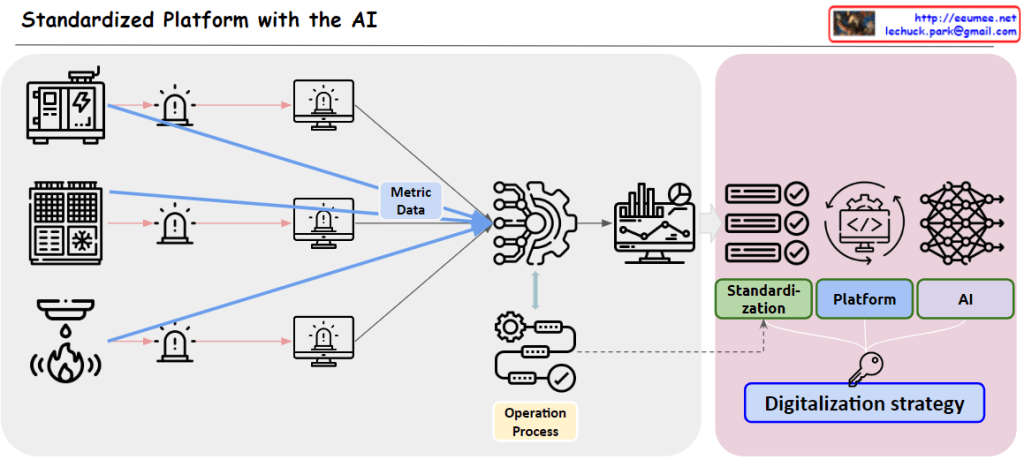
This image illustrates a “Standardized Platform with the AI”. Here’s a breakdown of the key components and processes:

  1. Left side: Various devices or systems (generator, HVAC system, fire detector, etc.) are shown. Each device is connected to an alarm system and a monitoring screen.
  2. Center: “Metric Data” from these devices is sent to a central gear-shaped icon, representing a data processing system.
  3. Upper right: The processed data is displayed on a dashboard or analytics screen.
  4. Lower right: There’s a section labeled “Operation Process”, indicating management or optimization of operational processes.
  5. Far right: Boxes representing the system’s components:
    • “Standardization”
    • “Platform”
    • “AI”
  6. Bottom: “Digitalization strategy” serves as the foundation for the entire system.

This diagram visualizes a digital transformation strategy that collects data from various systems and devices, processes it using AI on a standardized platform, and uses this to optimize and manage operations.

The flow shows how raw data from different sources is standardized, processed, and utilized to create actionable insights and improve operational efficiency, all underpinned by a comprehensive digitalization strategy.

Why digitalization?

From Claude with some prompting
The image depicts the effects of digitalization in three distinct stages:

Stage 1: Long-Term Accumulated Efficiency Gains Initially, efforts towards digitalization, such as standardization, automation, system and data-based work, may not yield visible results for a considerable amount of time. However, during this period, continuous improvement and optimization gradually lead to an accumulation of efficiency gains.

Stage 2: Eventual Leaps Once the efforts from Stage 1 reach a critical point, significant performance improvements and innovative breakthroughs occur, backed by the experience and learning acquired. The previously accumulated data and process improvement know-how enable these sudden leaps forward.

Stage 3: Extensive Huge Upturn with Big Data & AI Through digitalization, big data is built, and when combined with artificial intelligence technologies, unprecedented and massive levels of performance can be achieved. Data-driven predictions and automated decision-making enable disruptive value creation across a wide range of domains.

Therefore, while the initial stage of digital transformation may seem to yield minimal visible gains, persevering with continuous efforts will allow the accumulation of experience and data, eventually opening up opportunities for rapid innovation and large-scale growth. The key is to maintain patience and commitment, as the true potential of digitalization can be unlocked through the combination of data and advanced technologies like AI.

AI operation By Humans

From Claude with some prompting
This image illustrates a process called “Data Center AI Operation by Humans (Experts).” It depicts the various stages involved in utilizing artificial intelligence (AI) to analyze and optimize data center operations while ensuring that human experts have the final decision-making authority.

The process starts with data collection from various sources like servers and automation systems. This data is then verified and converted into a digital format suitable for analysis by AI algorithms. The AI system performs analysis and generates insights, which are combined with the data center processes to suggest optimizations.

However, before implementing any changes, human experts knowledgeable in data and AI review and finalize all decisions. This approach aims to leverage AI’s analytical capabilities while maintaining human expertise and oversight for critical operational decisions in the data center.

The image emphasizes that while AI acts as an “accelerator” for digitalization and analysis, the ultimate operation is carried out by human experts who understand the nuances of data and AI to ensure effective and responsible decision-making.

Digitalization

From DALL-E with some prompting
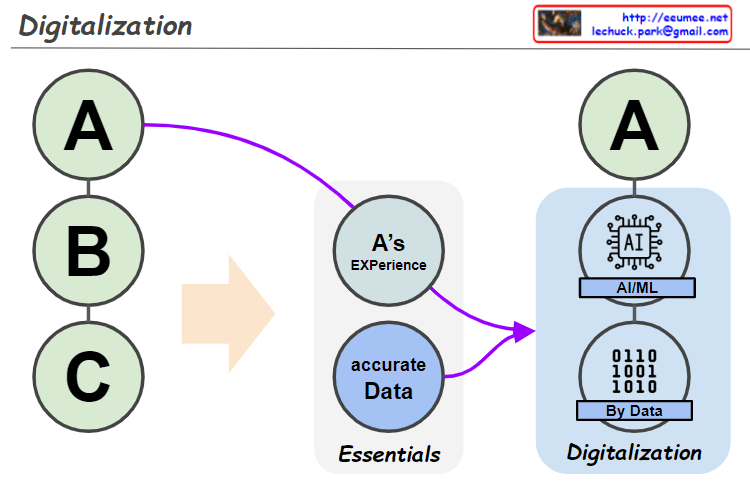
The image depicts three levels of experience, A, B, and C, highlighting that while A represents a high level of experience, levels B and C can be enhanced through digital transformation using data and AI technologies. This transformation underscores that the collection and analysis of accurate data are essential elements, as they lay the foundation for AI systems to perform sophisticated learning, thus improving operational efficiency and precision.

The integration of individual experiences and precise data is not merely a technical shift but also prompts significant changes in human resource management within organizations. By incorporating their expertise into digital platforms, employees can strengthen the organization’s knowledge base and contribute to their own professional development.

Ultimately, this digital transformation should be sustainable and maintain a human-centric approach, ensuring that the increase in operational efficiency through AI alleviates the workload on employees, fostering creativity and enhancing the organizational culture and values.


3 for Datacenter

From DALL-E with some prompting
This image visually represents “3 Key Strategies for DC Operation.”

  1. Transform
    • Digitalization: Transitioning data centers to digital technology.
      • KPI (Key Performance Indicators)
      • PUE (Power Usage Effectiveness) & Monitoring
      • Automation
      • Data API Service
  2. Use
    • Data Platform: Establishing platforms for data management and utilization.
      • Standardization
      • Platform
      • Continuous Upgrade
      • New!!
  3. Verify
    • AI: Validating efficiency and performance of data centers through AI.
      • Real AI
      • Early Warning
      • Energy Operation

These three strategies are interconnected with three objectives: “Experience to Digital,” “Continuous Innovation,” and “AI DC Now!!” This illustrates that the operation of data centers is moving towards impacting humans through digitalization, innovation, and the application of AI technology, driving transformation across the industry.