Lechuck History

From Claude with some prompting
“Lechuck History” diagram demonstrates the following technical career progression:

  1. “with Computer” section:
    • Advanced from C-based programming to system programming, O&M solutions, and network programming
    • Possess deep understanding of Linux kernel, RTOS, and TCP/IP stack
    • Performed “Single-Handedly A to Z” tasks in web service analysis/monitoring
    • Grew into the role of a software engineer
  2. “with People” section:
    • Gained experience in large ISP data centers, system management, large-scale network operations management, and CDN development/management
    • Developed skills to optimize and maximize existing system infrastructure
    • Created new service solutions including D/C business web portals, NMS big-data, DCIM, packet analysis customer solutions, and data analysis platforms
    • Managed “Big DC Op. System Design & DevOps”, demonstrating ability to handle customer-facing roles and collaborate with various partners

Additional key competencies:

  1. Maintain continuous interest in new technologies
  2. Possess the ability to quickly learn based on a solid understanding of fundamentals
  3. Currently enjoy learning cutting-edge technologies including AI and Quantum computing

This career path and skill set demonstrate the profile of a professional who continuously grows and pursues innovation in a rapidly changing technological environment.

BAS + EPMS + @ = DCIM

From Claude with some prompting
This image illustrates the distinction between BAS (Building Automation System), EPMS (Energy Power Management System), and DCIM (Data Center Infrastructure Management), explaining their development and relationships.

  1. BAS (Building Automation System):
    • Focuses on general buildings
    • Emphasizes water management and HVAC (cooling) systems
    • Named “BAS” because water and air conditioning were crucial elements in building management
    • Primarily deals with low-power usage environments
    • Includes water control, cooling control, flow control, and pipe/plumbing management
  2. EPMS (Energy Power Management System):
    • Specialized for high-power usage environments
    • Concentrates on power generation, distribution, and control
    • Developed separately from BAS due to the unique complexities of high-power environments
  3. DCIM (Data Center Infrastructure Management):
    • Tailored for data center environments
    • Integrates functions of both BAS and EPMS
    • Manages power (EPMS) and cooling/environmental (BAS) aspects
    • Addresses additional requirements specific to data centers

The diagram clearly shows the background and characteristics of each system’s development:

  • BAS evolved from the need to manage water and air conditioning in general buildings
  • EPMS developed separately due to the specific requirements of high-power environments
  • DCIM integrates and expands on BAS and EPMS functionalities to meet the complex needs of data centers

The formula “BAS + EPMS + @ = DCIM” indicates that DCIM incorporates the functions of BAS and EPMS, while also including additional management capabilities (@) specific to data centers.

This structure effectively demonstrates how each system has specialized and evolved to suit particular environments and requirements, and how they are ultimately integrated in DCIM for comprehensive management of data center infrastructures.

Automatic Control System

From Claude with some prompting
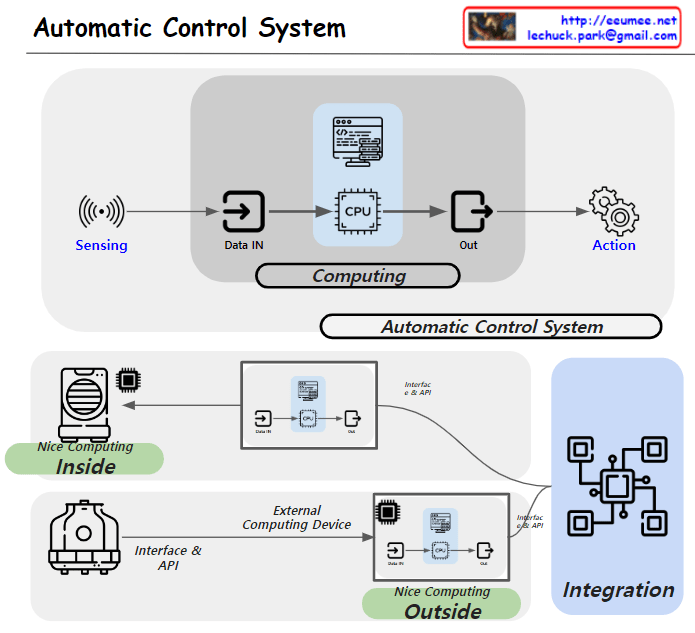
focusing on the importance of computing in automatic control systems and the distinction between devices with sufficient computing power and those without:

  1. Basic Structure of Automatic Control System:
    • The system operates in the sequence of Sensing -> Data IN -> CPU -> Out -> Action.
    • This entire process occurs within the ‘Computing’ phase, which is crucial for automatic control.
  2. Device Classification Based on Computing Capability:
    • ‘Nice Computing Inside’: Represents devices with sufficient computing power. These devices can process complex control logic independently.
    • ‘Nice Computing Outside’: Indicates devices with limited computing capabilities. These devices rely on external computing resources for automatic control.
  3. Utilization of External Computing Resources:
    • The ‘External Computing Device’ allows devices with limited computing power to perform advanced automatic control functions.
    • This is implemented through external computing devices such as PLCs (Programmable Logic Controllers) or DDCs (Direct Digital Controls).
  4. System Integration:
    • ‘Interface & API’ facilitates the connection and communication between various devices and external computing resources.
    • The ‘Integration’ section demonstrates how these diverse elements function as a unified automatic control system.
  5. Importance of Computing:
    • In automatic control systems, computing plays a crucial role in data processing, decision-making, and generating control commands.
    • By appropriately utilizing internal or external computing resources, various types of equipment can function as part of an efficient automatic control system.

This diagram effectively illustrates the flexibility and scalability of automatic control systems, explaining different approaches based on computing capabilities. The forthcoming explanation about PLC/DDC and other external computing devices will likely provide more concrete insights into the practical implementation of these systems.

SCADA & EPMS

From Perplexity with some prompting
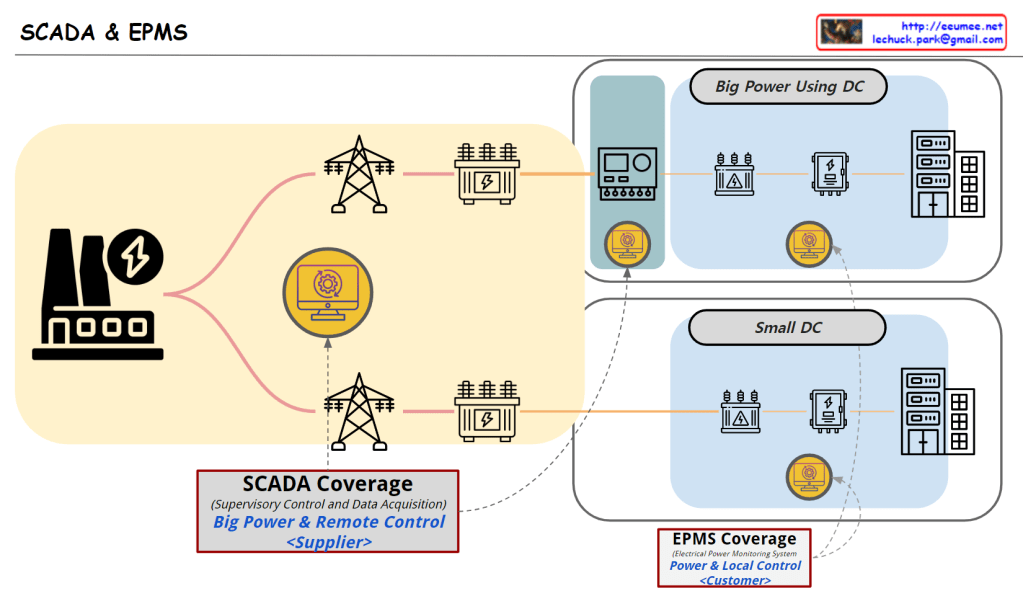
The image illustrates the roles and coverage of SCADA and EPMS systems in power management for data centers.

SCADA System

  • Target: Power Suppliers and Large Power Consumers (Big Power Using DC)
  • Role:
    • Power Suppliers: Remotely monitor and control infrastructure like power plants and substations to ensure the stability of large-scale power grids.
    • Large Data Centers: Manage complex power infrastructure and ensure stable power supply by utilizing some SCADA functionalities.
  • Coverage: Large power management and remote control

EPMS System

  • Target: Small Data Centers (Small DC)
  • Role:
    • Monitor and manage power usage within the data center to optimize energy efficiency.
    • Perform detailed local control of power management.
  • Coverage: Power monitoring and local control

Key Distinctions

  • SCADA focuses on large-scale power management and remote control, suitable for power suppliers and large consumers.
  • EPMS is used primarily in small data centers for optimizing energy consumption through local control.

In conclusion, large data centers benefit from using both SCADA and EPMS to effectively manage complex power infrastructures, while small data centers typically rely on EPMS for efficient energy management.

Standardization for DCIM

From Claude with some prompting
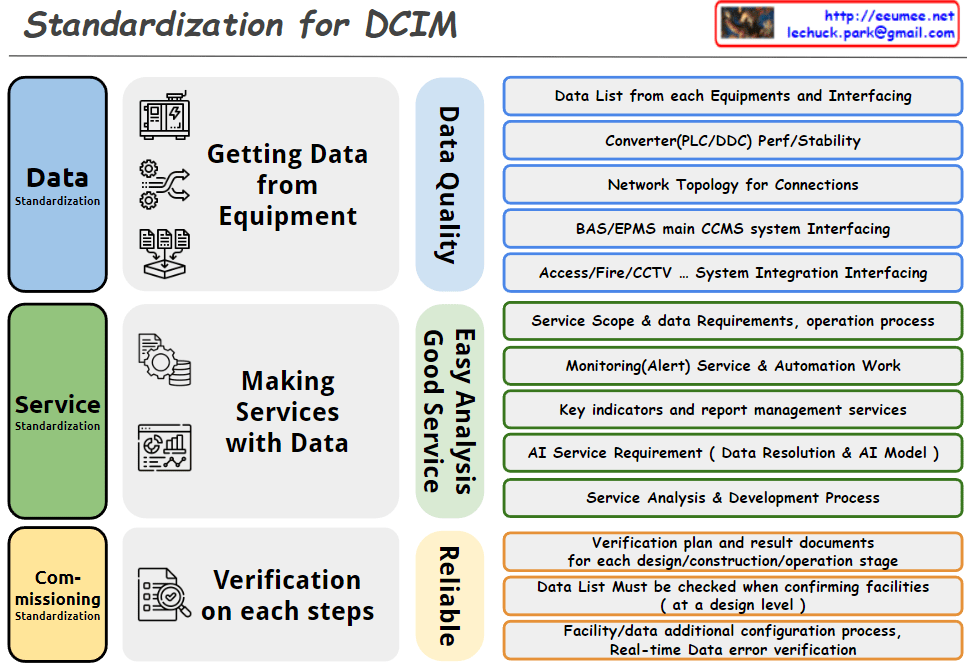
Data Standardization:

  • Defined a clear process for systematically collecting data from equipment.
  • Proposed an integrated data management approach, including network topology and interfacing between various systems.
  • Emphasized data quality management as a key factor to establish a reliable data foundation.

Service Standardization:

  • Structured the process of connecting data to actual services.
  • Highlighted practical service implementation, including monitoring services and automation tasks.
  • Specified AI service requirements, showing a forward-looking approach.
  • Established a foundation for continuous service improvement by including service analysis and development processes.

Commissioning Standardization:

  • Emphasized verification plans and documentation of results at each stage of design, construction, and operation to enable quality management throughout the entire lifecycle.
  • Prepared an immediate response system for potential operational issues by including real-time data error verification.
  • Considered system scalability and flexibility by incorporating processes for adding facilities and data configurations.

Overall Evaluation:

This DCIM standardization approach comprehensively addresses the core elements of data center infrastructure management. The structured process, from data collection to service delivery and continuous verification, is particularly noteworthy. By emphasizing fundamental data quality management and system stability while considering advanced technologies like AI, the approach is both practical and future-oriented. This comprehensive framework will be a valuable guideline for the implementation and operation of DCIM.

DC OP Platform

From Claude with some prompting
This image depicts a diagram of the “DC op Platform” (Data Center Operations Platform). The main components are as follows:

  1. On the left, there’s “DC Op Env.” (Data Center Operations Environment), which consists of three main parts:
    • DCIM (Data Center Infrastructure Management)
    • Auto Control
    • Facility These three elements undergo a “Standardization” process.
  2. In the center, there are two “Standardization” server icons, representing the standardization process of the platform.
  3. On the right, there’s the “Data Center Op. Platform”, which comprises three main components:
    • Service Development
    • Integrated operations
    • Server Room Digital Twin
  4. Arrows show how the standardized elements connect to these three main components.

This diagram visually illustrates how the data center operations environment evolves through a standardization process into an integrated data center operations platform.

Data Center Management Upgrade

From Claude with some prompting
explain the image in more detail from the data collection perspective and how the data analysis platform facilitates the expansion of AI services.

First, we can see the data collection stage where data is gathered from various systems within the data center building, such as electrical, mechanical, security, and so on, through subsystems like EPMS, BAS, ETC. This collected data is stored in the Data Gathering DB.

Next, this accumulated data is transmitted to the Data Analysis Platform via an API. The necessity of the data analysis platform arises from the need to process the vast amount of collected data and derive meaningful insights.

Within the Data Analysis Platform, tools like Query, Program, and Visualization are utilized for data analysis and monitoring purposes. Based on this, services such as Energy Optimization and Predictive Failure Detection are provided.

Furthermore, by integrating AI technology, data-driven insights can be enhanced. AI models can leverage the data and services from the data analysis platform to perform advanced analytics, automated decision-making, and more.

In summary, the flow is as follows: Data Collection -> Data Processing/Analysis on the Data Analysis Platform -> Provision of services like Energy Optimization and Failure Prediction -> Integration of AI technology for advanced analysis and automation, all contributing to effective data center management.