Biz AI Arch.

From Claude with some prompting
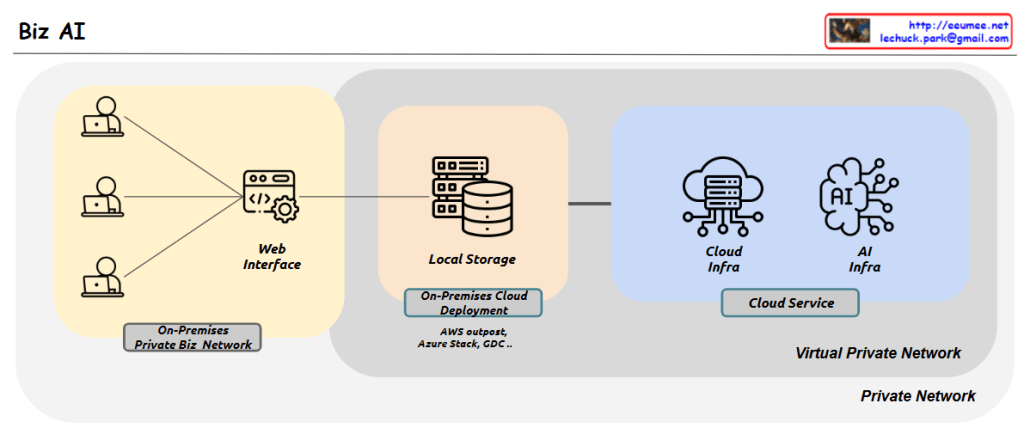
the AI-based enterprise document analysis/conversation service architecture:

Architectural Components:

  1. User Access Layer (On-Premises Private Biz Network)
  • User access through web interface
  • Secure access within corporate internal network environment
  1. Data Management Layer (Local Storage)
  • On-Premises Cloud Deployment support
  • Hybrid cloud environment with AWS outpost, Azure Stack, GCP
  • Secure storage of corporate documents and data
  1. Service Operation Layer (Cloud/AI Infra)
  • Enhanced security through Virtual Private Network
  • Cloud-based AI service integration
  • Document-based AI services like NotebookLM

Key Features and Benefits:

  1. Security
  • Private Network-based operation
  • Minimized data leakage risk
  • Regulatory compliance facilitation
  1. Scalability
  • Hybrid cloud architecture
  • Efficient resource management
  • Expandable to various AI services
  1. Operational Efficiency
  • Centralized data management
  • Unified security policy implementation
  • Easy monitoring and management

Considerations and Improvements:

  1. System Optimization
  • Balance between performance and cost
  • Implementation of caching system
  • Establishment of monitoring framework
  1. Future Extensibility
  • Integration potential for various AI services
  • Multi-cloud strategy development
  • Resource adjustment based on usage patterns

Technical Considerations:

  1. Performance Management
  • Network bandwidth and latency optimization
  • AI model inference response time management
  • Data synchronization between local and cloud storage
  1. Security Measures
  • Data governance and sovereignty
  • Secure data transmission
  • Access control and authentication
  1. Infrastructure Management
  • Resource scaling strategy
  • Service availability monitoring
  • Disaster recovery planning

This architecture provides a framework for implementing document-based AI services securely and efficiently in enterprise environments. It is particularly suitable for organizations where data security and regulatory compliance are critical priorities. The design allows for gradual optimization based on actual usage patterns and performance requirements while maintaining a balance between security and functionality.

This solution effectively combines the benefits of on-premises security with cloud-based AI capabilities, making it an ideal choice for enterprises looking to implement advanced document analysis and conversation services while maintaining strict data control and compliance requirements.
Operation with AI

From Claude with some prompting
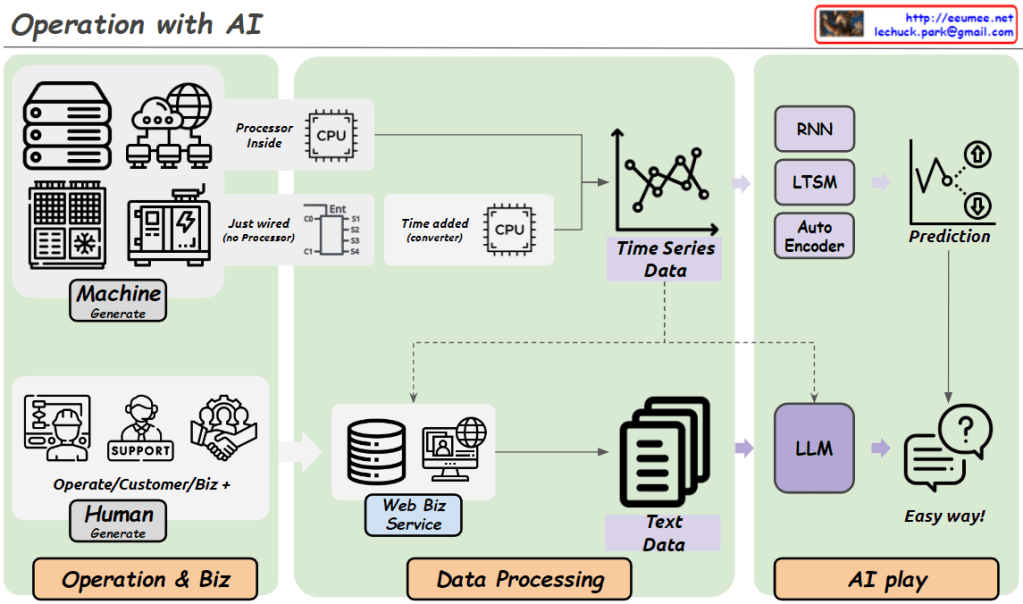
This diagram illustrates an integrated approach to modern operational management. The system is divided into three main components: data generation, data processing, and AI application.

The Operation & Biz section shows two primary data sources. First, there’s metric data automatically generated by machines such as servers and network equipment. Second, there’s textual data created by human operators and customer service representatives, primarily through web portals.

These collected data streams then move to the central Data Processing stage. Here, metric data is processed through CPUs and converted into time series data, while textual data is structured via web business services.

Finally, in the AI play stage, different AI models are applied based on data types. For time series data, models like RNN, LSTM, and Auto Encoder are used for predictive analytics. Textual data is processed through a Large Language Model (LLM) to extract insights.

This integrated system effectively utilizes data from various sources to improve operational efficiency, support data-driven decision-making, and enable advanced analysis and prediction through AI. Ultimately, it facilitates easy and effective management even in complex operational environments.

The image emphasizes how different types of data – machine-generated metrics and human-generated text – are processed and analyzed using appropriate AI techniques, all from the perspective of operational management.

through the LLM

From DALL-E with some prompting
The diagram provides a visual summary of how data from industrial facilities is aggregated and transformed through various processes, including equipment operation and business requirements. This data flow is depicted starting from the left, moving through icons representing servers, databases, safety equipment, and surveillance, indicating the collection and integration of diverse data types. The central AI chip symbolizes the analytical engine that processes this vast array of information, optimizing it for business intelligence and operational efficiency.

The processed data then feeds into a Large Language Model (LLM), highlighted in the diagram as the interface for communication. The AI’s capacity to analyze and manage this data results in a conversational output that closely resembles human interaction, as suggested by the “Like Human” label on the diagram. The integration of complex technical data with nuanced language processing allows the AI to communicate effectively with humans, symbolized by the network graphic on the right, which represents human connections.

In essence, the image encapsulates the journey of raw data from mechanical and logistical origins to sophisticated human-like dialogue, emphasizing the role of AI in bridging the gap between the technical and the personal in contemporary business environments.