Data handing

From Gemini with some prompting
Image Interpretation: Using AI, Deep Learning, and Quantum Computing for Data Analysis to Drive Future Advancement

  1. Limitations of Data Interpretation: Human Effort and Computing

Humans have traditionally interpreted data through note-taking and computing.
However, human interpretation capabilities have reached their limits as data volumes have grown.

  1. AI, Deep Learning, and Quantum Computing: New Possibilities for Data Interpretation

Advances in Artificial Intelligence (AI), Deep Learning, and Quantum Computing technologies have opened up new possibilities for data interpretation.
These technologies can analyze data much faster and more accurately than humans.

  1. Next Step Advancement through Data Analysis

Data analysis using AI, Deep Learning, and Quantum Computing technologies can lead to advancements in the following areas:
Scientific Research: New drug development, new material development, environmental problem solving, etc.
Healthcare: Disease diagnosis and treatment, personalized healthcare services, etc.
Industry: Production efficiency improvement, new product development, new business model discovery, etc.
Society: Social problem-solving, policy decision support, safety and security reinforcement, etc.

  1. Conclusion: Data Analysis, the Key to the Future

Data analysis using AI, Deep Learning, and Quantum Computing technologies will be the key driver of future development.
Through data analysis, we can create a better future.

From DALL-E with some prompting
The image conceptualizes the evolution and advancement in data processing. Initially, data understandable at a human level is processed using traditional note-taking and computing methods. This is represented by a simple binary code and is processed using tools symbolized by the human brain and computers.

However, the emergence of larger and more complex datasets necessitated new tools that extend beyond human processing capabilities. As illustrated at the bottom of the image, an extended binary code represents the data that must be handled by advanced tools based on Artificial Intelligence (AI), Deep Learning, and Quantum Physics. This data format is interpretable by machines, specifically AI created by humans.

These advanced tools enable the meaningful analysis of complex data, leading to the “Analysis & Development” stage depicted on the right side of the image. This signifies how insights derived from the processing are used to solve real-world problems and drive new developments.

Therefore, this image is more than a description of data processing methods; it provides an overview of how modern technologies are managing massive datasets and how the resulting analyses can lead to tangible advancements and development goals.
Works with data

From DALL-E with some prompting
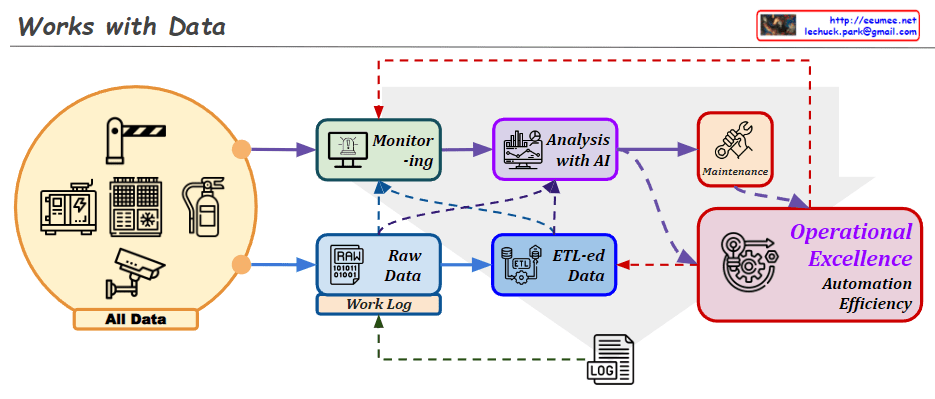
The image describes a data workflow process that involves various stages of data handling and utilization for operational excellence. “All Data” from diverse sources feeds into a monitoring system, which then processes raw data, including work logs. This raw data undergoes ETL (Extract, Transform, Load) procedures to become structured “ETL-ed Data.” Following ETL, the data is analyzed with AI to extract insights and inform decisions, which can lead to actions such as maintenance. The ultimate goal of this process is to achieve operational excellence, automation, and efficiency.

Requires for DL

From DALL-E with some prompting
The image outlines the importance of data in the era of deep learning (DL). It starts with “Data,” representing various sources and types, which feeds into “Deep Learning,” depicted by a neural network diagram. The process leads to “Result,” symbolized by charts and graphs indicating the output or findings. The central message, “Data determines the results,” stresses that the quality of data significantly impacts the outcome of deep learning processes. Below, “Data Verification” suggests the need for ensuring data accuracy, which ties into the cycle of “UPDATE” and “Analysis,” highlighting an iterative process to refine and improve deep learning applications. The phrase “What to deal with DL” hints at the challenges and considerations in managing and utilizing deep learning effectively.

Road to “the new”

From DALL-E with some prompting

The image visually explains the process of creating new ideas and innovations. Each stage is as follows:

Experience: The icon represents human experiences.
Digitization: The process of converting experiences into digital data.
Data: The digitized information.
AI/ML (Artificial Intelligence/Machine Learning): Technologies that analyze and learn from the data.
Accelerator: Represents the acceleration of the analysis and learning process through AI/ML.
Analysis: The process of analyzing data to extract useful insights.
Idea: The emergence of new ideas from data analysis. The phrase “Easy to Get” indicates that this process has become more accessible.
New: Two text icons depicting the implementation of new ideas into innovative products or services.


The image illustrates the flow of digitizing experiences into data, using AI/ML to analyze and accelerate this data, easily obtaining new ideas, and transforming them into new innovations.

New BIZ ?

From DALL-E with some prompting
This diagram explains the process of finding new business opportunities from the perspective of digital transformation. The first step, ‘Digitization,’ involves converting real-world information into digital data while ensuring data quality. The next step, ‘Digitalization,’ extends the use of digital data to enhance automated processes. By executing these two steps, new opportunities can be discovered, and through ‘Digital Transformation,’ these discoveries can be converted into actual innovations. Overall, this process presents a methodology for leveraging digital technology to innovate business models and create new value.