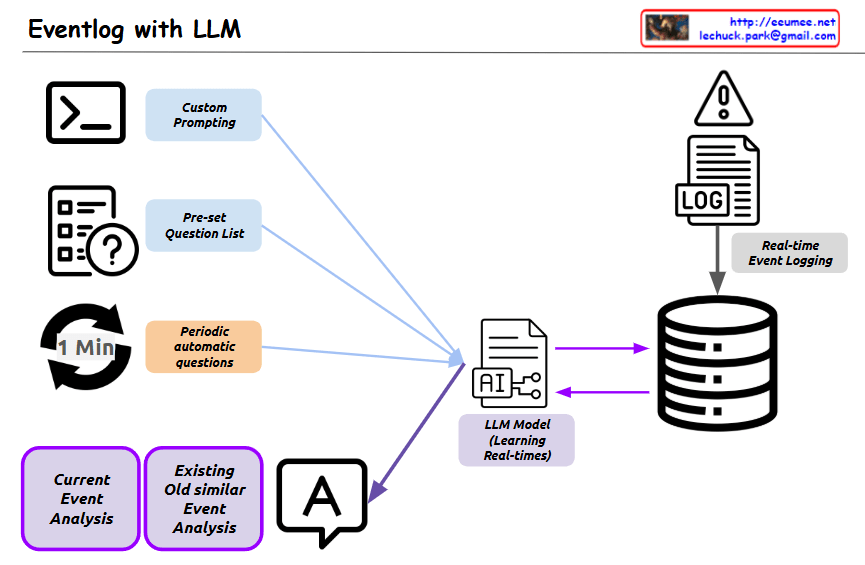
Eventlog with LLM

  1. Input methods (left side):
    • A command line/terminal icon with “Custom Prompting”
    • A questionnaire icon with “Pre-set Question List”
    • A timer icon (1 Min) with “Periodic automatic questions”
  2. Processing (center):
    • An “LLM Model” component labeled as “Learning Real-times”
    • Database/storage components for “Real-time Event Logging”
  3. Output/Analysis (bottom):
    • Two purple boxes for “Current Event Analysis” and “Existing Old similar Event Analysis”
    • A text/chat bubble showing output

This system collects and updates unstructured text-based event logs in real-time, which are then learned by the LLM. Through user-input questions, predefined question lists, or periodically auto-generated questions, the system analyzes current events and compares them with similar past cases to provide comprehensive analytical results.

The primary purpose of this system is to efficiently process large volumes of event logs from increasingly large and complex IT infrastructure or business systems. This helps operators easily identify important events, make quick judgments, and take appropriate actions. By leveraging the natural language processing capabilities of LLMs, the system transforms complex log data into meaningful insights, significantly simplifying system monitoring and troubleshooting processes.

With Claude
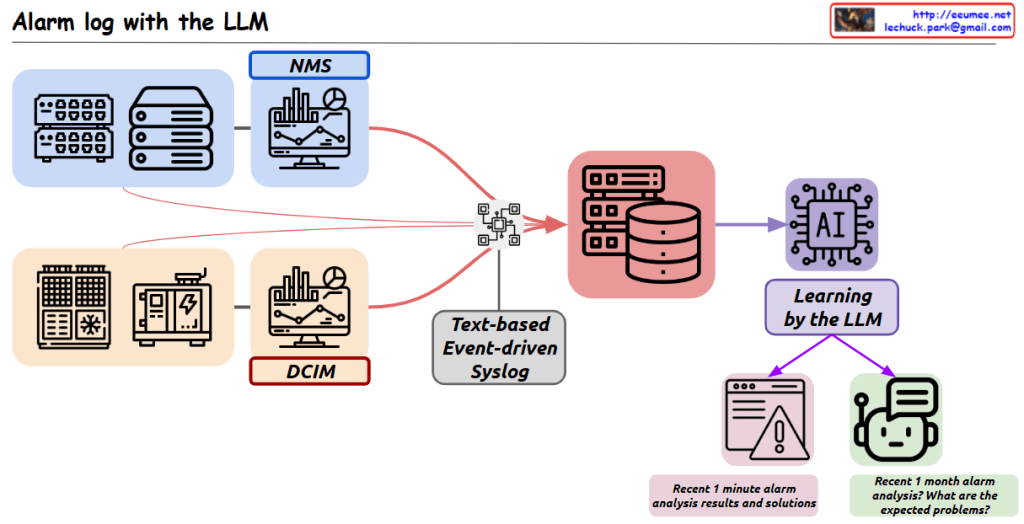
log with the LLM

From Claude with some prompting
This image represents an “Alarm log with the LLM” system. The key components and functionality are as follows:

  1. NMS (Network Management System): A monitoring system that collects and displays alarm data.
  2. Text-based Event-driven Syslog: A system that logs events and alarm data in real-time text format. Syslog provides immediate data that is easily collected from existing environments.
  3. DCIM (Data Center Infrastructure Management): A system that manages the physical infrastructure of a data center, including alarms and monitoring.
  4. AI: An artificial intelligence component that utilizes a Large Language Model (LLM) for learning.
  5. 1-minute alarm analysis results and solutions: From a real-time monitoring perspective, this analyzes immediate alarm situations and provides solutions.
  6. 1-month alarm analysis: This long-term analysis of alarm data identifies anticipated problems. The analysis results can be used to provide a chatbot-based status query and response environment.

Overall, this system can provide powerful alarm management capabilities through real-time monitoring and predictive analysis.

Prediction & Detection

From Claude with some prompting
This image illustrates a Prediction and Detection system for time series data. Let me break down the key components:

  1. Left Large Box (Learning and Prediction Section):
  • Blue line: Actual Temperature data
  • Red dotted line: Predicted Temperature data
  • Uses time series prediction models like LSTM, ARIMA, and Prophet for learning
  1. Top Right (Threshold-based Anomaly Detection):
  • “Abnormal Detection with Threshold”
  • Detects abnormal temperature changes based on threshold values
  • The area marked with a red circle shows where values exceed the threshold
  • Includes “Warning” and “Critical” threshold levels
  1. Bottom Right (Pattern-based Anomaly Detection):
  • “Anomaly Detection with Predict-Pattern”
  • Compares predicted patterns with actual data to detect anomalies
  • The area marked with a green circle shows where actual data deviates from the predicted pattern

The system detects anomalies in two ways:

  1. When values exceed predetermined thresholds
  2. When actual data significantly deviates from predicted patterns

This type of system is particularly useful in:

  • Industrial monitoring
  • Equipment maintenance
  • Early warning systems
  • Quality control
  • System health monitoring

The combination of prediction and dual detection methods (threshold and pattern-based) provides a robust approach to identifying potential issues before they become critical problems.

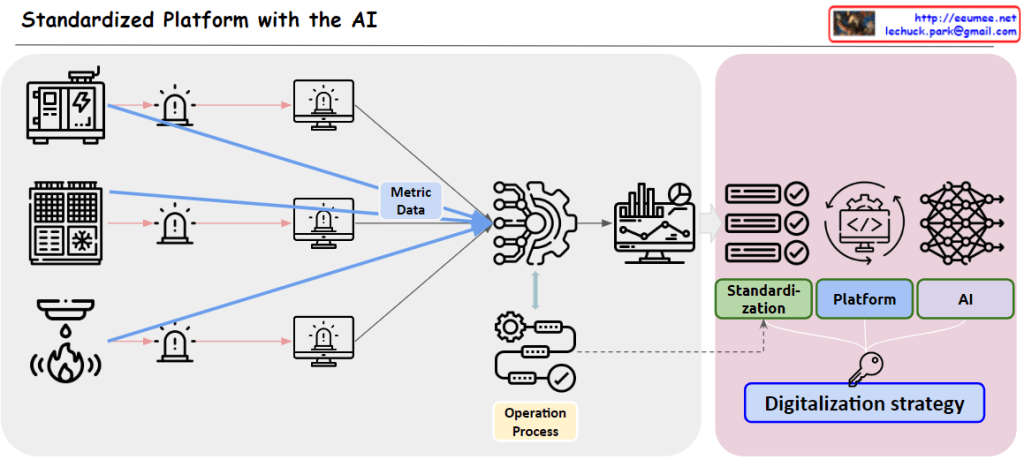
Standardized Platform with the AI

From Claude with some prompting
This image illustrates a “Standardized Platform with the AI”. Here’s a breakdown of the key components and processes:

  1. Left side: Various devices or systems (generator, HVAC system, fire detector, etc.) are shown. Each device is connected to an alarm system and a monitoring screen.
  2. Center: “Metric Data” from these devices is sent to a central gear-shaped icon, representing a data processing system.
  3. Upper right: The processed data is displayed on a dashboard or analytics screen.
  4. Lower right: There’s a section labeled “Operation Process”, indicating management or optimization of operational processes.
  5. Far right: Boxes representing the system’s components:
    • “Standardization”
    • “Platform”
    • “AI”
  6. Bottom: “Digitalization strategy” serves as the foundation for the entire system.

This diagram visualizes a digital transformation strategy that collects data from various systems and devices, processes it using AI on a standardized platform, and uses this to optimize and manage operations.

The flow shows how raw data from different sources is standardized, processed, and utilized to create actionable insights and improve operational efficiency, all underpinned by a comprehensive digitalization strategy.

TSDB flow for alerts

From Claude with some prompting
This image illustrates the flow and process of a Time Series Database (TSDB) system. The main components are:

Time Series Data: This is the input data stream containing time-stamped values from various sources or metrics.

Counting: It performs change detection on the incoming time series data to capture relevant events or anomalies.

Delta Value: The difference or change observed in the current value compared to a previous reference point, denoted as NOW() – previous value.

Time-series summary Value: Various summary statistics like MAX, MIN, and other aggregations are computed over the time window.

Threshold Checking: The delta values and other aggregations are evaluated against predefined thresholds for anomaly detection.

Alert: If any threshold conditions are violated, an alert is triggered to notify the monitoring system or personnel.

The process also considers correlations with other metrics for improved anomaly detection context. Additionally, AI-based techniques can derive new metrics from the existing data for enhanced monitoring capabilities.

In summary, this flow diagram represents the core functionality of a time series database focused on capturing, analyzing, and alerting on anomalies or deviations from expected patterns in real-time data streams.

Never miss an alert

From DALL-E with some prompting
The image illustrates the interaction between an alert system and a data analysis system, comprised of two distinct stages:

Raw Level Hardware (HW) Alert Detection:
This stage emphasizes internal alarms, which are hardwired to ensure that alerts are raised in critical situations without any buffering, allowing for the fastest possible alarm detection. The message “Don’t forget This Step is required” underscores the indispensability of this stage.

Analyzed Software (SW) Alert Detection:
Data passes through storage devices to analysis tools, where it can be subject to delays or potential loss. The data is analyzed by code, enabling advanced analysis with AI. However, the phrase “Even though You have a wonderful Data Analysis System” reiterates the importance of raw-level alert detection, regardless of the sophistication of the data analysis system.

Overall, the image indicates that raw-level alerts are crucial for immediate response needs, and while advanced data analysis can enhance system alerting and monitoring, it cannot replace the need for immediate alert mechanisms. The title “Never miss an alert” emphasizes the critical nature of these alert systems.