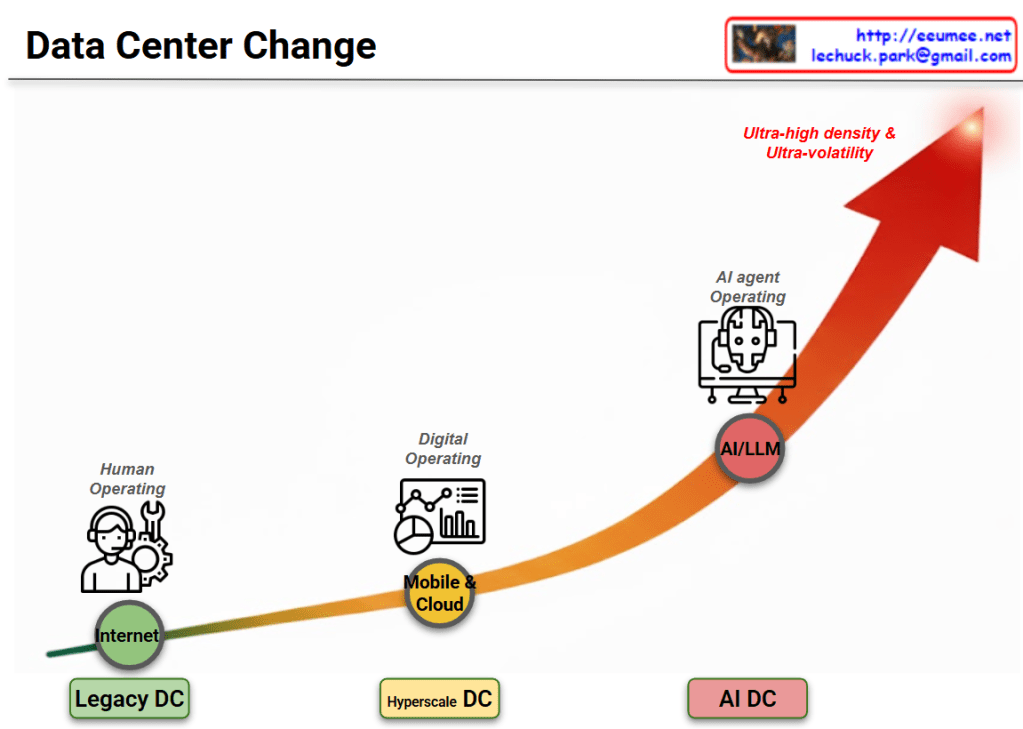
This diagram illustrates the evolutionary progression of infrastructure environments and operational methodologies over time. The upward-pointing arrow indicates the escalating complexity, density, and sophistication of these technologies.
Phase 1: Internet Era
Environment: Legacy Data Center
Core Technology: Internet
Operating Model: Human Operating
Characteristics: The foundational stage where human operators physically monitor and control the infrastructure, relying heavily on manual intervention and traditional toolsets.
Phase 2: Mobile & Cloud Era
Environment: Hyperscale Data Center
Core Technology: Mobile & Cloud
Operating Model: Digital Operating
Characteristics: A digital transformation phase designed to handle explosive data growth. This stage utilizes dashboards, analytics, and automated systems to significantly improve operational efficiency and scale.
Phase 3: Artificial Intelligence Era
Environment: AI Data Center
Core Technology: AI/LLM (Large Language Models)
Operating Model: AI Agent Operating
Characteristics: A highly advanced stage where an AI-driven agent takes over the integrated operations of the platform. It functions autonomously to manage and optimize the system, specifically to cope with the “Ultra-high density & Ultra-volatility” characteristic of modern AI workloads.
Summary
The diagram outlines a fundamental paradigm shift in infrastructure management. It traces the journey from early, manual-heavy environments to digitalized systems, ultimately culminating in an advanced era where an AI-driven agent autonomously manages operations for AI Data Centers, expertly handling environments defined by extreme density and volatility.
3 Layers for Digital Operations – Comprehensive Analysis
This diagram presents an advanced three-layer architecture for digital operations, emphasizing continuous feedback loops and real-time decision-making.
🔄 Overall Architecture Flow
The system operates through three interconnected environments that continuously update each other, creating an intelligent operational ecosystem.
1️⃣ Micro Layer: Real-time Digital Twin Environment (Purple)
Purpose
Creates a virtual replica of physical assets for real-time monitoring and simulation.
Key Components
Digital Twin Technology: Mirrors physical operations in real-time
Real-time Real-Model: Processes high-resolution data streams instantaneously
Continuous Synchronization: Updates every change from physical assets
Data Flow
Data Sources (Servers, Networks, Manufacturing Equipment, IoT Sensors) → High Resolution Data Quality → Real-time Real-Model → Digital Twin
Function
Provides granular, real-time visibility into operations
Enables predictive maintenance and anomaly detection
Simulates scenarios before physical implementation
Serves as the foundation for higher-level decision-making
2️⃣ Macro Layer: LLM-based AI Agent Environment (Pink)
Purpose
Analyzes real-time data, identifies events, and makes intelligent autonomous decisions using AI.
Analyzes patterns and trends from Digital Twin data
Generates actionable insights and recommendations
Automates routine decision-making processes
Provides context-aware responses using RAG technology
Escalates complex issues to human operators
3️⃣ Human Layer: Operator Decision Environment (Green)
Purpose
Enables human oversight, strategic decision-making, and intervention when needed.
Key Components
Human-in-the-loop: Keeps humans in control of critical decisions
Well-Cognitive Interface: Presents data for informed judgment
Analytics Dashboard: Visualizes trends and insights
Data Flow
Both Digital Twin (Micro) and AI Agent (Macro) feed into → Human Layer for Well-Cognitive Decision Making
Function
Reviews AI recommendations and Digital Twin status
Makes strategic and high-stakes decisions
Handles exceptions and edge cases
Validates AI agent actions
Provides domain expertise and contextual understanding
Ensures ethical and business-aligned outcomes
🔁 Continuous Update Loop: The Key Differentiator
Feedback Mechanism
All three layers are connected through Continuous Update pathways (red arrows), creating a closed-loop system:
Human Layer → feeds decisions back to Data Sources
Micro Layer → continuously updates Human Layer
Macro Layer → continuously updates Human Layer
System-wide → all layers update the central processing and data sources
Benefits
Adaptive Learning: System improves based on human decisions
Real-time Optimization: Immediate response to changes
Knowledge Accumulation: RAG database grows with operations
Closed-loop Control: Decisions are implemented and their effects monitored
🎯 Integration Points
From Physical to Digital (Left → Right)
High-resolution data from multiple sources
Well-defined deterministic processing ensures data quality
Parallel paths: Real-time model (Micro) and Event logging (Macro)
From Digital to Action (Right → Left)
Human decisions informed by both layers
Actions feed back to physical systems
Results captured and analyzed in next cycle
💡 Key Innovation: Three-Way Synergy
Micro (Digital Twin): “What is happening right now?”
Macro (AI Agent): “What does it mean and what should we do?”
Human: “Is this the right decision given our goals?”
Each layer compensates for the others’ limitations:
Digital Twins provide accuracy but lack context
AI Agents provide intelligence but need validation
Humans provide wisdom but need information support
📝 Summary
This architecture integrates three operational environments: the Micro Layer uses real-time data to maintain Digital Twins of physical assets, the Macro Layer employs LLM-based AI Agents with RAG to analyze events and generate intelligent recommendations, and the Human Layer ensures well-cognitive decision-making through human-in-the-loop oversight. All three layers continuously update each other and feed decisions back to the operational systems, creating a self-improving closed-loop architecture. This synergy combines real-time precision, artificial intelligence, and human expertise to achieve optimal digital operations.

 Lechuck Park