One Value to Value(s)

With Claude
“A Framework for Value Analysis: From Single Value to Comprehensive Insights”

This diagram illustrates a sophisticated analytical framework that shows how a single value transforms through various analytical processes:

  1. Time Series Analysis Path:
    • A single value evolves over time
    • Changes occur through two mechanisms:
      • Self-generated changes (By oneself)
      • External influence-driven changes (By influence)
    • These changes are quantified through a mathematical function f(x)
    • Statistical measures (average, minimum, maximum, standard deviation) capture the characteristics of these changes
  2. Correlation Analysis Path:
    • The same value is analyzed for relationships with other relevant data
    • Weighted correlations indicate the strength and significance of relationships
    • These relationships are also expressed through a mathematical function f(x)
  3. Integration and Machine Learning Stage:
    • Both analyses (time series and correlation) feed into advanced analytics
    • Machine Learning and Deep Learning algorithms process this dual-perspective data
    • The final output produces either a single generalized value or multiple meaningful values

Core Purpose: The framework aims to take a single value and:

  • Track its temporal evolution within a network of influences
  • Analyze its statistical behavior through mathematical functions
  • Identify weighted correlational relationships with other variables
  • Ultimately synthesize these insights through ML/DL algorithms to generate either a unified understanding or multiple meaningful outputs

This systematic approach demonstrates how a single data point can be transformed into comprehensive insights by considering both its temporal dynamics and relational context, ultimately leveraging advanced analytics for meaningful interpretation.

The framework’s strength lies in its ability to combine temporal patterns, relational insights, and advanced analytics into a cohesive analytical approach, providing a more complete understanding of how values evolve and relate within a complex system.

Deterministic Scheduling

With Claude
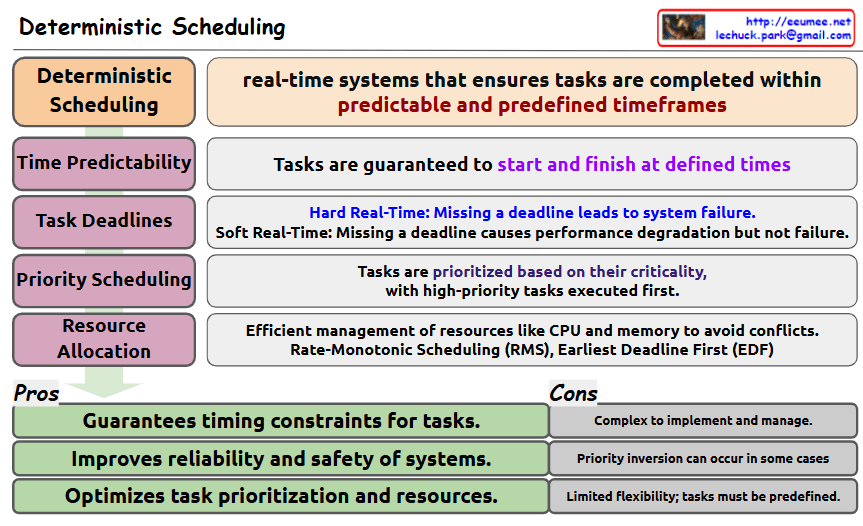
Definition: Deterministic Scheduling is a real-time systems approach that ensures tasks are completed within predictable and predefined timeframes.

Key Components:

  1. Time Predictability
  • Tasks are guaranteed to start and finish at defined times
  1. Task Deadlines
  • Hard Real-Time: Missing a deadline leads to system failure
  • Soft Real-Time: Missing a deadline causes performance degradation but not failure
  1. Priority Scheduling
  • Tasks are prioritized based on their criticality
  • High-priority tasks are executed first
  1. Resource Allocation
  • Efficient management of resources like CPU and memory to avoid conflicts
  • Uses Rate-Monotonic Scheduling (RMS) and Earliest Deadline First (EDF)

Advantages (Pros):

  • Guarantees timing constraints for tasks
  • Improves reliability and safety of systems
  • Optimizes task prioritization and resources

Disadvantages (Cons):

  • Complex to implement and manage
  • Priority inversion can occur in some cases
  • Limited flexibility; tasks must be predefined

The system is particularly important in real-time applications where timing and predictability are crucial for system operation. It provides a structured approach to managing tasks while ensuring they meet their specified time constraints and resource requirements.

What is The Next?

With Claude
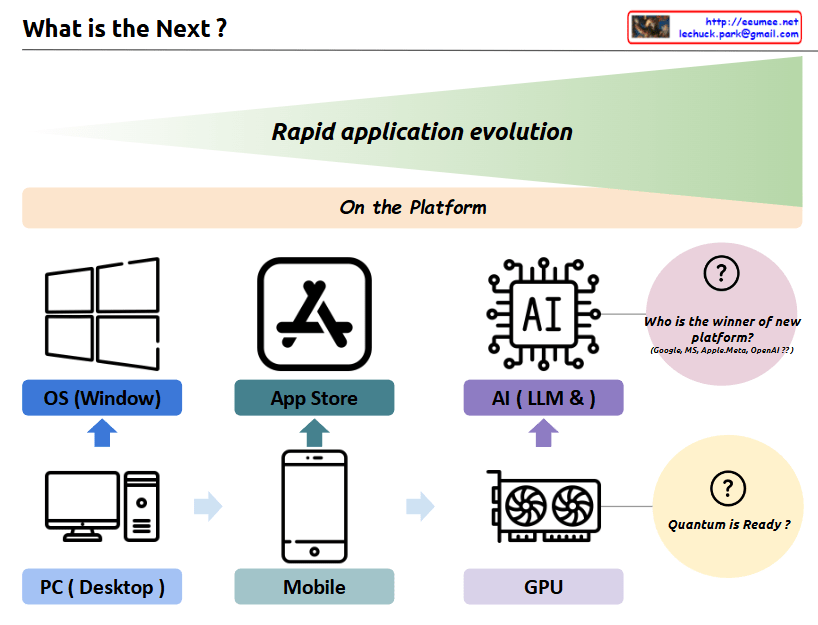
a comprehensive interpretation of the image and its concept of “Rapid application evolution”:

The diagram illustrates the parallel evolution of both hardware infrastructure and software platforms, which has driven rapid application development and user experiences:

  1. Hardware Infrastructure Evolution:
  • PC/Desktop → Mobile Devices → GPU
  • Represents the progression of core computing power platforms
  • Each transition brought fundamental changes in how users interact with technology
  1. Software Platform Evolution:
  • Windows OS → App Store → AI/LLM
  • Shows the evolution of application ecosystems
  • Each platform created new possibilities for user applications

The symbiotic relationship between these two axes:

  • PC Era: Integration of PC hardware with Windows OS
  • Mobile Era: Combination of mobile devices with app store ecosystems
  • AI Era: Marriage of GPU infrastructure with LLM/AI platforms

Each transition has led to exponential growth in application capabilities and user experiences, with hardware and software platforms developing in parallel and reinforcing each other.

Future Outlook:

  1. “Who is the winner of new platform?”
  • Current competition between Google, MS, Apple/Meta, OpenAI
  • Platform leadership in the AI era remains undecided
  • Possibility for new players to emerge
  1. “Quantum is Ready?”
  • Suggests quantum computing as the next potential hardware revolution
  • Implies the possibility of new software platforms emerging to leverage quantum capabilities
  • Continues the pattern of hardware-software co-evolution

This cyclical pattern of hardware-software evolution suggests that we’ll continue to see new infrastructure innovations driving platform development, and vice versa. Each cycle has dramatically expanded the possibilities for applications and user experiences, and this trend is likely to continue with future technological breakthroughs.

The key insight is that major technological leaps happen when both hardware infrastructure and software platforms evolve together, creating new opportunities for application development and user experiences that weren’t previously possible.

Metric Analysis

With a Claude
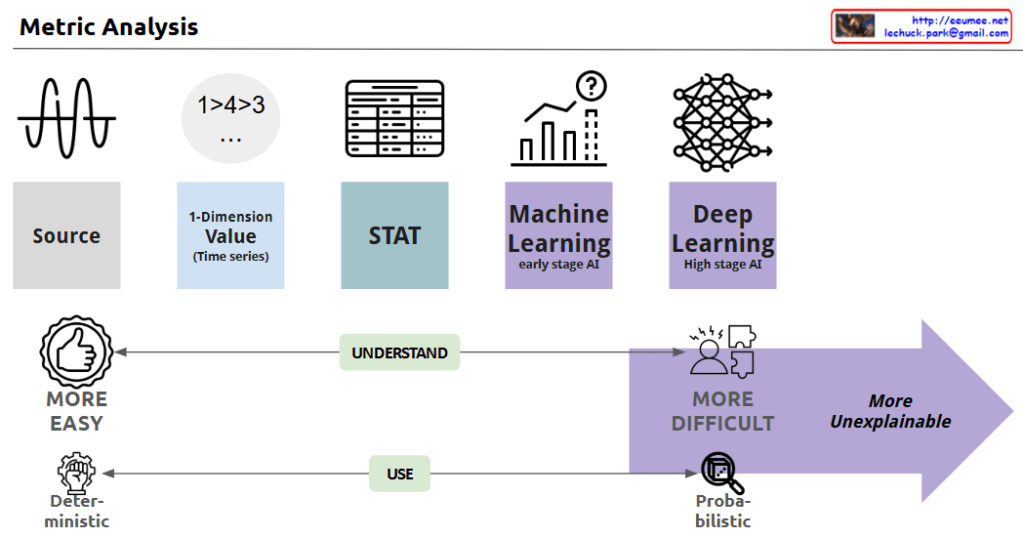
This image depicts the evolution of data analysis techniques, from simple time series analysis to increasingly sophisticated statistical methods, machine learning, and deep learning.

As the analysis approaches become more advanced, the process becomes less transparent and the results more difficult to explain. Simple techniques are more easily understood and allow for deterministic decision-making. But as the analysis moves towards statistics, machine learning, and AI, the computations become more opaque, leading to probabilistic rather than definitive conclusions. This trade-off between complexity and explainability is the key theme illustrated.

In summary, the progression shows how data analysis methods grow more powerful yet less interpretable, requiring a balance between the depth of insights and the ability to understand and reliably apply the results.