Numbers about power

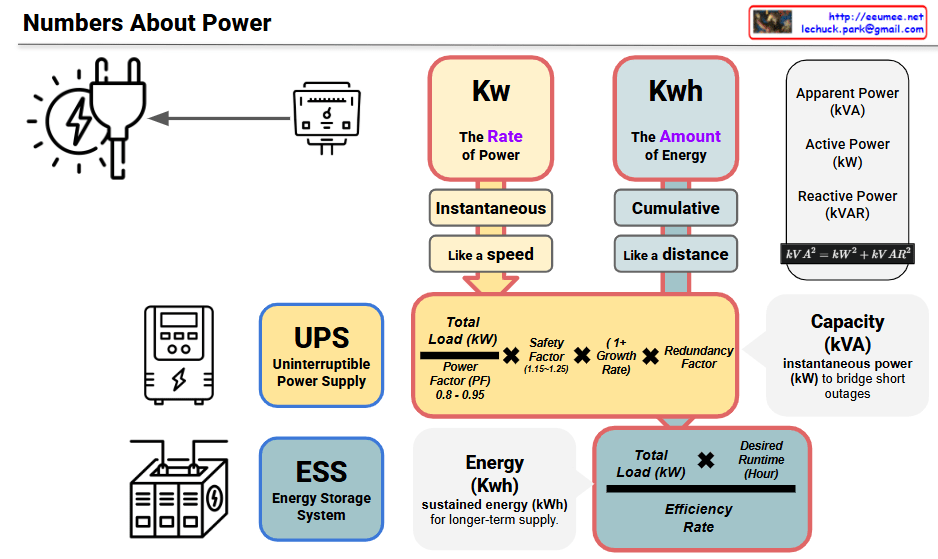
kW (Instantaneous Power) ↔ UPS (Uninterruptible Power Supply)

UPS Core Objective: Instantaneous Power Supply Capability

  • kW represents the power needed “right now at this moment”
  • UPS priority is immediate power supply during outages
  • Like the “speed” concept in the image, UPS focuses on instantaneous power delivery speed
  • Design actual kW capacity considering Power Factor (PF) 0.8-0.95
  • Calculate total load (kW) reflecting safety factor, growth rate, and redundancy

kWh (Energy Capacity) ↔ ESS (Energy Storage System)

ESS Core Objective: Sustained Energy Supply Capability

  • kWh indicates “how long” power can be supplied
  • ESS priority is long-term stable power supply
  • Like the “distance” concept in the image, ESS focuses on power supply duration
  • Required ESS capacity = Total Load (kW) × Desired Runtime (Hours)
  • Design actual storage capacity considering efficiency rate

Complementary Operation Strategy

Phase 1: UPS Immediate Response

  • Power outage → UPS immediately supplies power in kW units
  • Short-term power supply for minutes to tens of minutes

Phase 2: ESS Long-term Support

  • Extended outages → ESS provides sustained power in kWh units
  • Long-term power supply for hours to days

Summary: This structure optimally matches kW (instantaneousness) with UPS strengths and kWh (sustainability) with ESS capabilities. UPS handles immediate power needs while ESS ensures long-duration supply, creating a comprehensive power backup solution.

With Claude

Human-AI Collaborative Reasoning

This image illustrates the collaborative problem-solving process between humans and AI through reasoning, emphasizing their complementary relationship rather than a simple comparison.

Key Components and Interpretation

1. AI’s Operational Flow (Upper Section)

  • Big Data → Learning → AI Model: The process by which AI builds models through learning from vast amounts of data
  • Reasoning → Inferencing → Answer: The process by which AI receives questions and generates answers through reasoning

2. Human Role (Lower Section)

  • Experience: Knowledge and information acquired through direct experience
  • Logic: A logical thinking framework built upon experience
  • Reasoning: The cognitive process that combines experience and logic

3. Critical Interaction Mechanisms

Question:

  • Human reasoning results are input to AI in the form of sophisticated questions
  • These are not simple queries, but systematic and meaningful questions based on experience and logic

Answer:

  • AI’s responses are fed back into the human reasoning process
  • Humans verify AI’s answers and integrate them into new experiences and logic for deeper reasoning

4. Core Message

The red-highlighted phrase “humans must possess a strong, experience-based logical framework” represents the diagram’s central theme:

  • To collaborate effectively with AI, humans must also possess strong logical thinking frameworks based on experience
  • The ability to provide appropriate questions and properly verify and utilize AI’s responses is essential

Conclusion

This image demonstrates that human roles do not disappear in the AI era, but rather become more crucial. Human reasoning abilities based on experience and logic play a pivotal role in AI collaboration, and through this, humans and AI can create synergy for better problem-solving. The diagram presents a collaborative model where both entities work together to achieve superior results.

The key insight is that AI advancement doesn’t replace human thinking but rather requires humans to develop stronger reasoning capabilities to maximize the potential of human-AI collaboration.

With Claude, Gemini

FROM DIFFERENCES

This diagram illustrates the journey of recognizing and encoding “difference,” moving from philosophical thought to technological realization and finally AI. Ultimately, humans are beings who explain and create meaning, while AI is a system that calculates and processes patterns.

Massive simple parallel computing

This diagram presents a systematic framework that defines the essence of AI LLMs as “Massive Simple Parallel Computing” and systematically outlines the resulting issues and challenges that need to be addressed.

Core Definition of AI LLM: “Massive Simple Parallel Computing”

Massive: Enormous scale with billions of parameters Simple: Fundamentally simple computational operations (matrix multiplications, etc.) Parallel: Architecture capable of simultaneous parallel processing Computing: All of this implemented through computational processes

Core Issues Arising from This Essential Nature

Big Issues:

  • Black-box unexplainable: Incomprehensibility due to massive and complex interactions
  • Energy-intensive: Enormous energy consumption inevitably arising from massive parallel computing

Essential Requirements Therefore Needed

Very Required:

  • Verification: Methods to ensure reliability of results given the black-box characteristics
  • Optimization: Approaches to simultaneously improve energy efficiency and performance

The Ultimate Question: “By What?”

How can we solve all these requirements?

In other words, this framework poses the fundamental question about specific solutions and approaches to overcome the problems inherent in the essential characteristics of current LLMs. This represents a compressed framework showing the core challenges for next-generation AI technology development.

The diagram effectively illustrates how the defining characteristics of LLMs directly lead to significant challenges, which in turn demand specific capabilities, ultimately raising the critical question of implementation methodology.

With Claude

The Evolution of Mainstream Data in Computing

This diagram illustrates the evolution of mainstream data types throughout computing history, showing how the complexity and volume of processed data has grown exponentially across different eras.

Evolution of Mainstream Data by Computing Era:

  1. Calculate (1940s-1950s)Numerical Data: Basic mathematical computations dominated
  2. Database (1960s-1970s)Structured Data: Tabular, organized data became central
  3. Internet (1980s-1990s)Text/Hypertext: Web pages, emails, and text-based information
  4. Video (2000s-2010s)Multimedia Data: Explosive growth of video, images, and audio content
  5. Machine Learning (2010s-Present)Big Data/Pattern Data: Large-scale, multi-dimensional datasets for training
  6. Human Perceptible/Everything (Future)Universal Cognitive Data: Digitization of all human senses, cognition, and experiences

The question marks on the right symbolize the fundamental uncertainty surrounding this final stage. Whether everything humans perceive – emotions, consciousness, intuition, creativity – can truly be fully converted into computational data remains an open question due to technical limitations, ethical concerns, and the inherent nature of human cognition.

Summary: This represents a data-centric view of computing evolution, progressing from simple numerical processing to potentially encompassing all aspects of human perception and experience, though the ultimate realization of this vision remains uncertain.

With Claude

From RNN to Transformer

Visual Analysis: RNN vs Transformer

Visual Structure Comparison

RNN (Top): Sequential Chain

  • Linear flow: Circular nodes connected left-to-right
  • Hidden states: Each node processes sequentially
  • Attention weights: Numbers (2,5,11,4,2) show token importance
  • Bottleneck: Must process one token at a time

Transformer (Bottom): Parallel Grid

  • Matrix layout: 5×5 grid of interconnected nodes
  • Self-attention: All tokens connect to all others simultaneously
  • Multi-head: 5 parallel attention heads working together
  • Position encoding: Separate blue boxes handle sequence order

Key Visual Insights

Processing Pattern

  • RNN: Linear chain → Sequential dependency
  • Transformer: Interconnected grid → Parallel freedom

Information Flow

  • RNN: Single path with accumulating states
  • Transformer: Multiple simultaneous pathways

Attention Mechanism

  • RNN: Weights applied to existing sequence
  • Transformer: Direct connections between all elements

Design Effectiveness

The diagram succeeds by using:

  • Contrasting layouts to show architectural differences
  • Color coding to highlight attention mechanisms
  • Clear labels (“Sequential” vs “Parallel Processing”)
  • Visual metaphors that make complex concepts intuitive

The grid vs chain visualization immediately conveys why Transformers enable faster, more scalable processing than RNNs.

Summary

This diagram effectively illustrates the fundamental shift from sequential to parallel processing in neural architecture. The visual contrast between RNN’s linear chain and Transformer’s interconnected grid clearly demonstrates why Transformers revolutionized AI by enabling massive parallelization and better long-range dependencies.

With Claude