Learning with AI

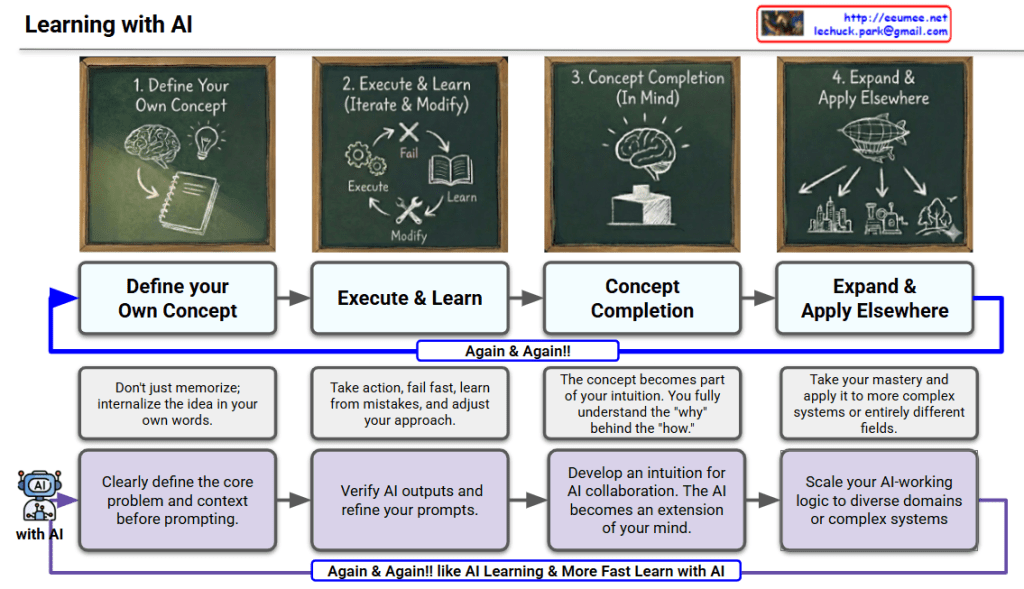
The concept of “Again & Again” is the heartbeat of this framework. It represents both the human commitment to iterative growth and the synergistic power of AI’s massive learning capacity to accelerate that very process.


Learning with AI: The Power of Iteration

1. Define Your Own Concept (The Architect)

Before prompting, you must own the “Why”.

  • Action: Internalize the problem and define the context in your own words.
  • Insight: AI cannot navigate without a human-defined destination.

2. Execute & Learn (The Editor)

The first “Again & Again” happens here—the loop of Iterative Growth.

  • Action: Take action, fail fast, and refine your prompts based on AI’s output.
  • Insight: Each repetition refines your understanding and the AI’s accuracy.

3. Concept Completion (The Director)

The concept moves from a task to your intuition.

  • Action: Develop a deep “gut feeling” for how to direct the AI.
  • Insight: AI becomes a seamless extension of your own cognitive process.

4. Expand & Apply Elsewhere (The Innovator)

The bottom “Again & Again” focuses on Synergistic Speed.

  • Action: Scale your mastered logic to solve complex, multi-domain problems.
  • Insight: Just as AI learns through massive repetition, you use AI to exponentially increase the frequency of your own learning cycles.

Summary

  1. Iterative Evolution: The middle “Again & Again” drives personal mastery through the constant refinement of your own concepts.
  2. AI Mirroring: The bottom “Again & Again” acknowledges that AI masters knowledge through massive repetition—just as we do.
  3. Accelerated Synergy: By collaborating with AI, you can complete these learning cycles faster than ever, achieving “High-Speed Mastery”.

#AgainAndAgain #AI_Synergy #IterativeGrowth #RapidMastery #HumanAI_Loop #LearningVelocity

With Gemini
CAPEX & OPEX

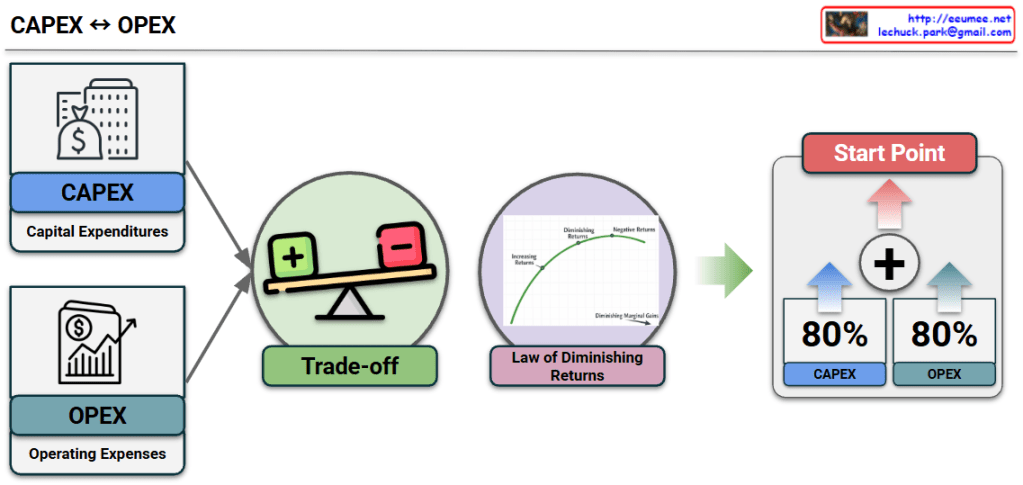
1. Definitions (The Pillars)

  • CAPEX (Capital Expenditures): Upfront investments for physical assets (e.g., hardware, infrastructure) to create future value.
  • OPEX (Operating Expenses): Ongoing costs required to run the day-to-day operations (e.g., maintenance, utilities, subscriptions).

2. The Economic Logic

  • Trade-off: There is a natural tension between the two; higher upfront investment (CAPEX) can lower future operating costs (OPEX), and vice versa.
  • Law of Diminishing Returns: This graph warns that striving for 100% perfection in optimization yields progressively smaller benefits relative to the effort and cost invested.

3. Strategic Conclusion: The 80% Rule

  • The infographic proposes a pragmatic “Start Point.”
  • Instead of delaying for perfection, it suggests that achieving 80% readiness in CAPEX and 80% efficiency in OPEX is the sweet spot. This balance allows for a timely launch without falling into the trap of diminishing returns.

Summary

  1. While CAPEX and OPEX involve a necessary trade-off, striving for 100% optimization in both leads to diminishing returns.
  2. Over-optimization drains resources and delays execution without proportional gains.
  3. The most efficient strategy is to define the “Start Point” at 80% readiness for both, favoring speed and agility over perfection.

#CAPEXvsOPEX #BusinessStrategy #CostOptimization #DiminishingReturns #TechInfrastructure #OperationalEfficiency #Infographic #TechVisualizer #DecisionMaking

Labeling for AI World

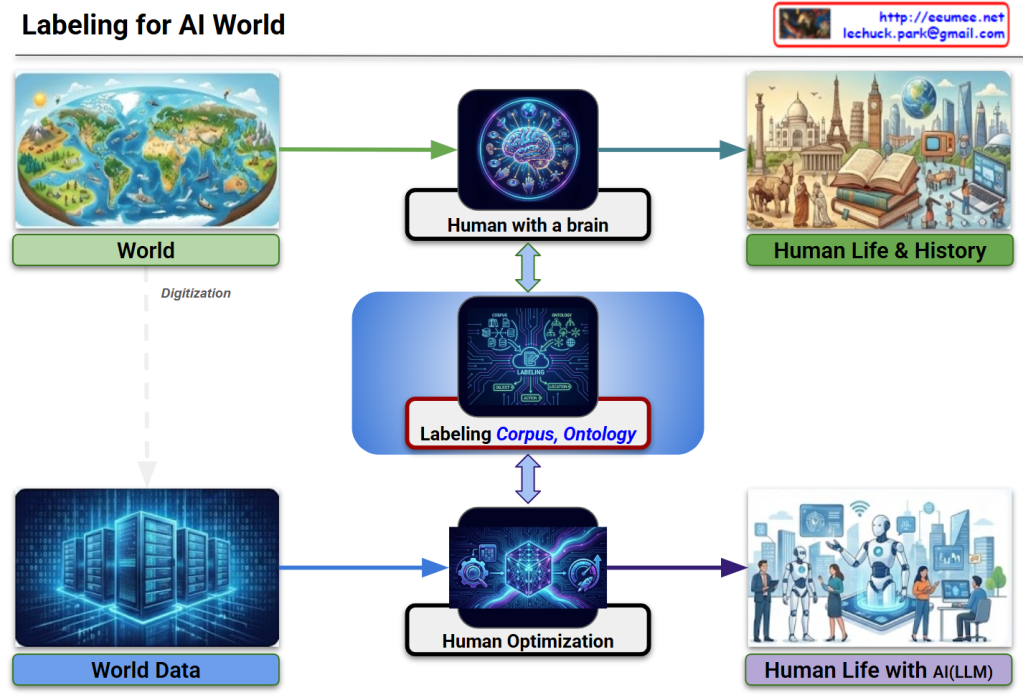
The image illustrates a logical framework titled “Labeling for AI World,” which maps how human cognitive processes are digitized and utilized to train Large Language Models (LLMs). It emphasizes the transition from natural human perception to optimized AI integration.


1. The Natural Cognition Path (Top)

This track represents the traditional human experience:

  • World to Human with a Brain: Humans sense the physical world through biological organs, which the brain then analyzes and processes into information.
  • Human Life & History: This cognitive processing results in the collective knowledge, culture, and documented history of humanity.

2. The Digital Optimization Path (Bottom)

This track represents the technical pipeline for AI development:

  • World Data: Through Digitization, the physical world is converted into raw data stored in environments like AI Data Centers.
  • Human Optimization: This raw data is refined through processes like RLHF (Reinforcement Learning from Human Feedback) or fine-tuning to align AI behavior with human intent.
  • Human Life with AI (LLM): The end goal is a lifestyle where humans and LLMs coexist, with the AI acting as a sophisticated partner in daily life.

3. The Central Bridge: Labeling (Corpus & Ontology)

The most critical element of the diagram is the central blue box, which acts as a bridge between human logic and machine processing:

  • Corpus: Large-scale structured text data necessary for training.
  • Ontology: The formal representation of categories, properties, and relationships between concepts that define the human “worldview.”
  • The Link: High-quality Labeling ensures that AI optimization is grounded in human-defined logic (Ontology) and comprehensive language data (Corpus), ensuring both Quality and Optimization.

Summary

The diagram demonstrates that Data Labeling, guided by Corpus and Ontology, is the essential mechanism that translates human cognition into the digital realm. It ensures that LLMs are not just processing raw numbers, but are optimized to understand the world through a human-centric logical framework.

#AI #DataLabeling #LLM #Ontology #Corpus #CognitiveComputing #AIOptimization #DigitalTransformation

With Gemini