AI Explosion

Analysis of the “AI Explosion” Diagram

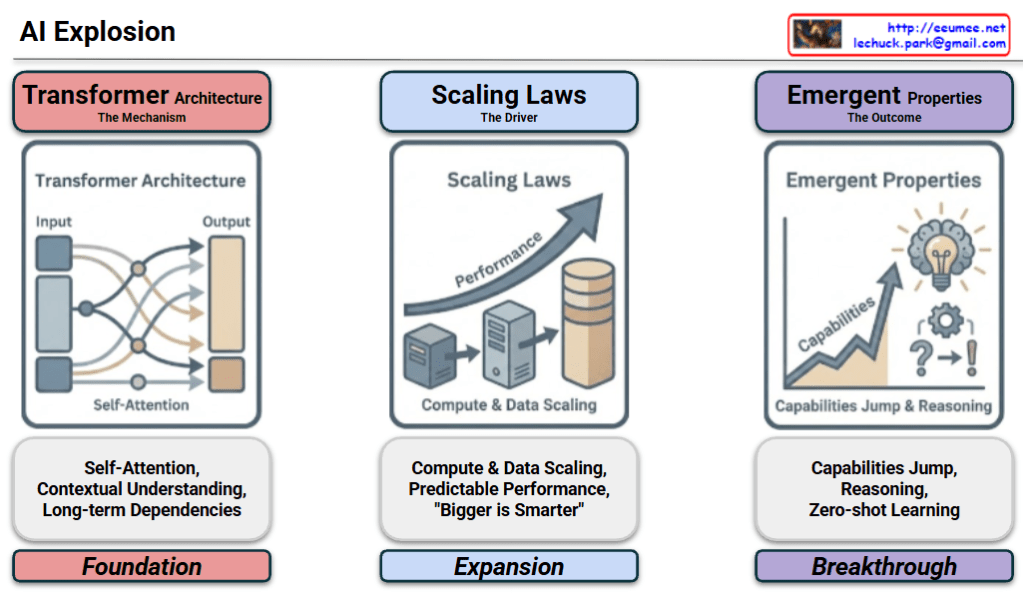
This diagram provides a structured visual narrative of how modern AI (LLM) achieved its rapid advancement, organized into a logical flow: Foundation → Expansion → Breakthrough.

1. The Foundation: Transformer Architecture

  • Role: The Mechanism
  • Analysis: This is the starting point of the explosion. Unlike previous sequential processing models, the “Self-Attention” mechanism allows the AI to grasp context and understand long-term dependencies within data.
  • Significance: It established the technical “container” capable of deeply understanding human language.

2. The Expansion: Scaling Laws

  • Role: The Driver
  • Analysis: This phase represents the massive injection of resources into the established foundation. It follows the principle that performance improves predictably as data and compute power increase.
  • Significance: Driven by the belief that “Bigger is Smarter,” this is the era of quantitative growth where model size and infrastructure were aggressively scaled.

3. The Breakthrough: Emergent Properties

  • Role: The Outcome
  • Analysis: This is where quantitative expansion leads to a qualitative shift. Once the model size crossed a certain threshold, sophisticated capabilities that were not explicitly taught—such as Reasoning and Zero-shot Learning—suddenly appeared.
  • Significance: This marks the “singularity” moment where the system moves beyond simple pattern matching to exhibiting genuine intelligent behaviors.

Summary

The diagram effectively illustrates the causal relationship of AI evolution: The Transformer provided the capability to learn, Scaling Laws amplified that capability through size, and Emergent Properties were the revolutionary outcome of that scale.

#AIExplosion #LLM #TransformerArchitecture #ScalingLaws #EmergentProperties #GenerativeAI #TechTrends

With Gemini

AI Processing Logic: Patterns vs. Unique Entities

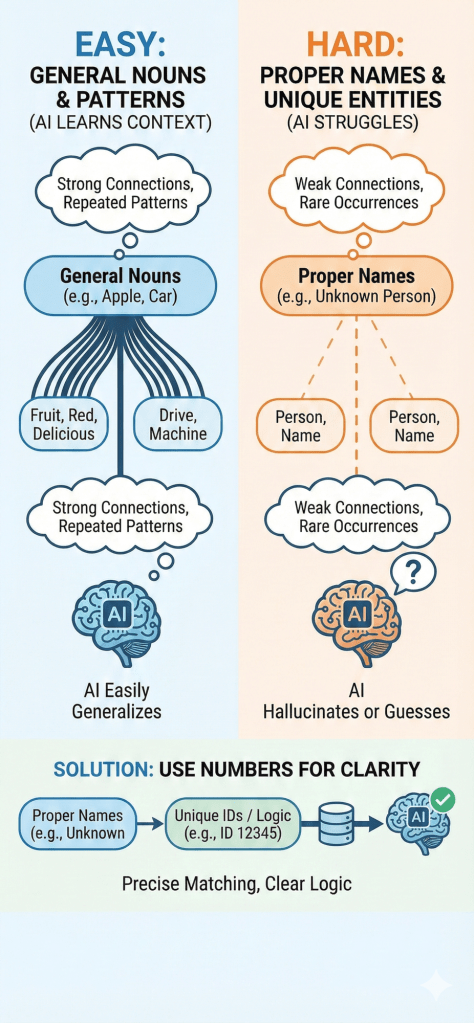
This infographic illustrates the fundamental difference in how AI processes language. It shows that AI excels at understanding General Nouns (like “apple” or “car”) because they are built on strong, repeated contextual patterns. In contrast, AI struggles with Proper Nouns (like specific names) due to weak connections and a lack of context, often leading to hallucinations. The visual suggests a solution: converting unique entities into Numbers or IDs, which offer the clear logic and precision that AI models prefer over ambiguous text.

With Gemini

Human Rules Always


The Evolutionary Roadmap to Human-Optimized AI

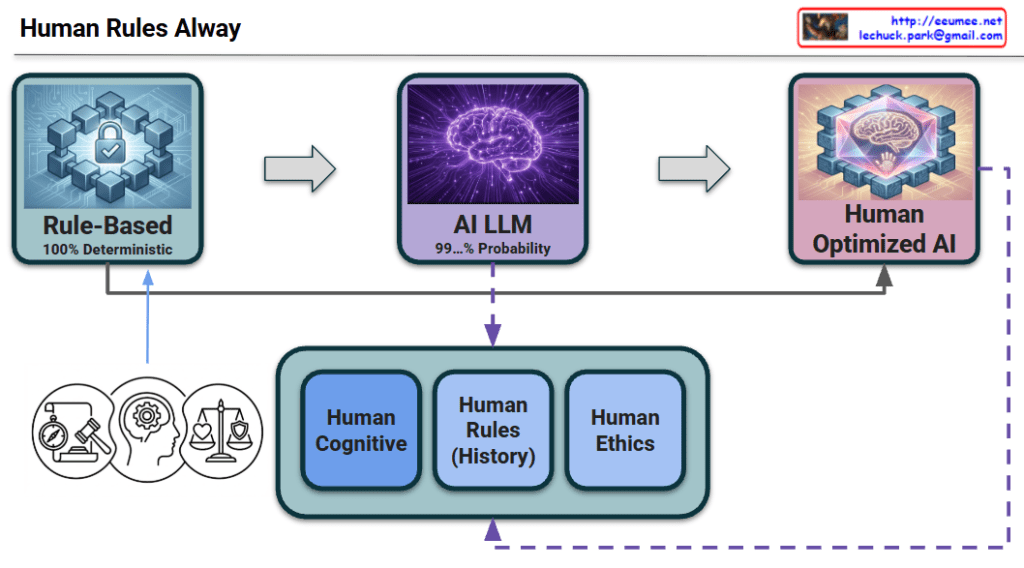
This diagram visualizes the history and future direction of intelligent systems. It illustrates the evolution from the era of manual programming to the current age of generative AI, and finally to the ultimate goal where human standards perfect the technology.

1. The 3 Stages of Technological Evolution (Top Flow)

  • Stage 1: Rule-Based (The Foundation / Past)
    • Concept: “The Era of Human-Defined Logic”
    • Context: This represents the starting point of computing where humans explicitly created formulas and coded every rule.
    • Characteristics: It is 100% Deterministic. While accurate within its scope, it cannot handle the complexity of the real world beyond what humans have manually programmed.
  • Stage 2: AI LLM (The Transition / Present)
    • Concept: “The Era of Probabilistic Scale”
    • Context: We have evolved into the age of massive parallel processing and Large Language Models.
    • Characteristics: It operates on 99…% Probability. It offers immense scalability and creativity that rule-based systems could never achieve, but it lacks the absolute certainty of the past, occasionally leading to inefficiencies or hallucinations.
  • Stage 3: Human Optimized AI (The Final Goal / Future)
    • Concept: “The Era of Reliability & Efficiency”
    • Context: This is the destination we must reach. It is not just about using AI, but about integrating the massive power of the “Present” (AI LLM) with the precision of the “Past” (Rule-Based).
    • Characteristics: By applying human standards to control the AI’s massive parallel processing, we achieve a system that is both computationally efficient and strictly reliable.

2. The Engine of Evolution: Human Standards (Bottom Box)

This section represents the mechanism that drives the evolution from Stage 2 to Stage 3.

  • The Problem: Raw AI (Stage 2) consumes vast energy and can be unpredictable.
  • The Solution: We must re-introduce the “Human Rules” (History, Logic, Ethics) established in Stage 1 into the AI’s workflow.
  • The Process:
    • Constraint & Optimization: Human Cognition and Rules act as a pruning mechanism, cutting off wasteful parallel computations in the LLM.
    • Safety: Ethics ensure the output aligns with human values.
  • Result: This filtering process transforms the raw, probabilistic energy of the LLM into the polished, “Human Optimized” state.

3. The Feedback Loop (Continuous Evolution)

  • Dashed Line: The journey doesn’t end at Stage 3. The output from the optimized AI is reviewed by humans, which in turn updates our rules and ethical standards. This circular structure ensures that the AI continues to evolve alongside human civilization.

This diagram declares that the future of AI lies not in discarding the old “Rule-Based” ways, but in fusing that deterministic precision with modern probabilistic power to create a truly optimized intelligence.


#AIEvolution #FutureOfAI #HybridAI #DeterministicVsProbabilistic #HumanInTheLoop #TechRoadmap #AIArchitecture #Optimization #ResponsibleAI